Generating Leads for Lawyers A Modern Law Firm Playbook
Generating leads for lawyers used to be about who you knew. Now, it’s about creating a predictable system that brings potential clients to your door, mostly through digital channels like paid ads, organic search (SEO), and targeted content marketing. This is a fundamental shift away from relying on sporadic word-of-mouth referrals to building a sustainable pipeline of new cases for your firm.
The Blueprint for Attracting Modern Legal Clients

Let's be honest, the days of growing a firm on reputation and a handshake alone are fading fast. Today’s clients don’t just ask a friend for a recommendation; their first move is to pull out their phone and search on Google, check social media, and read online reviews.
This change means your firm needs a proactive, multi-channel strategy. You have to show up where your ideal clients are already looking for answers.
A winning lead generation system starts with a deep understanding of your audience. It's not enough to just know your practice area. You have to get inside the heads of your potential clients—what specific problems are they facing? What questions are they typing into Google at 2 AM? This insight is what fuels every part of your marketing, from the ad copy you write to the blog posts you publish.
Key Pillars of a Modern Lead Strategy
To get a consistent flow of inquiries, the most successful firms I've seen focus on a few core components that have to work together. If you neglect one, it creates a bottleneck that completely stalls your growth.
These pillars are non-negotiable:
- Defining Your Ideal Client: This goes way beyond broad practice areas. You need to create detailed client personas. For example, a family law attorney might not just target "divorce cases," but specifically individuals searching for "uncontested divorce process in California" or "child custody rights for fathers."
- Choosing the Right Channels: Not all marketing channels are created equal for every firm. A personal injury firm might get incredible results from high-intent Google Ads, while an estate planning practice could build a massive client base through educational content and targeted campaigns on Facebook.
- Automating Intake and Follow-Up: Speed is your secret weapon. The moment a potential client submits their information, an automated system should kick in with an instant response. This simple step ensures your firm is the very first one to make contact.
The Power of a Multi-Channel Approach
Putting all your eggs in one basket is a massive risk. What if a Google algorithm update tanks your organic traffic overnight? Or ad costs for your main keywords suddenly skyrocket? A diversified strategy creates stability and lets you capture potential clients at different stages of their journey.
The move to digital is undeniable. In the hyper-competitive world of legal marketing, a staggering 71% of lawyers now report generating new leads directly from social media platforms. That single statistic highlights just how much client acquisition has changed. For a deeper dive, you can explore more legal marketing statistics to see these trends in action.
Here's a quick look at how the top channels stack up for law firms.
Top Lead Generation Channels for Law Firms at a Glance
This table breaks down the most effective digital channels we see firms using today, highlighting their core benefits and the types of clients they are best suited to attract.
| Channel | Primary Benefit | Best For Attracting Clients Who… |
|---|---|---|
| Google Ads | High Intent | Are actively searching for a lawyer right now with a specific, urgent legal problem. |
| Organic SEO | Long-Term Authority | Are in the research phase, looking for answers to legal questions and evaluating their options. |
| Facebook Lead Ads | Precise Targeting | Fit a specific demographic profile (e.g., location, age, interests) but may not be actively searching yet. |
| Content Marketing | Builds Trust | Are looking for expert guidance and want to feel confident in a lawyer's expertise before reaching out. |
| Referrals/Networking | High Conversion Rate | Trust a personal recommendation and are often pre-sold on your firm's credibility. |
Each channel plays a unique role, and the most successful firms find a strategic blend that keeps their pipeline full, even when one channel experiences a downturn.
The goal isn't just to get more leads; it's to build a predictable engine for firm growth. This means attracting the right inquiries, engaging them quickly, and converting them into retained clients as efficiently as possible.
Driving High-Intent Leads with Google and Facebook Ads

While building your firm’s organic presence is the marathon, paid ads are the sprint. They deliver something every firm needs: immediacy and precision. When you need a predictable stream of new client inquiries right now, nothing beats the power of Google and Facebook Ads.
These two platforms are the heavy hitters in digital advertising, but they play very different roles. Think of them as a one-two punch for capturing clients.
Google Ads is all about capturing high-intent demand. It's like setting up shop right where people are actively looking for a lawyer. They're already raising their hand for help; your job is just to be the best, most visible answer.
Facebook Ads, on the other hand, lets you create demand. You can get in front of your ideal client profile before they even start searching for legal help. It’s a proactive strategy that puts your firm on their radar early.
Mastering High-Intent Keywords on Google Ads
Jumping into Google Ads by bidding on broad terms like "lawyer" is a fast way to drain your marketing budget on irrelevant clicks. The real magic is in targeting long-tail keywords—those longer, more specific phrases that signal someone is ready to make a move.
These phrases have less search traffic, but the people using them are much closer to hiring an attorney because their intent is crystal clear.
- Weak Intent Example: "car accident lawyer"
- Strong Intent Example: "what to do after a rear-end collision in Miami"
The second searcher isn't just browsing; they have a specific, urgent problem in a specific location. Bidding on that phrase connects you with them at their exact moment of need.
Creating Compelling Ad Copy That Converts
Your ad copy has to speak directly to the searcher's emotional state, which varies wildly between practice areas.
For instance, a personal injury ad needs to convey urgency and empathy. A family law ad should feel discreet and supportive.
Scenario 1: Personal Injury
- Headline: Hurt in an Accident? Get a Free Case Review
- Description: No Fee Unless We Win. Our Miami injury attorneys fight for the compensation you deserve. Call us 24/7 for immediate help.
This copy is punchy and action-oriented. It hits on the user's pain point (being hurt) and immediately removes the financial risk with "No Fee Unless We Win."
Scenario 2: Family Law
- Headline: Compassionate Divorce Guidance in Austin
- Description: Navigate your family law matter with a trusted attorney. We offer discreet consultations to protect your privacy and your future.
See the difference? The tone is completely different. Words like "compassionate," "guidance," and "discreet" are used to build trust with someone going through a sensitive life event. To figure out where your budget is best spent, it's worth checking out a Google Ads vs Facebook Ads: A Practical ROI Guide to compare how each platform captures different types of leads.
Pro Tip: Your ad copy and landing page must be perfectly aligned. If your ad promises a "Free Car Accident Case Evaluation," your landing page better have that offer front and center. Any disconnect creates friction and kills conversions.
Tapping into Life Events with Facebook Lead Ads
While Google is reactive, Facebook is proactive. It lets you find potential clients based on major life events, making it a goldmine for practice areas like family law, estate planning, and real estate.
Facebook's targeting is incredibly granular. You can build audiences based on:
- Demographics: Age, location, income level.
- Life Events: Recently married, recently engaged, new parents, recently moved.
- Interests: Users following small business pages or real estate investing gurus.
The secret weapon here is Facebook Lead Ads. This format is a total game-changer. It lets users submit their contact information through a pre-filled form without ever leaving the Facebook app.
This removes almost all the friction from the process. A potential client can go from seeing your ad to being in your pipeline in just two taps. If you want to dive deeper, we have a whole guide on using Facebook ads for lead generation with more advanced strategies.
Building an Organic Lead Engine with SEO and Content
Paid ads can get you leads tomorrow, but a truly powerful, sustainable system for your law firm is built on an organic foundation. Think of search engine optimization (SEO) and high-value content marketing as long-term assets. They're the investments that pay you back for years, establishing your firm as the go-to authority in your practice area.
The whole dynamic shifts. Instead of you chasing down clients, they start finding you. It’s all about being the helpful, trusted resource they discover the exact moment they’re searching for a solution to their legal problem.
Focus on Local and High-Intent SEO
Let's be real: for most law firms (unless you're handling massive, nationwide torts), SEO success is local. Your ideal clients aren't just vaguely searching for a "personal injury attorney." No, they're typing in "personal injury attorney in San Diego." That distinction is everything.
Optimizing for local search means making sure your firm’s digital footprint is crystal clear and consistent everywhere online. This isn't optional.
- Google Business Profile: Your profile needs to be complete, accurate, and packed with positive client reviews. For many potential clients, this is the very first impression they'll have of your firm in a local search. Make it count.
- On-Page Optimization: Every single service page on your website must be laser-focused on a specific location. That means your title tags, headings, and the content itself should scream the practice area and the city you serve (e.g., "Austin Family Law and Divorce Attorney").
- Local Citations: Your firm's name, address, and phone number (NAP) must be identical across reputable online directories like Yelp, Avvo, and other legal-specific sites. Consistency is key.
This hyper-local focus makes sure your marketing dollars and effort are spent attracting clients you can actually serve. The quality of your leads will improve dramatically. To really dig into this, check out our complete guide to SEO lead generation strategies.
Create Content That Answers Real Questions
Optimizing your main pages is just the start. The real magic of organic lead generation comes from content that genuinely solves problems. Your blog shouldn't be a dumping ground for firm announcements. It needs to be an educational powerhouse that addresses the specific, often stressful, questions your potential clients are typing into Google.
Think about the first five questions every new client asks you during a consultation. Boom. Those are your next five blog posts.
The goal here isn't just to rank on Google. It's to build trust before a prospect even thinks about picking up the phone. When you provide clear, valuable answers for free, you become the obvious choice when they're finally ready to hire someone.
Here are a few content ideas that just plain work:
- For a Personal Injury Firm: "The First 5 Things You Must Do After a Car Accident in Florida"
- For an Estate Planning Attorney: "What Is the Difference Between a Will and a Trust in Texas?"
- For a Criminal Defense Lawyer: "Understanding Your Rights During a Traffic Stop in California"
Each of these titles targets a very specific user query and promises a direct, no-fluff answer. That's what people want.
Turning Traffic into Tangible Leads
Look, creating great content is only half the battle. Every article you publish has to have a clear path for the reader to become an actual lead. This is where so many firms drop the ball—they write brilliant stuff but give the reader no clear next step.
To convert your readers, every blog post needs strategically placed calls-to-action (CTAs). And I'm not talking about a generic "Contact Us" button at the bottom. Your CTAs should be directly related to the content the person just consumed.
| Content Type | Weak CTA | Strong CTA |
|---|---|---|
| Article on Car Accident Steps | Contact Us | "Injured? Get a Free, No-Obligation Case Evaluation Now" |
| Post on Estate Planning | Learn More | "Download Our Free Estate Planning Checklist to Get Started" |
| Guide on Divorce Process | Call for Info | "Schedule a Discreet Consultation with Our Family Law Team" |
By tailoring your CTAs, you meet the reader exactly where they are. Someone reading an informational blog post might not be ready to call you today, but they're very likely to download a helpful checklist. That simple action captures their information, turning a random visitor into a warm lead you can nurture over time. This organic engine, built on trust and expertise, will consistently deliver some of the highest-quality leads your firm can get.
Turn Your Website Into a Lead Conversion Machine
Getting traffic to your law firm's website is a great start, but it's only half the battle. A flood of visitors means nothing if they never pick up the phone or fill out a form. This is where you have to get serious about conversion rate optimization (CRO)—the art and science of turning a curious browser into a qualified lead.
Think of your website, especially your landing pages, as your firm’s most efficient intake specialists. They need to build instant trust, answer a potential client's most pressing questions, and make it ridiculously easy for them to ask for help.
Even a tiny improvement here can have a massive impact. Bumping your conversion rate from just 1% to 2% literally doubles your leads without spending a single extra dollar on ads.
What a High-Converting Legal Landing Page Looks Like
A landing page isn’t just another page. It's a highly-focused tool built for one purpose and one purpose only: getting a potential client to take action. That means stripping away all the usual distractions, like complex navigation menus, and creating a clear path straight to your contact form.
Here are the non-negotiables every law firm landing page needs:
- A Headline That Hits Home: Ditch the generic "Law Firm" or "Legal Services." Your headline must connect directly with the visitor's problem. Try something like, "Hurt in a Car Accident? We Fight for Maximum Compensation." It speaks to their pain point immediately.
- Obvious Trust Signals: People hire lawyers they trust, period. You need to show them why they can trust you. Display client testimonials, case results (where ethically permitted), and badges from respected legal directories like Avvo or Super Lawyers. This is instant social proof.
- A Call-to-Action (CTA) They Can't Ignore: The CTA is your final instruction. It needs to be crystal clear, action-focused, and feel low-risk to the person reading it.
The Simple Psychology of a Powerful Call-to-Action
The words on your button matter more than you think. A generic, passive CTA like "Submit" or "Contact Us" creates friction because it’s vague. What happens after I submit? Who am I contacting? It puts the burden on the user.
A powerful CTA, on the other hand, makes the value proposition crystal clear. It frames the action as a benefit for them.
| Vague & Passive CTA | Specific & Compelling CTA |
|---|---|
| "Submit Form" | "Get Your Free Case Evaluation" |
| "Contact Us" | "Schedule a Confidential Consultation" |
| "Learn More" | "Download My Free Accident Checklist" |
See the difference? The compelling options use words like "Free" and "Confidential" to remove mental roadblocks and highlight a direct benefit. They reduce the perceived risk and make clicking feel like the obvious next step.
Your entire landing page should build momentum toward a single, obvious action. Every sentence, image, and testimonial exists to reinforce the value of clicking that final button. If a visitor has to stop and think about what to do next, you've already lost them.
Simplify Your Intake Form, Get More Leads
Okay, you've convinced a visitor to reach out. Don't lose them at the final step! This is where countless law firms fumble the ball. A long, complicated contact form that asks for a dozen details upfront will scare people away, especially if they're on a phone.
Your initial form needs to be brutally simple. Ask for the absolute bare minimum:
- Name
- Phone Number
- A brief message box
That’s it. You can gather the nitty-gritty case details on the follow-up call. According to one study, firms using simple, integrated lead capture forms see an 18% lead conversion rate. That’s the power of making things easy.
Every extra field you add is just one more reason for a potential client to give up and find a competitor with a simpler process. The goal here is just to open the door to a conversation, not conduct a full interview on the first click.
Automating Your Intake to Convert Leads Faster
The moment a potential client fills out a form on your website or a Facebook ad, a clock starts ticking. In the world of generating leads for lawyers, every single second you delay gives that person another chance to find—and hire—your competitor down the street. Speed isn't just an advantage; it's the entire game.
Trying to manage this process by hand is a recipe for lost business. I see it all the time: firms running Facebook Lead Ads fall into the trap of downloading CSV files once or twice a day. This might not seem like a big deal, but it’s a critical failure. A lead that comes in at 9 AM might not even land in front of your intake team until the afternoon. By then, they’ve likely already spoken to two other attorneys.
That manual process creates a massive, unnecessary bottleneck between someone asking for help and your firm being able to give it. The goal is to close that gap completely.
From Manual Lag to Instant Action
Automating your lead retrieval is the single most effective way to slash your firm's response time. Instead of relying on manual downloads, you can set up a direct pipeline from the lead source right into your team's workflow. The second a lead comes in, the right people know about it and can act immediately.
Picture this scenario:
- A potential client sees your Facebook ad for a free divorce consultation at 8 PM.
- They fill out the lead form right there in the Facebook app.
- Instantly, your intake specialist gets an email and an SMS notification with all the lead's details.
- At the same time, that info pops up as a new row in a shared Google Sheet or as a new contact in your firm's CRM.
Within minutes, your team has everything they need to make that first, critical outreach call. This seamless flow transforms your intake from a slow, reactive chore into a proactive, real-time system.
The difference between calling a lead back in five minutes versus five hours is often the difference between signing a new client and never hearing from them again. Automation makes sure you're always the first to respond.
This simple flowchart breaks down the powerful sequence from capturing attention to driving action on your website.
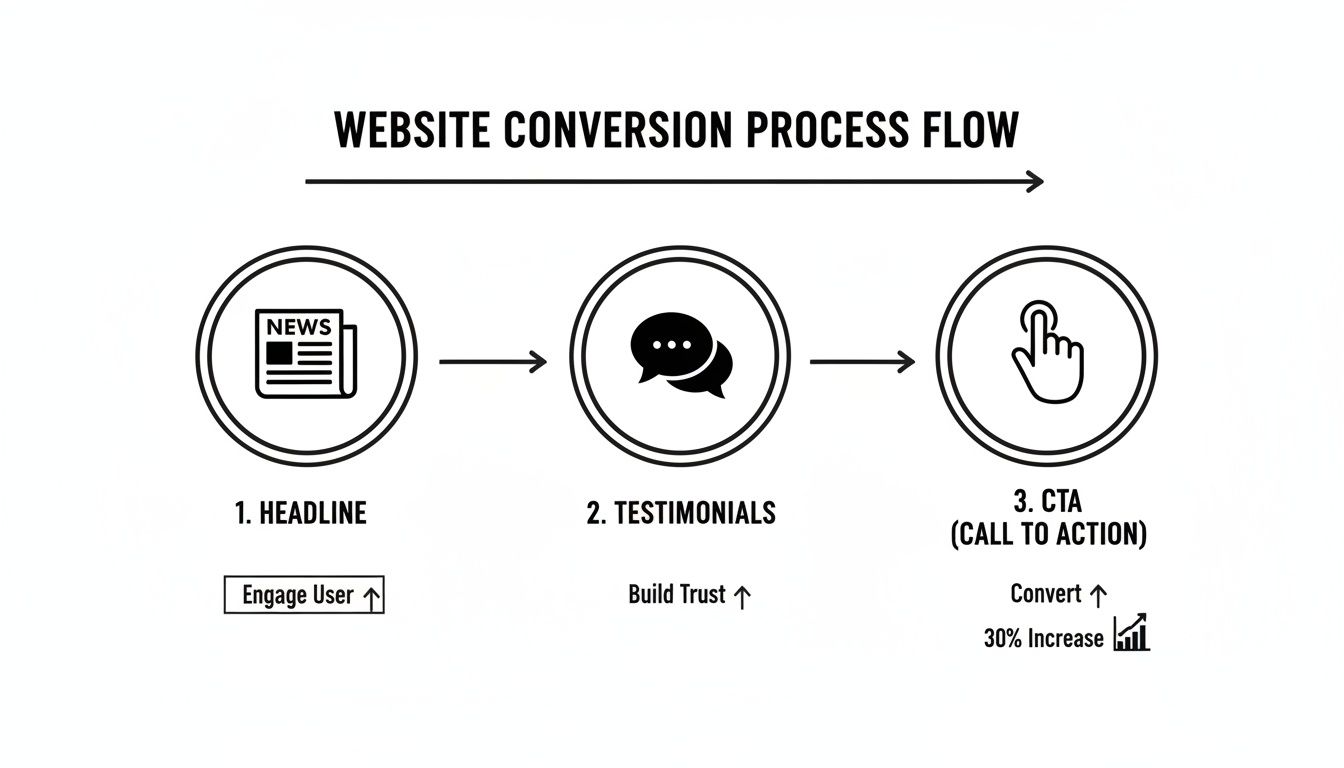
It really shows how every element—a compelling headline, trust-building testimonials, and a clear call-to-action—works together to guide a visitor toward becoming a real lead for your firm.
Setting Up Your Automated Workflow
Connecting your lead sources to your intake system is way simpler than it sounds. Platforms like LeadSavvy Pro are designed specifically for this, bridging the gap between ad platforms like Facebook and your everyday tools like Google Sheets or a dedicated CRM.
Here's a look at how simple it is to set up an effective automation.
The interface lets you connect your Facebook Page, pick the exact lead form you want to pull from, and then choose where to send the data—in this case, a Google Sheet. It takes just a few clicks.
This setup completely eliminates manual work. Your intake team can just keep an eye on the designated Google Sheet or wait for the email notifications to roll in, confident that every single lead is being captured and delivered in real-time. You can learn more about why a CRM is so crucial for modern lead generation here.
The impact here is huge. We've seen that law firms using CRM and automation tools convert 47% more leads than those still stuck on manual tracking. That’s a massive leap, especially in an industry where the average firm only converts about 14% of its inquiries into signed clients. By automating just the initial intake, you're not just saving time—you're fundamentally improving your firm’s ability to turn marketing dollars into actual revenue.
Common Questions About Generating Leads for Lawyers
Diving into digital marketing can bring up a lot of questions, especially when you're talking about your firm's budget and reputation. Let's tackle some of the most common questions we hear from attorneys trying to generate more leads.
How Much Should a Law Firm Spend on Marketing to Get Leads?
There's no single magic number here, but a solid starting point for an established firm is 5-10% of your gross revenue. If you're in an aggressive growth phase, pushing that closer to 10-15% isn't uncommon.
What's more important than the total spend, though, is how you allocate it.
For example, a personal injury firm might pour a significant budget into high-cost, high-intent Google Ads keywords because a single case can yield a massive return. On the other hand, a family law practice might get a much better ROI from hyper-targeted Facebook campaigns that reach people experiencing specific life events.
My advice? Start with a test budget. Meticulously track your Cost Per Lead (CPL) on every channel. Then, double down on what works—scaling the channels that bring in the most valuable clients, not just the cheapest leads.
What Is the Most Effective Lead Generation Channel for Lawyers?
This comes down to your practice area and how urgently your ideal client needs you. The best channel is simply the one that meets your client where they are, mentally and emotionally.
- For urgent, right-now needs (think criminal defense, personal injury), Google Ads is usually king. You're getting in front of people actively searching for an attorney at this very moment.
- For needs tied to major life events (like estate planning, family law, or real estate), Facebook Ads can be incredibly powerful. It lets you target the right demographic before they even start their formal search.
- For long-term, sustainable growth, nothing beats organic SEO. It takes patience, no doubt. But it builds a consistent flow of high-quality, low-cost leads over time and cements your firm's authority.
Honestly, the most resilient strategy is a diversified one. It keeps your pipeline full, even if one channel has a slow month.
The "best" channel is always a moving target. What crushed it last year might be less effective today. The real secret is building a system that lets you test, measure, and pivot based on actual performance data.
How Can I Ensure My Firm’s Advertising Is Ethically Compliant?
This is non-negotiable. Every ad you run, every piece of content you publish, must follow the rules set by your state bar association. Getting this wrong can lead to serious penalties, so it has to be a top priority.
While the rules vary a bit by state, a few principles are almost universal.
- Avoid Making Guarantees: You can never promise a specific outcome. Language like "We will win your case" is a huge red flag and almost certainly a violation.
- Use Clear Disclaimers: Any paid promotion needs to be identified as such. A simple "This is an advertisement" disclaimer is often required.
- Be Truthful and Accurate: Every claim about your firm—experience, case results, testimonials—must be 100% factual and verifiable. If you're using client testimonials, make sure you have their written consent.
- Don't Create Unjustified Expectations: Your ads shouldn't mislead potential clients or give them unrealistic hopes about what you can achieve.
Before you launch any campaign, have a senior partner or a compliance expert review everything. That includes ad copy, landing pages, and images. It’s a small step that can save you from a world of headaches later on.
Ready to stop wasting time on manual downloads and start converting leads faster? LeadSavvy Pro instantly syncs your Facebook leads to a Google Sheet or CRM, sending you real-time notifications so you can be the first to respond. Try LeadSavvy Pro for free and see the difference automation makes.