A Modern Guide to High-Performing Email Marketing Campaigns
Look, great email marketing isn't just about blasting out a message and hoping for the best. The campaigns that actually move the needle are built on a solid plan. Think of it as a strategic conversation—one that starts with clear goals, a list of people who actually want to hear from you, and a smart way to talk to them differently based on who they are.
Building the Foundation for Your Email Campaigns

Before you even think about writing a killer subject line, you need to lay the groundwork. This initial planning is what separates the campaigns that get deleted from the ones that get results.
First things first: what are you trying to accomplish? Seriously, what does a "win" look like for this campaign? Are you trying to drive sales for a new product? Nurture fresh leads until they're ready to buy? Or maybe just keep your existing customers engaged and loyal?
Each of those goals demands a completely different playbook. A sales-focused email is going to be heavy on promotions and clear calls-to-action. A lead nurturing sequence, on the other hand, will be all about delivering value and building trust with educational content over time.
Why a Quality List Is Everything
Once you know your goal, it's all about the audience. A huge email list means nothing if it's full of people who don't care about what you have to say. You want to attract subscribers who are genuinely interested.
This is where ethical, effective list-building comes in. Things like high-converting lead capture forms are your best friend for turning casual website visitors into eager subscribers. We've got a whole guide on creating effective lead capture forms that's worth a read.
At the end of the day, a quality list gives you better engagement, higher deliverability rates, and a much stronger ROI. It’s always quality over quantity.
Think of your email list as your most valuable digital asset. It’s a direct line to your audience that you own—no algorithm changes or social media whims can take it away from you.
Before launching any campaign, a quick check-in on these core elements can make all the difference. This table breaks down the essentials.
Essential Campaign Planning Checklist
| Planning Element | Key Action | Why It Matters |
|---|---|---|
| Define the Goal | Decide on one primary objective (e.g., drive sales, nurture leads). | A clear goal dictates your content, CTA, and success metrics. |
| Identify the Audience | Pinpoint exactly who you're talking to for this specific campaign. | Ensures your message is relevant and resonates with the right people. |
| Segment Your List | Group subscribers based on behavior, purchase history, or engagement. | Prevents sending generic messages and dramatically boosts open/click rates. |
| Plan the Content | Outline the key message, value proposition, and call-to-action. | Good planning prevents last-minute, ineffective copy and ensures a cohesive message. |
| Set KPIs | Determine how you'll measure success (e.g., open rate, CTR, conversions). | You can't improve what you don't measure. KPIs tell you if it's working. |
This isn't just busy work; it's the strategic framework that ensures your emails don't just get sent—they get results.
The Power of Smart Audience Segmentation
Sending the same email to every single person on your list is a rookie mistake and a surefire way to get ignored. This is where segmentation becomes your secret weapon. It’s simply the practice of dividing your subscribers into smaller groups based on specific criteria so you can send them more relevant content.
You can slice and dice your audience in a ton of different ways:
- Demographics: Based on things like age, location, or job title.
- Purchase History: Grouping new customers, repeat buyers, or your VIP clients.
- Engagement Level: Separating your die-hard fans from the folks who haven't opened an email in months.
- Behavioral Data: Segmenting based on which pages they've visited on your site or links they clicked in past emails.
This kind of targeting is no longer optional. With global email volume expected to hit a staggering 376.4 billion per day in 2025, you have to be relevant to get noticed. The proof is in the numbers: segmented campaigns see 30% more opens and 50% higher clicks. That right there tells you that getting personal with your messaging is the key to winning in the inbox.
Crafting Emails People Actually Want to Read
An email isn't just a marketing message; it's a conversation. You're showing up in someone's personal space—their inbox—and asking for their attention. To earn that, every single piece of your email, from the subject line that gets it opened to the CTA that gets it clicked, needs to be intentional.
This is where we move from just sending emails to building a real connection.
Your subject line is everything. It’s the bouncer at the door of your email. Think about it: nearly half of all subscribers decide whether to open an email based on the subject line alone. This is your first and most important test. Forget clickbait; focus on clarity, stoking curiosity, or creating a little urgency. A great subject line makes a promise that the email itself delivers on.
For instance, ditch the generic "Our New Collection is Here." It's boring.
Try something with more punch:
- Urgency: "Last Chance for 25% Off Summer Styles"
- Curiosity: "Is This the Reason Your Plants Are Dying?"
- Personalization: "Alex, We Think You'll Love These New Arrivals"
These aren't huge changes, but they can make a massive difference in your open rates.
Designing for Scanners (Because Everyone Scans)
Once they're in, nobody is reading your email like it's a novel. They're scanning. Period.
With over 60% of emails now opened on mobile, attention spans are shorter than ever. If your subscribers open your email and see a giant wall of text, you've already lost. They're gone.
So, you have to build your emails for the way people actually read:
- Short paragraphs are your friend. Stick to one core idea per paragraph, max two or three sentences.
- Embrace white space. Let your words and images breathe. It makes the whole email feel less intimidating and easier to digest.
- Use visuals wisely. A great image or a clever GIF can support your message, but don't just throw them in for decoration.
- Guide their eyes. Use simple headings and bold text to pull the reader through the email, highlighting the can't-miss points.
This approach ensures that even the fastest scanner walks away with your main message.
Your Unmistakable Call-to-Action
Every email you send should have one clear goal. Your call-to-action (CTA) is how you get there. Don’t muddy the waters by asking them to do three different things. Pick the single most important action you want them to take and make it impossible to miss.
A powerful CTA is:
- Action-Oriented: Use strong, command verbs. Think "Shop Now," "Download Your Guide," or "Reserve Your Spot."
- Visually Obvious: Put it in a button with a color that pops. It needs to stand out from everything else in the email.
- Perfectly Placed: Position your CTA right where the reader is ready to make a move, usually after you’ve clearly explained the value.
A confused mind always says no. If your subscribers have to hunt for what to do next, they’ll just leave. Make your CTA the easiest, most obvious thing on the screen.
At the end of the day, a great email is a mix of art and science. It’s about respecting the reader’s time, giving them something genuinely valuable, and making it dead simple for them to take the next step. Nail the subject line, the scannable design, and the strong CTA, and you'll have emails that don't just get sent—they get results.
Using Automation to Scale Your Growth
Sending emails one by one just won't cut it if you're serious about growth. The real magic happens when you automate the repetitive stuff, turning your email marketing into a 24/7 engine that works for you. Automation makes sure every single new subscriber gets the right message at the right time—without you lifting a finger.
This is especially true when you're running paid ads, like Facebook Lead Ads. Instead of manually downloading a CSV of new leads and uploading them days later (when they've already forgotten about you), a tool like LeadSavvy Pro builds a seamless bridge. The moment someone shows interest on Facebook, your welcome sequence is instantly triggered. That speed is everything for turning warm leads into customers.
Connecting Facebook Lead Ads to a Welcome Sequence
Picture this: someone sees your ad on Facebook, clicks, and fills out your lead form. Instead of that lead gathering dust in a spreadsheet, automation kicks in and does this:
- Instant Sync: LeadSavvy Pro grabs the new lead's info from Facebook and pushes it straight into your email marketing platform.
- Trigger Welcome Email: Your email system immediately fires off a pre-written welcome email. This is where you confirm their submission and deliver whatever you promised—a guide, a discount code, etc.
- Start the Nurture Flow: The subscriber is then automatically dropped into a nurture sequence designed to build a relationship over the next few days.
This hands-off process ensures no lead ever falls through the cracks and you connect with them while their interest is at its peak. If you want to really scale up and keep your communication consistent, implementing marketing automation is a must.
An automated email isn't just a time-saver; it’s a powerful first impression. Delivering value instantly when a lead is most engaged sets the tone for the entire customer relationship and dramatically increases the likelihood of conversion.
The numbers don't lie. The ROI on email marketing is wild, consistently pulling in $36 to $42 for every dollar or euro spent. Even better, automated emails crush it with 42.1% open rates, and the use of welcome sequences has jumped by 2.5x year-over-year. It just works.
Designing an Effective Welcome and Nurture Cadence
A great automated sequence is more than just one email—it’s a conversation planned out over several days. The whole point is to take someone from being mildly interested to actually trusting you.
Here’s a simple, effective cadence you can steal and adapt:
- Email 1 (Sent Instantly): The Welcome & Delivery. This email has one job: give them what they asked for in your ad. Keep it short, say thanks, and give them a clear link to their download or offer.
- Email 2 (Day 3): Share a Valuable Resource. Don't go for the sale yet. Instead, send them something else that's genuinely useful, like a related blog post, a short video tutorial, or a case study. This shows you know your stuff and builds goodwill.
- Email 3 (Day 5): Introduce the Problem & Solution. Now you can start making the turn. Talk about a common pain point your audience has—the one your product or service solves. Frame your offer as the solution, but don't be pushy about it.
This simple diagram breaks down how to think about crafting each individual email in your sequence.
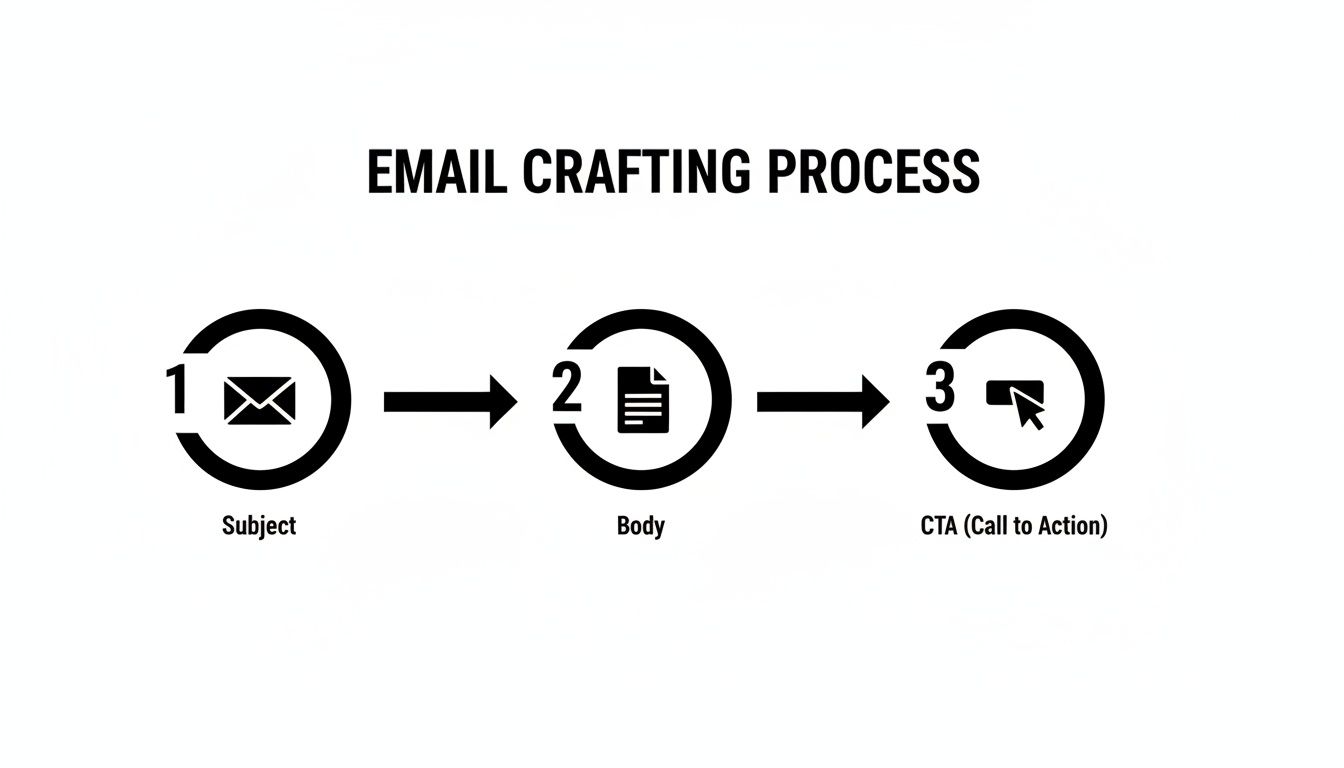
The path from the subject line to the call-to-action needs to be smooth and logical, guiding the reader right where you want them to go.
Being patient like this keeps you from sounding like a sleazy salesperson and gives the subscriber time to see the value you're offering. For a deeper look at building these flows, check out our complete guide on email marketing automation strategies. When you map out these touchpoints, you create a reliable system that nurtures leads and drives growth on autopilot.
How to Measure and Optimize Your Performance
Launching your email campaigns is just the beginning. The real magic—and the real growth—happens when you dive into the data to see what worked, what flopped, and most importantly, why.
This is where you stop guessing and start making smart, data-driven moves that make every future email better than the last.
Too many marketers get obsessed with open rates. Sure, a high open rate feels good, but it doesn't pay the bills. The numbers that actually tell you if a campaign was a success are the ones that track real action and impact.
Focusing on KPIs That Actually Matter
Think of your analytics dashboard as a story. Your job is to learn how to read it. To get the full picture of your campaign’s health, you need to look past the vanity metrics.
Here are the core numbers you should be tracking:
- Click-Through Rate (CTR): This is the percentage of people who actually clicked a link in your email. It's a dead-simple way to measure how compelling your message and call-to-action really were.
- Conversion Rate: This is the big one—the ultimate success metric. It tells you how many people completed the goal after clicking, whether that was making a purchase, filling out a form, or signing up for a webinar.
- Unsubscribe Rate: A few unsubscribes with every send is totally normal. But if you see a sudden spike, it's a huge red flag that your content isn't hitting the mark or you’re emailing way too often.
And the data shows that email is far from dead. Global averages are sitting at a 42.35% open rate and a 5.63% click-to-open rate (CTOR). That proves engaged audiences are still very much ready to click.
The Power of A/B Testing for Optimization
Want to know the single most effective way to improve your key metrics? It’s methodical A/B testing, sometimes called split testing.
The concept is simple: you send two slightly different versions of an email to small, separate chunks of your audience to see which one performs better.
A/B testing isn't about finding a single "perfect" formula. It's about creating a system of continuous improvement where every campaign teaches you something new about your audience.
You can test just about any element of your email, but you'll get the most bang for your buck by starting with the things that have the biggest potential impact.
Here are a few high-impact variables to test right away:
- Subject Lines: Pit a straightforward, descriptive subject line against one that sparks curiosity or uses an emoji.
- Call-to-Action (CTA): Test a button versus a simple text link. Or try different copy, like "Shop Now" vs. "Explore the Collection."
- Send Times and Days: Does your audience open more emails on a Tuesday morning or a Thursday afternoon? There's only one way to find out.
By testing just one thing at a time, you get clean, actionable data. This is how good campaigns become great ones.
Key Email Marketing KPIs and What They Mean
To really get a handle on what's working, you need to understand the story behind each number. This table breaks down the most critical metrics and what they're telling you about your audience and your strategy.
| Metric (KPI) | What It Measures | Actionable Insight |
|---|---|---|
| Open Rate | The percentage of subscribers who opened your email. | Indicates subject line effectiveness and brand recognition. A low rate might mean your subject lines are weak or you're landing in spam. |
| Click-Through Rate (CTR) | The percentage of subscribers who clicked on a link within your email. | Shows how engaging your content and offer are. A low CTR suggests your message or CTA isn't compelling enough. |
| Conversion Rate | The percentage of subscribers who completed a desired action (e.g., purchase, sign-up). | The ultimate measure of campaign success and ROI. If CTR is high but conversions are low, check your landing page. |
| Unsubscribe Rate | The percentage of subscribers who opted out of your email list. | A high rate can signal issues with content relevance, email frequency, or audience targeting. |
| Bounce Rate | The percentage of emails that couldn't be delivered. | High "hard bounces" mean invalid email addresses that should be cleaned from your list to protect your sender reputation. |
| Click-to-Open Rate (CTOR) | The percentage of openers who clicked a link. | A more precise measure of content engagement than CTR, as it removes non-openers from the equation. |
Tracking these KPIs consistently is the key. It moves you from "I think this will work" to "I know this works."
For a much deeper look, our guide on measuring marketing campaign effectiveness breaks down the entire framework. This constant cycle of measuring and optimizing is how you guarantee every email you send is an opportunity to learn and grow.
Advanced Strategies to Elevate Your Campaigns

Alright, once you've got the basics of your email campaigns humming along, it's time to kick things up a notch. We need to add layers of sophistication that do more than just send emails—they create genuinely memorable experiences for your subscribers.
This is all about moving past simply dropping a [First Name] tag in your subject line and into tactics that make every single email feel like a one-on-one conversation.
That's where dynamic content becomes your superpower. Imagine sending one email that shows brand new product recommendations to a first-time buyer, while a loyal VIP sees an exclusive offer based on their purchase history. This isn't science fiction; it's deep personalization, and it can boost transaction rates by as much as 6x compared to generic, one-size-fits-all campaigns.
It all comes down to using the data you already have—things like past purchases, browsing behavior, or even their location—to swap out specific content blocks inside a single email template. The result? A message that feels incredibly relevant because it speaks directly to that subscriber's journey with you.
Winning Back Inactive Subscribers
Look, it's a fact of life: not everyone who joins your list will stay engaged forever. People get busy, their interests change, and some subscribers will inevitably go cold. When that happens, it can drag down your sender reputation and seriously skew your performance metrics. This is exactly why a smart re-engagement campaign is non-negotiable.
Instead of just hitting delete on inactive users, a "win-back" flow gives you a fighting chance to reignite their interest.
Here’s a simple, effective approach I’ve seen work time and again:
- The Gentle Nudge: Start with an email that acknowledges their absence. A compelling subject line like, "Is This Goodbye?" or "We've Missed You" usually does the trick.
- The Special Offer: If they don't bite, follow up a few days later with something of value. This could be an exclusive discount or a link to a killer piece of content to remind them why they signed up in the first place.
- The Final Farewell: For anyone who still doesn't engage, a final email confirming their removal from your active list is the right move. It keeps your database clean and shows you respect their inbox.
This proactive process doesn't just help you reclaim potentially valuable customers; it shows you care about their preferences.
Your email deliverability is a direct reflection of your list's health. Regularly cleaning out inactive subscribers and running re-engagement campaigns are powerful signals to inbox providers like Gmail and Outlook that you're a responsible sender.
Building Trust with Social Proof
Finally, one of the most authentic ways to build trust is by weaving social proof into your emails. It’s simple psychology: people trust other people way more than they trust brands. When you sprinkle in user-generated content (UGC) and testimonials, your conversion rates can see a significant lift.
For instance, a clothing brand could feature customer photos from Instagram in their newsletter, showing real people looking great in their products. A software company might drop a powerful quote from a happy client right into their onboarding sequence.
These small additions provide credible, third-party validation that your best marketing copy just can't replicate. By showing that other people already trust you, you make it so much easier for new subscribers to do the same. This simple tactic transforms your email campaigns from a sales channel into a genuine community-building tool.
Got Questions About Email Marketing? We've Got Answers.
Even if you've been in the email game for years, a few questions always seem to pop up. Let's tackle some of the big ones so you can fine-tune your strategy and get back to what matters: converting leads.
How Often Should I Send Marketing Emails?
Look, there’s no single magic number here. The "right" frequency comes down to your specific audience and whether you're consistently delivering value. If you're just starting out, once a week is a solid baseline. It's all about building a consistent habit with your subscribers.
But the real answer is hiding in your data.
Keep a close eye on your engagement metrics, but pay special attention to your unsubscribe rates. If you decide to ramp up your sends and see a jump in people opting out, that’s your audience telling you to back off. On the flip side, if engagement stays strong, you might have room to send a little more often.
What Is the Best Time to Send an Email Campaign?
Countless studies will tell you that mid-week mornings are the "golden hour" for sending emails. Ignore them. The only best time is the one that works for your audience.
Think about it. A B2B list focused on productivity software is probably checking their inbox during the 9-to-5 grind. But if you're selling hobby supplies, your subscribers might be way more active on evenings and weekends. The answer is buried in your own analytics.
Don't ever rely on generic industry benchmarks. The smartest move you can make is to use your email platform's A/B testing feature. Test different days and times, and let your own data guide you.
How Can I Keep My Emails Out of the Spam Folder?
Great deliverability starts with a healthy, permission-based list. This is non-negotiable. Never, ever purchase an email list. Always get explicit consent from your subscribers, and make it a habit to regularly clean out contacts who haven't opened anything in a while.
On the technical side, authenticating your domain is a must-do.
Beyond that, watch your language. Avoid spammy trigger words in your subject lines (like "FREE!" in all caps or a dozen exclamation points). At the end of the day, the single most powerful way to stay in the inbox is by sending content people genuinely want to open. High engagement rates send a massive positive signal to inbox providers, telling them your emails are valuable and welcome.
Ready to turn your Facebook leads into perfectly timed, automated email sequences? LeadSavvy Pro makes it simple to connect your ads directly to your email platform, ensuring every new lead gets an instant welcome. Stop downloading CSVs and start converting faster at https://leadsavvy.pro.