What is Lead Capture: A Quick Guide to Turning Visitors into Leads
Lead capture is simply the moment you turn an anonymous website visitor into a known contact. It's when you collect key bits of information, like an email address or phone number, giving you a way to stay in touch.
Think of it as a digital handshake. It’s that critical first step where you exchange contact details, laying the groundwork for a real business relationship. This single action is the foundation of every sales funnel that actually works.
The Digital Handshake Your Business Needs

Imagine your website is a real-world storefront. Lead capture is like having a friendly associate ask an interested shopper, "Want to join our mailing list for exclusive discounts?" Instead of letting that person walk out the door forever, you create a direct line for future conversations.
This process transforms passive website traffic—people who might otherwise click away and forget you—into a valuable marketing asset that you own and control.
Of course, you can't just ask for someone's info without offering something in return. The exchange has to be valuable for them, too. You might offer a free guide, a seat at a webinar, or a special discount. This "value proposition" is what nudges a visitor to go from anonymous browser to identified lead.
To really nail the art of attracting potential customers, check out this great guide to lead generation for manufacturers.
Core Components of Effective Lead Capture
A solid lead capture system isn't just a form slapped on a page. It's a carefully planned sequence of steps that work together. To pull off this digital handshake smoothly, you need four key elements in place.
Let's break down the essential components that make any lead capture system successful. Think of these as the four pillars holding up your entire process.
The Four Pillars of a Lead Capture System
| Component | Its Role in the Process | A Real-World Example |
|---|---|---|
| The Irresistible Offer | The hook. This is the compelling reason for someone to share their info with you. | A free ebook titled "10 Mistakes to Avoid When Buying Your First Home." |
| The Clear Call-to-Action (CTA) | The instruction. This tells visitors exactly what to do next in a direct, action-focused way. | A bright button that says, "Download Your Free Guide Now." |
| The Simple Collection Form | The tool. A user-friendly form that only asks for the most essential information. | A clean form asking for just a name and an email address. |
| The Reassuring Confirmation | The follow-through. This confirms the action was successful and delivers on your promise. | A "Thank You" page with a download link, followed by an automated email with the ebook attached. |
Getting these parts right is what separates a system that just sits there from one that consistently brings in new prospects.
But here’s the reality check: while organizations generate around 1,877 leads per month on average, a staggering 80% of them never become customers. Why? Often, it’s due to poor follow-up. Effective capture is just the beginning of the race, not the finish line.
It's also important to remember that lead capture is just one piece of the puzzle. It's different from the broader strategy of lead generation, which is all about attracting those visitors in the first place. You can learn more about how they fit together in our guide on what is lead generation in marketing.
Why Lead Capture Is Your Most Valuable Marketing Activity
Every dollar you pour into ads, SEO, or social media is an investment to get people in the door. But without a solid lead capture strategy, you're essentially buying expensive invitations to a party and then locking the front door when guests arrive. It’s the critical step that turns fleeting website traffic into a real, measurable return on your investment (ROI).
Picture your business as a brick-and-mortar shop. A potential customer walks in, browses around, seems interested… and then leaves. If you didn't get their name or number, you have zero ability to tell them about next week's big sale or the new product line they’d love. They're just gone, maybe forever.
Lead capture is the digital version of your friendly shopkeeper asking, "Hey, can I get your email to let you know about special offers?" It transforms a one-time visit into an ongoing conversation. By getting a visitor’s contact details, you earn the right to build a relationship, nurture their interest, and guide them toward a purchase on your terms—not just whenever they happen to remember you.
Turning Traffic into a Tangible Asset
Building your own contact list is one of the single smartest things you can do for your business. That list is a proprietary marketing asset. You own it. You control it. This dramatically reduces your dependence on the ever-rising costs of paid advertising channels. Instead of paying Google or Facebook every single time you want to reach someone, you can talk to your audience directly, for free.
This has never been more critical. Customer acquisition costs are soaring. The average cost per lead (CPL) effectively doubled from around $200 in 2017 to nearly $400 by 2023, thanks to fierce competition and major online privacy shifts. A sharp lead capture system is your best defense, ensuring you squeeze every drop of value from the traffic your marketing budget brings in. You can find more insights on key lead generation metrics at CUFinder.io.
Think of it this way: Paid ads are like renting an audience from platforms like Google or Facebook. Building an email list through lead capture is like buying the land and building your own community. You own the relationship.
At the end of the day, lead capture isn't just some technical task to check off a list; it's a core business strategy. It ensures your marketing spend doesn't just create a temporary spike in traffic but builds a sustainable pipeline of potential customers who have raised their hands and said they're interested in what you do. That direct line of communication is priceless.
Field-Tested Lead Capture Methods That Actually Work
Alright, you get the "what" and "why" behind lead capture. Now for the fun part: the "how." It's time to move past the theory and get our hands dirty with the actual tools and tactics that successful businesses use every single day.
Think of this as your playbook. Each method is a different tool in your toolbox, perfect for a specific job. Your goal is to know which one to grab to turn that anonymous website visitor into a real, tangible lead.
Let's break down five of the most reliable ways to capture leads.
1. Strategic Website Forms
The humble website form is still one of the most common and effective tools out there. When you place them strategically, they act like friendly gatekeepers, offering something valuable in exchange for contact info. And they’re not just for your "Contact Us" page anymore.
You can sprinkle them all over your site:
- Newsletter Sign-Ups: Often tucked into a footer or sidebar, these are perfect for building a long-term audience.
- Gated Content Forms: Use these to "lock" your best content—like white papers or case studies—capturing leads who are deep in the research phase.
- Contact & Quote Forms: These are your money-makers, capturing high-intent leads who are basically raising their hands to talk business.
2. High-Impact Landing Pages
Your website has dozens of goals—to inform, to entertain, to show off your brand. A landing page, on the other hand, has only one job: to convert a visitor into a lead for a specific offer. It’s a laser-focused, distraction-free environment built around a single call-to-action.
Say you're running a Google Ad for a "Social Media Marketing Webinar." Clicking that ad shouldn't dump someone on your busy homepage. It should take them straight to a dedicated landing page that talks only about the webinar, its benefits, and has a big, obvious registration form. The conversion rates will be night and day.
A great landing page is like a specialized salesperson. They only know how to talk about one product, but they sell it flawlessly. By removing all the other exits and distractions, you guide the visitor exactly where you want them to go.
3. Irresistible Lead Magnets
A lead magnet is the thing of value you offer in exchange for an email address. It’s the ethical bribe that makes the whole deal feel like a win for your prospect. The secret is to offer something so genuinely useful that your target audience can't help but say yes.
A good lead magnet solves a very specific problem for your ideal customer. Some of the classics include:
- Ebooks or Guides: A deep-dive PDF on a topic your audience cares about.
- Checklists or Templates: Actionable tools someone can use right now.
- Webinar Access: An expert training session that provides immediate value and positions you as an authority.
4. Engaging Interactive Tools
Static content is fine, but interactive tools take lead capture to a whole new level by giving people personalized value on the spot. These tools pull users in, ask them a few questions, and give them a custom result—right after they pop in their email.
A perfect example is an ROI calculator. A software company could build a simple calculator that shows a potential customer exactly how much money they could save with their product. To get the final numbers, all they have to do is provide their email. Just like that, you’ve captured a super-qualified lead who has already seen the value of what you offer. Quizzes and assessments work the same way, trading personalized insights for contact info.
5. Streamlined Social Media Ads
Finally, platforms like Facebook and LinkedIn have made lead capture ridiculously easy with their native Lead Ads. When a user clicks your ad, a form pops up right inside the app, pre-filled with their profile information. They just have to click "submit."
This process is seamless. There’s no friction, no slow-loading websites, and no typing. It removes all the usual barriers, which is why these ads often have killer conversion rates, especially for people scrolling on their phones.
Automating Your Facebook Lead Capture for Faster Growth
Running Facebook Lead Ads is one thing; actually converting those leads is another game entirely. The easy part is getting people to click and show interest. The real challenge—and where most businesses leak money—is getting to that person fast.
If you're still manually downloading CSV files from Facebook, you're creating a massive delay. In the time it takes you to find that file and hand it off to sales, your hot lead has already gone ice cold.
This manual process is a silent killer of your ad spend ROI. Every minute you wait is another opportunity for a competitor to swoop in. An automated solution is the bridge that instantly connects your Facebook ad to your sales team, turning a slow, clunky process into a real-time sales machine. This isn't just about making life easier; it's about turning ad clicks into actual revenue.
The Problem with Manual Lead Downloads
Picture this: a potential customer sees your ad and fills out your form at 9 AM. Your marketing manager doesn't get around to downloading the leads until 5 PM. By then, that prospect has moved on. They've forgotten why they were interested, found three of your competitors, and probably already had a conversation with one of them.
You just lost a sale.
When you ditch the manual download, you shrink the gap between a lead signing up and your team reaching out from hours down to seconds. That speed becomes your unfair advantage. It drastically increases your chances of starting a real conversation and closing the deal.
The good news? Setting this up is surprisingly straightforward with the right tools. This image breaks down the most common ways businesses capture leads today.
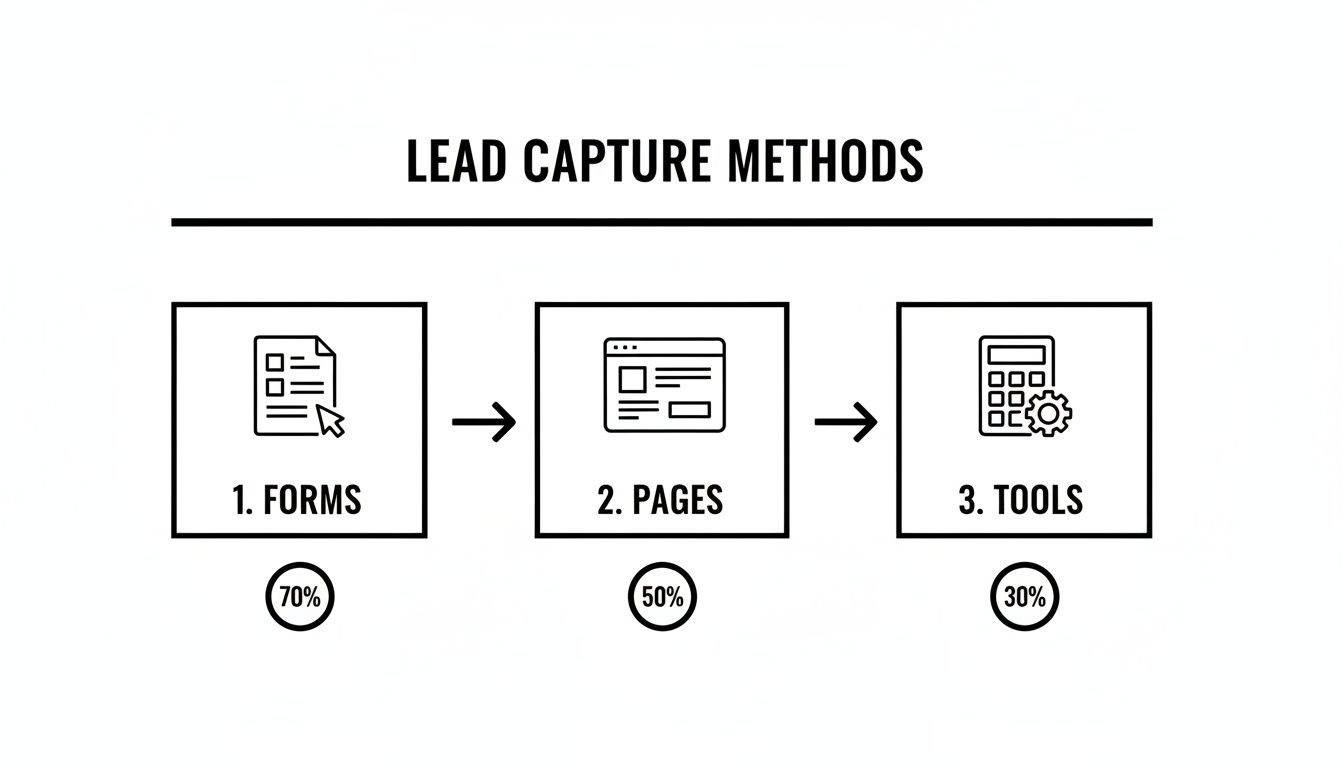
As you can see, simple forms are the starting point for most companies, but a seamless flow is what makes them truly powerful.
Setting Up Your Automated Workflow
With a tool like LeadSavvy Pro, you can build this bridge in just a few minutes, no coding or tech skills needed. The entire platform is designed to replace those tedious downloads with a smooth, instant connection to your sales process.
Here’s how simple the three-step process is:
- Connect Your Facebook Account: Link your Facebook Page to LeadSavvy Pro securely. This is a one-time step that gives the system permission to see your new leads as they come in.
- Choose Your Lead Destination: Tell your leads where to go. You can instantly send them to a Google Sheet for simple tracking, or sync them directly into your CRM.
- Set Up Instant Notifications: Give your sales team a heads-up. Configure real-time email or Slack alerts so the moment a new lead arrives, your team knows and can jump on it.
As you plan your campaigns, it's also smart to understand how much Facebook ads cost so you can manage your budget and expectations effectively.
Automation transforms lead capture from a passive data-entry task into an active, real-time sales trigger. It makes sure no lead ever falls through the cracks because someone forgot to download a file.
This shift is more than just a nice-to-have. Projections show that by 2026, a staggering 90.7% of marketers will rely on digital channels like social media to generate leads. For any business serious about Facebook ads, automating the follow-up isn't a luxury anymore—it's essential to stay in the game.
Want to see exactly how it's done? Check out our detailed guide on how to automate your Facebook leads with LeadSavvy Pro.
Simple Ways to Optimize Your Lead Capture Strategy
Getting a lead capture system in place is only half the battle. The real win comes from optimizing it. A few smart tweaks can seriously boost your conversion rates, turning the traffic you already have into a much more powerful asset for your business.
This isn't about tearing everything down and starting over. It’s about making small, strategic changes that pack a big punch. The goal here is simple: remove any friction and build trust the moment someone thinks about giving you their info. Every single element, from your headline to the color of your button, can either help you or hurt you.
Nail the First Impression
Your headline and call-to-action (CTA) are doing all the heavy lifting. They have one job: grab attention and push people to act. If they’re vague or boring, even the most amazing offer will completely fall flat.
Start split-testing different versions. This is often called A/B testing, where you show two different versions of your page to your audience to see which one gets better results.
- Test Your Headlines: Try a benefit-focused headline against one that asks a question. For example, see if "Boost Your Sales by 30%" performs better than "Are You Making These Common Sales Mistakes?"
- Refine Your CTA: Play around with the text on your buttons. "Get Your Free Guide" might crush "Download Now." You'd be surprised how tiny wording changes can dramatically affect what people do next.
Reduce Form Friction
Long, complicated forms are absolute conversion killers. Every extra field you ask someone to fill out is another reason for them to just give up and leave. The secret is to ask for the bare minimum you need to start a real conversation.
Your form is a conversation, not an interrogation. Start simple.
You can always ask for more information down the road as you build the relationship. For a simple offer like an ebook, a name and email are usually all you need. If you need more details for your sales team, think about using a multi-step form to make it feel less overwhelming. You can find more tips on building effective forms in our guide to designing better lead capture forms.
Build Trust Instantly
Let's be real—people are skeptical about sharing their personal info online. You have just a few seconds to earn their trust. One of the most powerful ways to do this is by placing social proof right next to your form.
Here are a few trust signals you can add right next to your CTA and form fields:
- Testimonials: A short, punchy quote from a happy customer.
- Review Ratings: Logos and star ratings from sites like G2 or Capterra.
- Client Logos: Showing the logos of well-known companies you've worked with.
- Subscriber Counts: A simple line like "Joined by 15,000+ marketers" instantly builds confidence.
Avoid Common Pitfalls
Finally, optimization is just as much about avoiding common mistakes. So many businesses accidentally sabotage their own lead capture efforts.
Watch out for a vague value proposition—if it's not crystal clear what's in it for them, they're gone. Another killer is a clunky mobile experience. If your form is a pain to use on a phone, you're losing leads. Make sure your page loads fast and looks great on every device to squeeze the most value out of every visitor.
Answering Your Top Lead Capture Questions
Even with a solid plan, you're bound to have questions once you start getting your hands dirty with lead capture. It's totally normal. Getting clear on the details helps you sidestep common pitfalls and move forward with confidence.
Let's dig into a few of the most common questions we hear from marketers and business owners.
What Is a Good Lead Capture Rate?
This is the million-dollar question, but there's no single magic number. A "good" rate really depends on your industry, where your traffic is coming from, and how compelling your offer is.
For a general-purpose form on your website, like a newsletter signup, a 1-3% conversion rate is a solid benchmark. Think of it as casting a wide net—a lower percentage is perfectly normal.
But for a laser-focused landing page with a killer offer—say, a free webinar you're promoting with a targeted ad campaign—you should be aiming way higher. In that kind of scenario, rates of 10-20% (or even more) are absolutely within reach.
The most important metric isn't how you stack up against others, but how you're improving over time. The real goal is to consistently bump up your own rate by split-testing headlines, simplifying forms, and making your offer irresistible.
Focus on beating your own numbers, month after month. That's how you win.
How Is Lead Capture Different from Lead Generation?
It's easy to get these two mixed up, but it becomes crystal clear when you think of it as a two-step process.
Lead generation is your entire game plan for attracting potential customers and getting them curious about what you do. It’s all the work you put in to draw an audience, like:
- Writing helpful blog posts
- Running social media ad campaigns
- Doing SEO to show up in search results
Lead capture is that one critical moment within your strategy where you successfully get someone's contact info. It’s the specific transaction where an anonymous browser becomes a known lead by filling out your form.
Think of it like fishing. Lead generation is everything you do to attract fish to your boat—finding the right spot, using the perfect bait, casting your line. Lead capture is the instant you hook a fish and reel it in. You can't have one without the other.
Why Is Response Speed So Important After Capturing a Lead?
A lead's interest is at an all-time high the exact moment they hit "submit." Their problem is fresh in their mind, and they are actively looking for a solution right now. This makes the first few minutes after they reach out the most valuable window of opportunity you will ever get.
Study after study shows the odds of actually qualifying a lead plummet with every minute that ticks by. Responding within the first five minutes can skyrocket your chances of making contact compared to waiting even half an hour.
Speed is king for three big reasons:
- It Capitalizes on Peak Intent: You engage them while their motivation is through the roof.
- It Signals Professionalism: A fast reply shows you're on top of your game.
- It Beats Competitors: You get your foot in the door before they even have a chance to look somewhere else.
This is exactly why automation isn't a "nice-to-have" anymore. Using tools that give you instant notifications is essential for turning a fresh lead into a real sales opportunity.
Ready to stop leads from going cold? LeadSavvy Pro automates your Facebook lead capture, sending new contacts directly to your sales team in real-time. Start for free at https://leadsavvy.pro and see the difference speed makes.