A Modern Playbook for Plumber Lead Generation
Getting your phone to ring with good, profitable jobs isn't about luck or just waiting for word-of-mouth to kick in. Real, sustainable growth comes from a smart, systematic approach to plumber lead generation—a reliable pipeline that moves beyond outdated tactics.
The best systems I’ve seen combine a few key things: dominating local search for those "pipe burst" emergency calls, running sharp paid ads for bigger-ticket projects, building a referral engine that works for you, and automating your follow-up so no lead ever goes cold.
Why You Need a Real Lead Generation Blueprint
This isn't just another list of marketing ideas to throw at the wall. This is a playbook for building a predictable system that brings in quality work. Stop relying on sporadic referrals or seasonal rushes and start turning your marketing from a guess into a powerful investment that generates consistent cash flow.
Let's be real, the plumbing industry is booming. The global market for fixtures and fittings is on track to hit $114.31 billion by 2025. That growth is fueled by new construction and renovations—and you need a modern game plan to get your piece of the pie.
To build a lead generation machine that actually works, we need to focus on four proven pillars. Each one has a specific job, but they all work together to keep your schedule packed.
We call these "The Four Pillars of Modern Plumbing Leads." Think of it as your foundation for a steady stream of customers. Each channel targets a different type of customer with a unique strategy.
The Four Pillars of Modern Plumbing Leads
| Channel | Ideal Customer | Key to Success |
|---|---|---|
| Local SEO | The homeowner with an urgent problem (e.g., "emergency plumber near me"). | Being #1 in Google's local pack through reviews, a great Google Business Profile, and on-page SEO. |
| Paid Ads (PPC) | The customer actively looking for high-value services (water heater installs, repiping). | Highly-targeted campaigns, compelling ad copy, and a landing page that converts visitors fast. |
| Referrals | Existing happy customers and other local trade professionals. | A simple, proactive system for asking for and rewarding referrals. Don't just hope for them! |
| Automated Follow-Up | Every single lead from any channel. | Instant, automated responses (SMS/email) to every inquiry. Speed is the name of the game. |
Getting these four areas dialed in creates a powerful, self-sustaining engine for your business. Neglect one, and the whole system can feel shaky.
A killer lead generation strategy isn't about picking just one channel. It's about building an integrated system where local search, paid ads, and referrals all feed each other to create a steady, reliable flow of work.
Tying It All Together for Maximum Impact
These pillars don't exist in a vacuum. A homeowner might see your Google Ad, click over to your website, and be sold by your 5-star customer reviews. Someone else might see a Facebook post, read a blog about water heaters, and then ask a neighbor who—you guessed it—refers them to you.
The goal is to create multiple touchpoints that build trust and make you the obvious choice.
Each channel reinforces the others. Great reviews from your local SEO work make your paid ads far more believable. A clean, professional website—which is crucial for SEO—is also what turns that expensive ad traffic into actual phone calls. If you need help with this, check out our guide on how to create a landing page that converts traffic into leads. It's all about building a cohesive online presence that turns clicks into customers.
Dominate Local Search for Emergency Calls
When a pipe bursts at 2 AM, nobody is casually browsing. Homeowners grab their phones and search for an "emergency plumber near me," and in that high-stress moment, being the first name they see is everything. This isn't just about marketing; it's about being the go-to solution for urgent, high-value jobs. That's where a killer local SEO strategy becomes your most powerful tool.
The game has completely moved online. By 2025, an estimated 65% of all plumbing leads in North America will come from digital marketing like SEO and paid ads. That's a huge jump from just 35% a decade ago, which shows you just how critical a strong online presence is for growth.
Your Google Business Profile Is Your Digital Storefront
Think of your Google Business Profile (GBP) as your most important local asset. It's what gets you into the Google Maps "local pack"—that block of three businesses that shows up at the very top of local searches. A weak profile is like having a shop with no sign on the door. People will just walk right by.
To really pull in those emergency calls, you need to optimize your Google Business Profile for local wins. This goes way beyond just listing your business name and address.
Here’s where to put your energy for the biggest impact:
- Get Your Categories Right: Your primary category must be "Plumber," but don't stop there. Add secondary categories like "Water Heater Installation & Repair," "Drain Cleaning Service," and "Emergency Plumber" to show up for those specific, high-intent searches.
- Show Off Your Work: Post high-quality photos often. I'm talking pictures of your team in uniform, your branded vans, and especially before-and-after shots of jobs you've crushed. It builds instant trust and screams professionalism.
- Turn on Messaging: A lot of customers, especially younger ones, would rather send a quick message than make a call. Enable this feature in your GBP and set up alerts so you can respond instantly. If you don't, they'll just message the next guy on the list.
Keep a Steady Flow of Five-Star Reviews Coming
Reviews are the lifeblood of local SEO. It's simple: more than 90% of people read online reviews before they ever decide to call a local business. A constant stream of fresh, positive reviews signals to Google that you're an active and trusted company, which directly boosts your rankings in that coveted local pack.
Asking for reviews doesn't have to be awkward. Just build a simple, automated system. After every single job, have an email or text go out with a direct link to your GBP review page. Something as simple as, "Thanks for choosing us! If you were happy with our work, could you take a minute to leave a review?" works wonders.
Pro Tip: You absolutely have to respond to every review, good or bad. Thanking customers for good reviews builds loyalty. Professionally addressing a bad one shows everyone else that you care about your customers and stand by your work.
Build Powerful, Location-Specific Service Pages
Your GBP gets you on the map, but it's your website that closes the deal. To rank for valuable keywords that make you money, you need to build out dedicated pages for each service you offer in the specific towns you serve. A generic "Our Services" page just won't cut it.
Instead, create targeted pages like:
- Water Heater Repair in [Your Town]
- Emergency Drain Cleaning in [Neighboring City]
- Trenchless Sewer Repair in [Your County]
Each page needs to be detailed. Answer common questions your customers have and show off your expertise for that specific service. This is how you start ranking for those long-tail, high-intent searches from people who know exactly what they need fixed. You can see how this fits into the bigger picture in our complete guide to SEO lead generation.
Finally, make sure your business Name, Address, and Phone Number (NAP) are identical everywhere online—your website, GBP, Yelp, you name it. Consistency is a huge trust signal for search engines, solidifying your local authority and making you the plumber customers find first when disaster strikes.
Land High-Value Jobs with Paid Advertising
Think of local SEO as building the foundation of your house—it's essential for long-term stability. Paid advertising, on the other hand, is like hitting the nitrous button. It’s hands-down the fastest, most direct way to get your business in front of homeowners who have a serious problem and need a plumber right now.
This is how you capture those high-value jobs today, not next quarter.
But let's be clear: effective paid advertising isn't about spraying money at Google or Facebook and hoping for a miracle. It’s about surgical precision. You need to target the right people, with the right message, at the exact moment their pipe bursts. A smart campaign can fill your schedule with the profitable jobs you actually want, like water heater installations or trenchless sewer repairs.

Target High-Intent Keywords on Google Ads
Google Ads is your direct line to customers in crisis mode. When a homeowner searches for "tankless water heater installation cost" or "emergency plumber for sewer backup," they aren't just browsing. They're looking for an immediate solution and are ready to pay for it. Your only goal is to be the first name they see.
Success here all comes down to the keywords you choose. Generic terms like "plumber" are a great way to burn cash on low-quality clicks. You need to get specific and focus on long-tail keywords that scream intent.
Think about the searches that lead to profitable jobs:
- High-Value Installation Keywords: "tankless water heater installation," "whole house repipe cost," "sump pump replacement service."
- Urgent Repair Keywords: "emergency sewer line repair," "burst pipe repair near me," "no hot water plumber."
- Specific Problem Keywords: "slab leak detection service," "hydro jetting main line," "gas line repair plumber."
Your ad copy has to match that urgency. Don't just announce that you're a plumber. Speak directly to their pain point. An ad that reads, "24/7 Emergency Sewer Repair. Fast Response & Upfront Pricing. Call Now!" will win every single time against a generic one.
The real power of Google Ads for plumbers is its ability to capture intent. You're not interrupting someone's day; you are providing the exact solution they are actively searching for at that very moment.
Use Facebook Lead Ads to Find Local Homeowners
While Google catches people actively searching, Facebook Lead Ads lets you get in front of potential customers before they even realize they need you. These ads are fantastic because they allow a homeowner to request info with just a couple of taps, right inside their feed.
The secret sauce on Facebook is its incredibly precise targeting. You can zero in on specific zip codes and layer on powerful demographic and interest data.
Here are a few targeting combos that work wonders for plumbers:
- Demographics: Target users listed as Homeowners within a 15-mile radius of your shop.
- Interests: Add interests like "Home Improvement," "DIY Network," or "Home Renovation."
- Behaviors: Target users who have recently moved. New homeowners almost always uncover surprise plumbing issues.
Your ad creative needs to stop them from scrolling. Think before-and-after photos of a slick bathroom remodel, a quick video of your lead tech explaining how to winterize pipes, or an offer for a free water quality test. These are the kinds of things that grab attention.
For a deeper dive into pay-per-click strategies, you can explore the role of PPC in lead generation to understand how these platforms fit into a broader marketing plan.
Creating Ad Campaigns That Convert
A winning paid ad campaign is more than just keywords and targeting. The ad itself—the copy, the visuals, and the offer—is what ultimately convinces someone to click.
Ad Creative Best Practices
| Platform | Best Creative Approach | Example |
|---|---|---|
| Google Ads | Text-based, benefit-driven copy. Focus on solving the searcher's immediate problem with speed, reliability, and trust signals like "Licensed & Insured." | Ad Headline: Fast Water Heater Repair – Call Us Description: No hot water? Get same-day service from certified plumbers. Upfront pricing. 100+ 5-star reviews. |
| Facebook Ads | Visually compelling images or short videos. Showcase your team, your work, and your professionalism. An offer can drive immediate action. | A short video of your team cleanly installing a new water heater with a text overlay: "Tired of cold showers? Upgrade to a tankless water heater. Get a free estimate!" |
At the end of the day, paid advertising gives you a predictable and scalable source of leads. By focusing on high-intent searches on Google and razor-sharp demographic targeting on Facebook, you skip the waiting game and connect directly with homeowners ready to book high-margin jobs. It puts you in complete control of your lead flow.
Automate Your Lead Capture and Follow-Up
Landing a new lead feels great, but it's just the starting line. In the plumbing business, a leaky pipe can cause thousands in damage in minutes. That means the speed of your response is everything—it's what actually lands you the job.
Let's be honest: the plumber who calls back first, sounding confident with a clear plan, almost always wins. This is where automation stops being a "nice-to-have" and becomes your secret weapon for converting leads into paying customers.
Relying on manually checking emails or downloading CSV files from Facebook Ads is a surefire way to lose business. A lead that sits untouched for even an hour is probably already on the phone with two of your competitors. The mission is simple: shrink your follow-up time from hours to minutes. Automation is the only way to do that consistently.
Create a Centralized Lead Hub
First things first, you have to stop letting your leads get scattered everywhere. A lead from a Facebook Ad, your website's "Request an Estimate" form, and a Google Business Profile message should all end up in the same place. Period.
Using a tool like LeadSavvy Pro, you can automatically pipe all those leads from their different sources into one organized system. This could be a simple Google Sheet your entire team can see or a more advanced CRM. The specific tool doesn't matter as much as the principle: centralize everything.
This gives you a single source of truth for your entire sales pipeline.
- No more dropped balls: Nothing falls through the cracks when it’s all in one place.
- Clear ownership: You know exactly who is responsible for which lead and where it is in the process.
- Smarter marketing: You can finally see at a glance which lead sources are actually making you money.
This screenshot shows just how a tool can pull everything together into one unified dashboard.
By connecting platforms like Facebook Lead Ads and your own website forms, you’re building an automated bridge. It completely removes the need for manual data entry and guarantees every single lead gets captured the second it comes in.
The Game-Changing Power of Instant Notifications
Getting the lead is step one. Acting on it is what makes you money. A good automation system doesn't just collect leads; it instantly pings the right person on your team.
Picture this: a homeowner frantically fills out your emergency repair form. Before they can even close the web browser, your on-call plumber gets a text message with the homeowner's name, number, and problem. That's not just fast—it's a game-changer.
Study after study shows that contacting a new lead within the first five minutes makes you exponentially more likely to win the job. After that, your odds of even connecting with them plummet.
An automated follow-up system isn't just a convenience—it's a powerful competitive advantage. It tells a panicked homeowner that you are responsive, professional, and ready to solve their problem right now.
Setting up these alerts is incredibly simple. For example, you can easily forward email lead notifications directly to your team’s mobile phones as text messages. This completely bypasses the delay of waiting for someone to get back to a desk and check an email inbox.
To see just how big of a difference this makes, let's compare the old way versus the new way.
Manual Process vs. Automated Follow-Up
| Metric | Manual Process | Automated Process (with LeadSavvy Pro) | Business Impact |
|---|---|---|---|
| Response Time | 1-4 hours (or longer) | Under 5 minutes | Drastically higher chance of winning the job. |
| Lead Loss Rate | High (missed emails, forgotten downloads) | Near zero | Every marketing dollar works harder. |
| Team Efficiency | Low (constant checking, manual entry) | High (focus on talking to customers) | More jobs closed with less administrative work. |
| Customer Perception | Slow, maybe unreliable | Fast, professional, on-the-ball | Builds trust before you even speak. |
The table makes it pretty clear. Automation isn't just about saving time; it directly impacts your bottom line by improving the core metrics that drive growth for a service business.
Proven Follow-Up Templates That Actually Work
Okay, so your system is set up to be lightning-fast. What do you actually say? That first message needs to be quick, personal, and aimed at getting a conversation started. A generic "We got your request" just doesn't cut it.
Here are a couple of battle-tested templates you can plug right into your automation system.
For Emergency Service Requests
- SMS Template: "Hi [Name], this is [Your Name] from [Your Company]. Got your request about the [Plumbing Issue]. I'm the technician on call. Are you free for a quick call in the next 2 minutes to figure this out?"
For Quote or Estimate Requests
- Email Template: "Hi [Name], thanks for asking [Your Company] for an estimate on your [Project Type]. To give you an accurate quote, I just need a few more details. Do you have 5 minutes for a quick call this afternoon?"
These work because they're direct, they reference the customer's specific need, and they propose a simple, low-pressure next step. Remember, the goal of that first touch isn't to sell the whole job. It's just to start talking. By automating this crucial first outreach, you guarantee every lead gets a professional and prompt response, massively boosting your odds of turning that inquiry into a customer.
Measure and Optimize for Better Results
https://www.youtube.com/embed/rczE8Ji2Oag
So, you've launched your campaigns. The leads are starting to trickle in. Job done, right? Not even close.
Getting campaigns live is just the starting line. If you're not tracking what happens next, you're basically just throwing money at the wall and hoping something sticks. Real growth—the kind that builds a plumbing empire—comes from digging into the data, figuring out what's working, and ditching what isn't.
It's easy to get distracted by "vanity metrics." Things like clicks, impressions, and likes feel good, but they don't pay the bills. The pros ignore the noise and focus on the numbers that directly impact the bottom line.
Key Metrics That Actually Matter
To turn your marketing from a cost center into a predictable profit engine, you need to become obsessed with a few core numbers. These metrics give you the honest truth about your marketing's health and tell you exactly where your next dollar should go.
For any plumbing business, it really boils down to three things:
- Cost Per Lead (CPL): This is your most fundamental number. How much are you paying for a single person to raise their hand and show interest? You find it by dividing your total ad spend by the number of leads you got. Simple, but powerful.
- Lead-to-Booking Rate: Here's where the rubber meets the road. Not every lead becomes a job. This percentage tells you how good your team is at turning an inquiry into an actual, scheduled appointment. If this number is low, the problem might be your follow-up, not your ads.
- Return on Ad Spend (ROAS): This is the ultimate scorecard. It answers the most important question: "For every dollar I put into ads, how many dollars do I get back in revenue?" A ROAS of 5:1 means you're generating $5 in revenue for every $1 you spend. That’s a win.
Zeroing in on these three metrics shifts your entire mindset. You stop chasing leads for the sake of being busy and start acquiring customers that actually make you money.
This whole process is way easier when it’s automated. The moment a lead comes in, it needs to be captured and sent straight to your team.
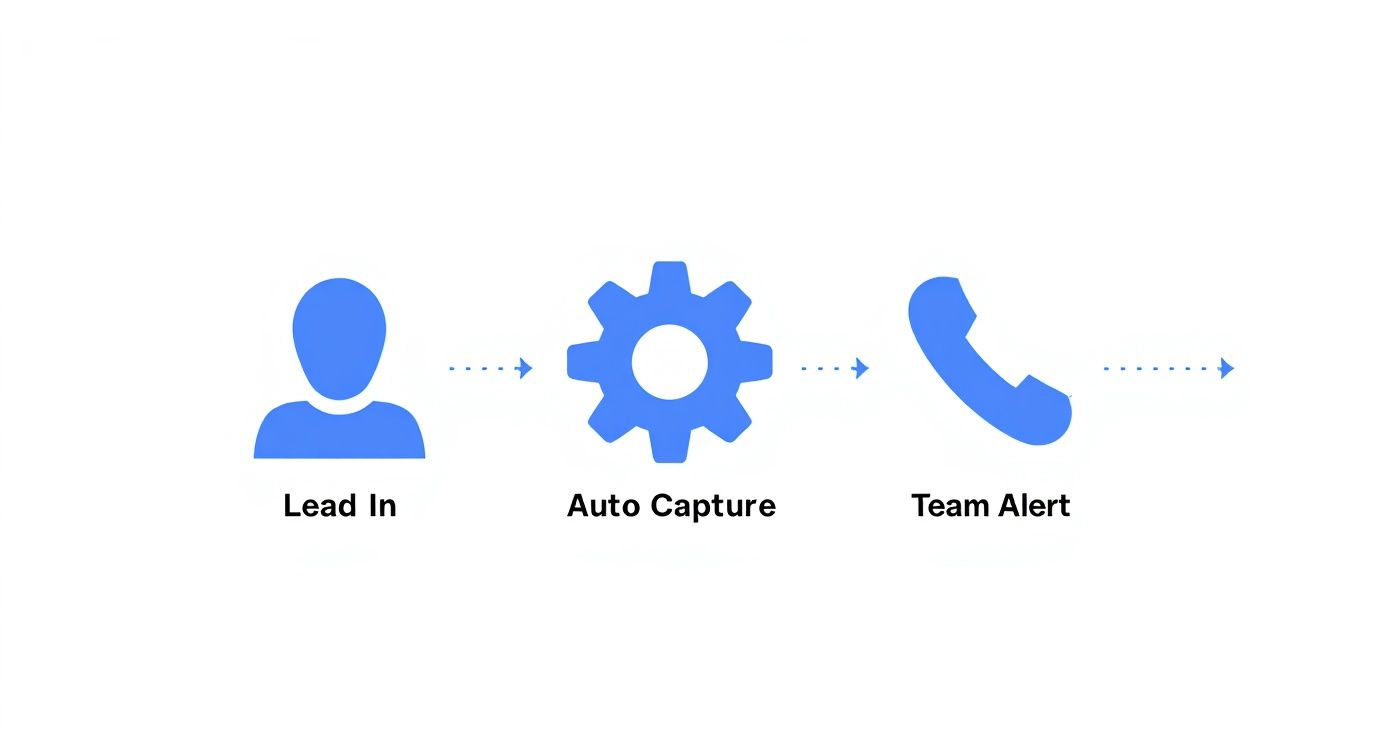
This kind of instant, automated flow is the first step to accurately measuring that crucial lead-to-booking rate. No leads falling through the cracks.
How to Track Your Lead Sources Effectively
You can't figure out your CPL or ROAS if you don't know where the leads came from. Did that call come from a Google Ad, a yard sign, or your Google Business Profile? Without that info, you're flying blind.
Luckily, tracking this is easier than you think. One of the most effective tools in the box is call tracking. Services like CallRail give you unique phone numbers you can assign to different marketing efforts.
For example, you could:
- Put one number exclusively on your Google Ads.
- Use a different number on your website's homepage.
- Assign a third number just for your Google Business Profile.
When a call comes in, the system automatically tags it to the right source. At the end of the month, there’s no guesswork. You know for a fact that Google Ads brought in 25 calls and your flyers only brought in two.
Pro Tip: Never stop asking, "How did you hear about us?" This simple question is your failsafe. It catches any leads your tech might miss and gives you real-world feedback on what's catching people's attention.
Making Smart Optimization Decisions
Once you have this data, the game changes. You can stop guessing and start making strategic moves to improve your results. This isn't a one-time fix; it's a constant process of tweaking and refining.
Let's say you're running two campaigns: one on Facebook targeting bathroom remodels and one on Google Ads for emergency leak repairs.
Your data might look something like this:
- Facebook Campaign: CPL is $150. The lead-to-booking rate is pretty low, but when you do get a job, the ticket price is huge.
- Google Ads Campaign: CPL is only $75. The booking rate is fantastic, and it brings in a steady stream of profitable, everyday jobs.
With that kind of clarity, your next move is obvious. You can confidently pull some of your budget from the expensive Facebook campaign and pump it into your high-performing Google Ads. Your overall ROAS will improve almost instantly.
This is how you build a lean, mean, lead-generating machine. You trim the fat, double down on what works, and create a predictable system that fuels your company’s growth month after month.
Answering Your Top Questions About Lead Gen for Plumbers
Jumping into marketing can feel like a lot, but a few core concepts can make all the difference. I've found that most plumbing business owners I talk to have the same handful of questions when they're trying to figure out how to get more leads.
Let's cut through the noise and get you some straightforward answers. We'll tackle the big ones, from figuring out a realistic budget to deciding where to actually spend your money for the best results.
How Much Should I Actually Budget for Plumber Leads?
A good rule of thumb for most plumbing shops is to set aside 5-10% of your target revenue for marketing. If you're just dipping your toes in, that might look like $500 to $1,500 a month, spent mostly on local Google Ads and maybe some essential SEO tools.
But honestly, the starting number isn't what matters most. The real key is to get obsessed with tracking your Return on Ad Spend (ROAS).
Once you see that every $1 you put into a specific Google Ads campaign brings back $5 in profitable jobs, the question changes. It’s no longer "What's my budget?" but "How much can I possibly afford to spend on this?"
Start with a budget you're comfortable with. But from day one, track everything. Find the channels that are actually making you money, and then double down on those winners. Don’t just spend—invest where you can prove it works.
Should I Focus on SEO or Paid Ads?
This is a classic. A lot of people see SEO and paid ads as an "either/or" choice, but that’s a mistake. The best way to think about it is as a team. One gets you business today, and the other builds an asset for tomorrow.
- Paid Ads (PPC): This is your short game. It's the absolute fastest way to make the phone ring. You're getting in front of homeowners who have a burst pipe or a clogged drain and are searching for a plumber right now.
- Local SEO: This is your long game. It's about building up your online reputation and authority so that you consistently get "free" leads from Google over time. Good SEO means you won't always have to rely on paying for ads.
The smartest play is to use paid ads to bring in cash flow and fill up your schedule now. At the same time, you steadily invest in local SEO to build a dominant presence that will pay off for years to come.
How Fast Do I Really Need to Follow Up with a New Lead?
You need to be on it in under five minutes. That might sound crazy, but the numbers don't lie. Study after study shows that your chances of actually converting a lead from your website plummet after the first 5-10 minutes.
Think about it from the customer's perspective. Their basement is flooding. They're not going to fill out one form and patiently wait for a call back. They are going down the list on Google and calling until someone picks up the phone.
This is exactly why automated follow-up is such a game-changer.
An instant, automated text message or a quick call from your office shows a level of professionalism that immediately puts you ahead of the competition. It tells that frantic homeowner that you're on the ball and ready to solve their problem, while your competitors are still waiting for an email to land in their inbox. More often than not, that speed is what wins you the job.
Ready to stop losing leads to slower competitors? LeadSavvy Pro gets your leads from Facebook and your website into your hands instantly. You get a notification the second a lead comes in, so you can be the first one to call. See how LeadSavvy Pro can help you turn more inquiries into jobs.