Driving Growth How to Get More Leads for Auto Dealers
For any modern dealership, a steady stream of high-intent leads isn't just a goal—it's the engine that powers the entire operation. This means moving past outdated tactics and building a smart, multi-channel digital strategy. The game is won by dominating local search, getting sharp with social media ads, and having a lightning-fast follow-up system to engage buyers the second they raise their hand.
This playbook is your guide to building that engine from the ground up.
Your Modern Playbook for Automotive Leads

Welcome to the definitive guide for generating a consistent flow of quality leads for your dealership. We’re cutting through the noise to give you a practical, multi-channel strategy that top dealers are using right now to fill their sales pipeline. Forget cold calls and yesterday's print ads. The modern car buyer's journey starts online, and your dealership needs to be front and center at every turn.
Here, we're laying out the core pillars of a successful lead generation machine. We'll show you exactly how to attract, capture, and convert leads with an efficiency that turns your website and social profiles into automated powerhouses.
The Shift to a Digital-First Approach
Today's buyers are armed with more information than ever before. They spend hours researching models, comparing prices, and digging into reviews long before they even think about setting foot in a showroom.
This fundamental shift means your first impression almost always happens on a screen, not on the lot. A digital-first mindset isn't just a good idea anymore—it's absolutely essential for survival and growth.
Adopting this approach means getting serious about a few key areas:
- Owning Local Search: You need to be at the top of Google Maps and local search results when someone types in "SUV dealership near me." No excuses.
- Targeted Social Campaigns: Using platforms like Facebook to put compelling offers and your best inventory directly in front of in-market buyers.
- Rapid, Automated Follow-Up: Building systems that engage every single lead within minutes, capitalizing on that peak moment of buyer interest.
The core principle is simple: be where your customers are. By meeting them on the digital platforms they use every day, you position your dealership as the obvious choice in their buying journey.
Understanding the Numbers Game
Let's talk numbers, because that's what drives sales performance. To hit typical sales targets of 100 to 200 vehicles sold, a successful dealership needs to generate between 100 to 150 solid leads per month.
Here’s the kicker: modern digital tactics like SEO and social media ads collectively generate 70% more leads than old-school advertising. They're just flat-out more effective at hitting that volume. For a deeper dive, you can check out some great automotive sales prospect insights from recent industry analyses.
To help you focus your efforts, here's a quick look at the channels that are delivering the best results for dealers right now.
High-Impact Lead Generation Channels for Dealerships
These are the digital channels where the highest-intent buyers are found. Mastering them is key to building a predictable lead flow.
| Channel | Primary Benefit | Key Success Metric |
|---|---|---|
| Facebook Lead Ads | Capture lead info instantly without users leaving the app. | Cost Per Lead (CPL) |
| Local SEO & Google Business Profile | Attract nearby buyers actively searching for a dealership. | Phone Calls & Direction Requests |
| Paid Search (Google Ads) | Target "bottom-of-funnel" keywords for immediate results. | Click-Through Rate (CTR) |
| On-Site & Walk-In Capture | Convert existing lot traffic into digital leads for follow-up. | Lead Capture Rate |
Focusing on these four channels creates a powerful, diversified strategy that keeps your pipeline full of buyers who are ready to talk.
Ultimately, this playbook isn't just theory. It's a hands-on framework built to increase both the volume and quality of your leads, giving your sales team the opportunities they need to close more deals.
Attracting High-Intent Buyers Across Channels
To keep a steady flow of leads coming into your dealership, you have to be where your buyers are looking. And let's be honest, they're looking online. With 95% of vehicle buyers turning to digital channels first, your strategy can't be a shot in the dark. It’s not about casting a wide, expensive net; it's about precision fishing in the most profitable waters.
We're going to break down the channels that consistently deliver high-intent prospects—the people who are deep into the car-buying journey and ready to talk. Each of these methods is designed to grab their attention and turn that initial interest into a solid lead for your team.
Dominate Local Search with SEO and Google Business Profile
When someone types "used trucks near me" or "Honda dealership open now" into Google, they aren't just browsing. They're on the verge of making a call or stopping by. Winning that moment is everything.
Your Google Business Profile (GBP) is basically your digital storefront, and keeping it optimized is non-negotiable. Make sure every field is filled out and triple-checked for accuracy: hours, address, phone number, and a direct link to your inventory. Get your happy customers to leave reviews, too. That positive feedback is gold for your local search ranking and builds immediate trust.
A few must-dos for local search:
- Keep Info Spotless: Your dealership's name, address, and phone number need to be identical everywhere online. Consistency is key.
- Show, Don't Just Tell: Regularly upload high-quality photos of your inventory, showroom, and service bays. Let people see what you're all about.
- Answer the Obvious: Use the Q&A feature on your GBP to proactively answer common questions. It shows you're engaged and gives searchers instant value.
Crafting High-Converting Facebook Lead Ads
Facebook is still a beast for generating auto leads because of its ridiculously specific targeting. You can get your ads in front of people based on behaviors that scream "I'm in the market for a car," like visiting automotive websites or engaging with your competitors' pages.
The secret sauce here is Facebook Lead Ads. They let a user submit their info without ever leaving the app. It’s a smooth, frictionless experience that makes your conversion rates jump.
Picture this: you run a campaign for a fresh shipment of certified pre-owned SUVs. The ad has a killer video walkaround and a clear call-to-action: "Get a No-Obligation E-Price." When a user clicks, the form pre-fills their name and email from their profile. One or two taps, and they're a lead. That’s how you turn mindless scrolling into a real sales opportunity. For more on this, check out our guide to social media lead generation strategies.
Capturing Walk-In and On-Lot Opportunities
Not every hot lead starts on a screen. Your physical lot is a goldmine of potential customers who can be turned into digital leads for follow-up. Just because someone leaves without buying doesn't mean the game is over.
Get creative with on-site capture methods to snag contact info from showroom visitors. A simple tablet kiosk where people can sign up for sale alerts or get a digital brochure for a car they just looked at works wonders.
Here’s a simple but brilliant tactic: put a QR code on the window stickers. When someone scans it, send them to a page offering a free vehicle history report or a special online-only discount in exchange for their email.
This simple action turns a physical visit into a digital touchpoint. Now you can follow up and stay on their radar. While digital is where the action is, it's always smart to have a diverse playbook. To see how old-school channels can support your digital game, you might find some good ideas in this piece on TV advertising for automotive dealerships.
By mastering these different channels—from the hyper-local focus of Google to the surgical precision of Facebook and the untapped potential of your own lot—you build a powerful system for attracting ready-to-buy customers. Each channel supports the others, creating a pipeline of quality leads that keeps your sales floor buzzing.
Building Lead Capture Systems That Actually Convert
All the traffic in the world won't sell a single car if you can't turn a click into a contact. This is where your lead capture system comes in. A well-designed form is the bridge between a potential buyer's passing interest and a real conversation with your sales team.
Getting this right means creating a process that feels less like a barrier and more like a helpful first step for the customer. It has to be fast, intuitive, and give them a clear reason to hand over their information.
Designing the Perfect Automotive Lead Form
The biggest challenge with any lead form is the tug-of-war between gathering data and keeping the user happy. Ask for too much, and you’ll scare people off. Ask for too little, and your sales team won't have what they need to start a productive conversation.
For auto dealers, the sweet spot usually involves these core fields:
- First Name: Absolutely essential for personalizing any follow-up.
- Email Address: Your go-to channel for sending info and follow-up sequences.
- Phone Number: This is critical. 61% of shoppers call after an online search, so getting their number is key for a quick, direct connection.
- Vehicle of Interest (Optional): This gives your team a massive head start.
- Trade-In Info (Optional): Even a simple "Yes/No" helps route the lead to the right person.
That word "optional" is doing a lot of heavy lifting. Making fields like vehicle interest optional lowers the bar for users who are just starting their research. The goal is to make submitting the form feel effortless, especially on mobile, where the average auto shopper spends 33% of their research time.
The golden rule? Only ask for what's absolutely necessary to start a meaningful conversation. You can always gather more details during the follow-up call.
Crafting Irresistible Incentives and CTAs
A strong call-to-action (CTA) paired with a killer incentive is what actually gets someone to fill out your form. Forget generic buttons like "Submit" or "Send"—they’re boring and uninspired. Your CTA needs to promise real value.
Put yourself in the customer’s shoes. What do they get right now in exchange for their info?
High-Impact Incentives for Dealers:
- "Get My E-Price": A classic that works because it promises instant, specific pricing.
- "Schedule a Priority Test Drive": This offers convenience and makes the shopper feel like a VIP.
- "Claim My Online-Only Offer": Exclusivity is a powerful motivator. People love a special deal.
- "Unlock a Free Vehicle History Report": This provides tangible value and builds immediate trust.
These offers directly address what a buyer needs at different stages. Someone comparing prices will jump on an e-price, while a buyer who has narrowed down their choice is ready to book that test drive. Your form's success hinges on matching the offer to the user's intent. For a full playbook on this, check out our guide to designing effective lead capture forms for your business.
The Power of A/B Testing Your Forms
You can't perfect what you don't measure. Small, almost unnoticeable changes to your lead capture system can have a massive impact on your submission rates. This is where A/B testing—pitting one version of a form against another—becomes your best friend.
Consider a real-world test: one dealership tested a two-step form against a single, longer one. The two-step version, which asked for contact info first and vehicle details second, boosted lead submissions by 22%. The psychological trick was getting a small commitment upfront, making users much more likely to see it through to the end.
Another dealer simply tested their CTA button text. Changing it from the bland "Submit Inquiry" to the benefit-driven "Get Today's Best Price" resulted in a 15% lift in conversions. The second version was specific and focused on what the customer wanted. These small tweaks add up, turning more of your website traffic into real leads for auto dealers and filling your sales pipeline without spending another dime on ads.
Mastering the First Hour with Rapid Follow-Up
The moment a potential buyer hits that "Get My E-Price" button, a timer starts ticking. This isn’t just any timer; it’s the countdown clock on your chance to actually close a deal.
Those first few minutes after a lead submits their info are the most valuable—and volatile—part of the entire sales cycle. Their interest is at an absolute peak. They are actively shopping for a car, and your dealership is top-of-mind. Every single minute you wait, that interest cools off, and the odds they’ll just click over to your competitor down the street skyrocket.
The Five-Minute Rule
The data on follow-up speed is pretty staggering and should be a wake-up call for any dealer. Research shows that responding to leads for auto dealers within five minutes can boost your conversion probability by an incredible 900%.
That’s not a typo.
Wait just 30 minutes, and that massive advantage almost completely disappears. The bottom line is that speed isn’t just a nice-to-have; it's the single most important factor in turning a digital lead into a showroom appointment.
To put it another way, a lead is 60 times less likely to convert if you wait an hour versus reaching out in that initial five-minute window. This is exactly why an automated, rapid-response system isn't a luxury anymore—it’s a fundamental part of a modern dealership's playbook.
Your Automated First-Touch Sequence
Look, you can’t have a salesperson glued to their screen 24/7, but you can have automation ready to engage for you instantly. The second a lead comes in, a two-pronged automated response should fire off without fail.
Instant SMS Confirmation
- The Goal: Immediately confirm you got their request and set the right expectation. Text messages have a nearly perfect open rate, which makes them the ideal first touchpoint.
- Example You Can Use: "Hi [First Name]! This is Dave from Premier Auto. Thanks for your interest in the [Vehicle Model]. Just confirming we got your request, and I'll be calling you from this number in the next 5-10 minutes to go over the details. Talk soon!"
Immediate Email Follow-Up
- The Goal: Provide some value and reinforce your dealership's brand while the lead is still engaged and in "shopping mode."
- Example You Can Use: "Subject: Your E-Price for the [Vehicle Model] is almost ready! Hi [First Name], Thanks again for reaching out. While I prepare your custom pricing, here's a link to the vehicle's details and a free history report. I’ll call you shortly to discuss. Best, [Salesperson Name], Premier Auto."
This automated one-two punch makes the customer feel heard and tells them exactly what to expect next, all within seconds of them hitting "submit."
The data doesn't lie: every second counts. This table breaks down just how quickly the odds stack against you when follow-up is delayed.
Lead Response Time vs. Conversion Probability
| Response Time | Impact on Conversion Probability | Actionable Tip |
|---|---|---|
| Under 5 Mins | Highest probability of contact and conversion (up to 900% increase). | Use automation (like LeadSavvy Pro) to trigger instant SMS/email notifications to your sales team. |
| 5-30 Mins | Significant drop-off. The lead's attention is already shifting elsewhere. | If automation isn't instant, have a dedicated BDC rep whose primary job is monitoring and responding. |
| 30-60 Mins | Drastic decrease. The lead is likely engaging with competitors. | This is the danger zone. Your chances are slim. Acknowledge the delay in your outreach. |
| 1+ Hour | The lead is effectively cold. Conversion is 60x less likely than a 5-min response. | At this point, you're in recovery mode. The goal is simply to re-engage, not assume a sale. |
As you can see, the difference between five minutes and thirty minutes is massive. Speed is your ultimate competitive advantage.
The Human Touch: A Call Script That Books Appointments
After your automated messages have broken the ice, it’s time for a real human connection. Remember, the goal of this first call is not to sell the car over the phone. It's to build a little rapport, confirm their interest, and lock in a firm appointment.
Here’s a simple, effective script your BDC or sales team can adapt:
"Hi, am I speaking with [First Name]? This is [Your Name] from Premier Auto. You just requested some information on our [Vehicle Model] a few minutes ago. I'm looking at it now—it's a great choice. I have that pricing ready for you, but more importantly, is the vehicle still available? Yes, it is. When would be a good time for you to come in for a quick test drive? I have openings at 4:15 PM today or 10:30 AM tomorrow. Which works better for you?"
Why this script works:
- Immediate Context: It reminds them exactly why you’re calling.
- Creates Urgency: "Is the vehicle still available?" makes it feel real and time-sensitive.
- Assumes the Appointment: It offers two specific times instead of asking an open-ended question like "When can you come in?"
This approach turns a simple follow-up call into a direct path to a showroom visit.
Mastering this sequence—immediate automation followed by a purposeful human touch—is how you capitalize on every single hard-earned lead. For more in-depth strategies, explore our comprehensive guide covering lead follow-up best practices to help refine your dealership's entire process.
Putting Your Lead Management on Autopilot
If you're still manually downloading CSV files and plugging them into a spreadsheet to manage your leads, you're lighting money on fire. Seriously. In the time it takes you to even see that new lead from Facebook, they’ve already gotten a text from the dealership down the street.
Good lead management isn't just about collecting names. It’s about building a lightning-fast, automated system that gets every single opportunity in front of a salesperson the second it comes in. This is how you stop reacting to old leads and start proactively closing fresh ones. Tools like your dealership CRM or a dedicated connector like LeadSavvy Pro exist to kill the busywork that costs you deals.
Hooking Up Your Lead Sources for Instant Capture
First thing’s first: you need to create a direct pipeline from where your leads are coming from (like Facebook Lead Ads) straight into your management system. This is the biggest bottleneck for most dealers.
Instead of having a BDC manager check Facebook every hour, you connect your dealership's Facebook page directly to your system. Think of it as a digital tripwire. The moment a potential buyer fills out your ad, their info is instantly pulled and sent exactly where it needs to go. This happens in real-time. No delays.
Sending Leads Where They Need to Go
Once you've got that live connection, you decide where the lead's information lands. The whole point is to slide it right into your team’s existing workflow, whether that’s a simple Google Sheet or your main dealership CRM.
-
Google Sheets Integration: For teams who like to keep things simple, syncing leads right into a Google Sheet is a game-changer. Every new lead creates a new row, giving you a clean, real-time list of every prospect. It’s perfect for smaller teams or for tracking a specific weekend ad campaign without bogging down your CRM.
-
CRM Synchronization: For most dealerships, this is the gold standard. Piping leads directly into your CRM means they can be automatically assigned to a salesperson, dropped into follow-up sequences, and tracked from first contact to final sale. It keeps everything neat and tidy in one place.
Here’s a pro tip that gets missed all the time: data mapping. You have to make sure the fields from your Facebook form (like 'First Name', 'Phone Number', 'Vehicle of Interest') match up perfectly with the columns in your Google Sheet or CRM. If you map the 'Phone' field to the 'Email' column, you’re going to break the automation and give your sales team a headache.
Setting Up Instant Alerts for Your Sales Team
Getting the lead into your system is only half the job. If your sales team doesn't know it's there, you've wasted that speed advantage. This is where instant, automated notifications become your secret weapon against cold leads.
You can set up your system to fire off an alert the moment a new lead is captured. These can be sent via email or, even better, an SMS message directly to your BDC, a specific salesperson, or a round-robin group to ensure fair distribution.
A good notification needs to have the vitals, right at a glance:
- Lead's Name and Contact Info: So your rep can hit "call" immediately.
- Lead Source: "Facebook Ad – Certified Pre-Owned SUV Campaign."
- Vehicle of Interest: If they specified one.
- Time of Submission: This drives home the urgency.
This one simple step closes the loop, turning a passive list of names into a hot, active sales opportunity.
Fixing Common Connection Problems
Even the best systems can have a hiccup now and then. The good news is that most issues are simple fixes if you know what to look for.
Common Problems and Quick Fixes:
-
Leads Aren't Syncing: 9 times out of 10, this is an expired connection token. Facebook makes you re-authorize apps every so often for security. Just log into your automation tool and reconnect your Facebook account. It usually takes less than 30 seconds.
-
Data is Missing or Wrong: This almost always goes back to a data mapping error. Jump back into your setup and double-check that your Facebook Lead Form fields are pointing to the right places in your Sheet or CRM. Make sure "Phone" is going to "Phone"!
-
Notifications Aren't Sending: Check the email addresses or phone numbers you've set up for alerts. A simple typo is a common culprit. It's also worth checking your spam filter and whitelisting the sender's address just in case.
By automating this whole process, you take human error out of the equation, crank up your response speed, and give your team the best shot at converting the leads for auto dealers that you're working so hard to get.
Measuring What Matters with KPIs and Benchmarks
If you’re not measuring your lead gen, you’re flying blind. It's one thing to get a flood of new leads for auto dealers, but it's another thing entirely to know which ones are actually turning into sales. The dealerships that win are the ones who understand the story their numbers are telling.
Forget vanity metrics. We're talking about the key performance indicators (KPIs) that directly map to your bottom line. A data-first mindset shows you which channels are printing money and which are just burning it. Tracking just a few key metrics is all it takes to make smarter ad buys, boost your ROI, and finally build a predictable sales pipeline.
Core KPIs Every Auto Dealer Should Track
To get a real handle on performance, you need to be watching these numbers like a hawk. Together, they give you a complete picture of your funnel, from the initial ad click all the way to a signed deal.
- Cost Per Lead (CPL): This is your starting point. Just divide your total ad spend on a channel by the number of leads you got from it. But be careful—a super low CPL from a Facebook campaign doesn't mean much if none of those leads ever pick up the phone.
- Lead-to-Appointment Ratio: How good is your team at turning a form submission into a butt in a seat at the dealership? This number is a direct reflection of your follow-up game. It tells you if your scripts and speed are on point.
- Appointment-to-Sale Ratio: Of the people who actually show up, how many drive off the lot in a new car? This metric is all about the effectiveness of your showroom experience and your sales team's closing skills.
The real magic happens when you start slicing this data by lead source. You might find your local SEO leads cost you nothing directly but have a sky-high appointment-to-sale ratio, making them pure gold. On the other hand, that cheap Facebook lead might have a terrible conversion rate, making it more expensive in the long run.
The diagram below shows how an automated flow—from capture to notification—makes tracking this stuff in real-time possible.
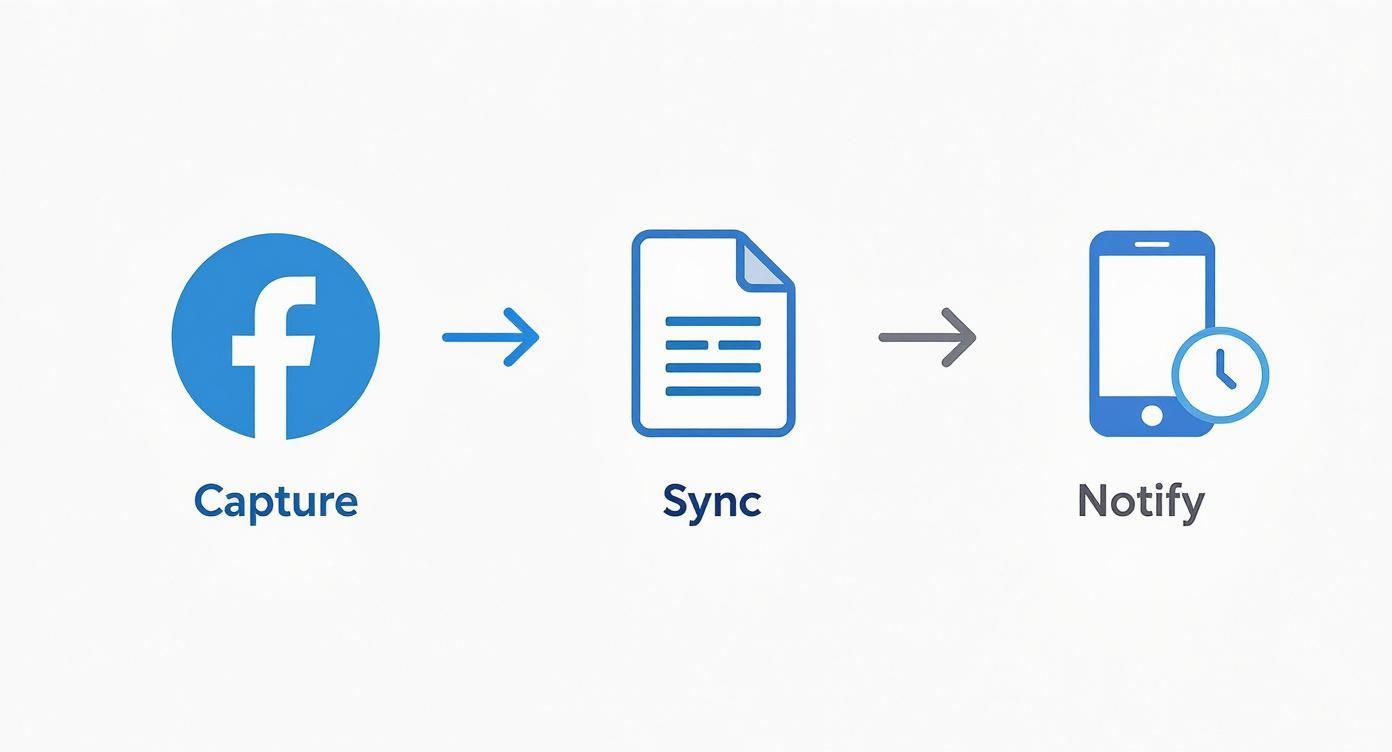
This kind of instant sync ensures every lead is accounted for, giving you clean data you can actually trust for your KPI reports.
Industry Benchmarks and What They Mean
Knowing your own numbers is step one, but context is everything. What's a "good" number, anyway?
Honestly, it varies wildly. Automotive lead conversion rates can be anywhere from 2% to 10%. The cost per lead is even crazier, bouncing between $43 and $283. That massive gap is exactly why you have to figure out what works for your dealership, in your market, with your inventory. If you're curious, you can dig into more lead generation statistics to see how different factors move these numbers around.
Your Top Dealership Lead Gen Questions, Answered
When you're running digital ads for a dealership, the same questions pop up time and time again. Getting straight answers is the only way to know you're putting your budget in the right place. Let's tackle the big ones we hear from dealers every day.
How Many Leads Should My Dealership Aim for Each Month?
There's no single magic number, but a solid benchmark to shoot for is between 100 and 150 high-quality leads a month.
For most dealerships aiming to move 100-200 cars, this volume gives your sales team plenty of at-bats. Of course, this assumes you have a lightning-fast follow-up process to actually convert them.
What's the Most Cost-Effective Way to Get Leads?
This might surprise you, but it’s often your Google Business Profile and local SEO. Why? Because you're capturing people who are already searching for a dealer near them. These are high-intent buyers, and the leads don't come with a per-click ad cost.
When it comes to paid channels, a well-targeted Facebook Lead Ad campaign is incredibly hard to beat. They are remarkably efficient and almost always deliver a lower cost-per-lead than traditional search ads.
My Leads Are Junk. How Do I Improve the Quality?
If you want better leads, you have to get more specific. It's that simple.
Start by tightening up your ad targeting to zero in on in-market buyers. Then, craft your ad copy to scream value, not just list features. The biggest game-changer? Add one simple qualifying question to your lead form. Something like, "What is your purchase timeframe?" can weed out the tire-kickers and dramatically improve the quality of your incoming leads for auto dealers.
Tired of the daily grind of downloading CSV files? LeadSavvy Pro pipes your Facebook leads directly into your Google Sheet or CRM the second they come in.
Sign up for a free account and get your lead flow on autopilot in minutes.