
A Modern Guide to Lead Generation for Lawyers
In the legal world, a steady stream of new clients is everything. Lead generation for lawyers is simply the system you build to make that happen—a reliable pipeline that moves your firm beyond unpredictable word-of-mouth and creates consistent growth. It's about using smart, modern strategies to make sure your firm shows up exactly when and where people are desperately searching for legal help.
Why Traditional Referrals Just Don't Cut It Anymore
Relying only on referrals today is like running a top-notch practice with no sign on the door. Sure, word-of-mouth will always have its place, but the way clients find a lawyer has been completely turned on its head. The journey no longer starts at the country club or with a call to a family friend; it starts with a frantic search on a smartphone.

Think of your law firm as a lighthouse. Its job is to guide ships—your potential clients—safely to shore. If that lighthouse is only visible to a handful of boats that already know it's there (referrals), it's missing almost everyone else navigating the foggy waters of a legal crisis. Modern lead generation means turning on a powerful digital beacon that can be seen for miles.
The Big Shift to Digital Discovery
This isn't just a small trend; it's a massive, permanent change in how people behave. Over the last decade, online channels have decisively overtaken referrals as the primary engine for new business.
Take a look at how the landscape has changed:
Modern vs. Traditional Law Firm Marketing
| Aspect | Traditional Approach (Referral-Based) | Modern Approach (Digital-First) |
|---|---|---|
| Visibility | Limited to your personal network | Reach thousands of active searchers |
| Client Source | Relies on past clients and colleagues | Attracts clients from Google, social media, ads |
| Scalability | Difficult to predict or grow reliably | Measurable, scalable, and predictable |
| Control | Passive; you wait for calls to come in | Proactive; you meet clients where they are |
Recent data shows that a staggering 67% of law firms now get less than half their business from traditional referrals. At the same time, more than a third of all clients kick off their search for an attorney online. The numbers don't lie—this shift demands a new playbook.
Your next client isn't asking their neighbor for a recommendation. They're typing "personal injury lawyer near me" into Google at 10 PM. If you're not part of that digital conversation, you're invisible.
A modern, multi-channel strategy isn't optional anymore. It's essential for survival. Without it, you’re missing out on a huge, motivated group of potential clients who are actively looking for the exact expertise you offer. And you don't have to break the bank to start; there are plenty of effective free lead generation strategies that can build a powerful foundation.
The New Client Journey
Today’s client journey looks nothing like the old referral model. It now involves multiple digital stops before someone even thinks about picking up the phone.
- The Problem Hits: An individual has a legal issue and their first move is to ask Google for answers, not their friends.
- The Research Phase: They start reading blog posts, watching videos, and consuming articles to get a handle on their situation.
- The Vetting Process: They search for local lawyers, dig into online reviews, and compare firm websites to gauge credibility and expertise.
Each of these steps is a golden opportunity for your firm to connect. By building a strong digital presence, you meet potential clients where they are, offer real value, and build the trust needed to turn a random searcher into a signed case. This guide will show you exactly how to do it.
Building Your Client Acquisition Funnel

Real lead generation isn't about throwing random tactics at the wall and hoping something sticks. It’s about building a predictable system—a client acquisition funnel—that methodically guides a complete stranger with a legal problem to becoming your next paying client.
Think of it as the roadmap of your entire marketing effort. People rarely go from a quick Google search to signing a retainer overnight. They move through distinct stages, and your job is to meet them at each step with exactly what they need to move forward.
When you map out this journey, you create a repeatable process that turns your marketing dollars into actual, measurable results. Best of all, this framework works for any practice area, from family law to high-stakes corporate litigation.
The Three Core Stages of the Legal Funnel
Every potential client you'll ever work with goes through a similar decision-making process. We can break this journey down into three simple stages that will form the backbone of your firm's growth engine.
- Awareness (Top of the Funnel): This is the very beginning. Someone realizes they have a legal issue and starts looking for answers, not lawyers. They’re typing questions into Google, trying to understand their situation. Your goal here is to be the helpful, authoritative voice that provides those answers.
- Consideration (Middle of the Funnel): Okay, now they understand their problem. The next logical step is to find a solution, which means finding the right professional. At this stage, they're actively comparing law firms, reading reviews, and looking for signs of expertise and trustworthiness.
- Conversion (Bottom of the Funnel): This is decision time. The potential client has done their homework, narrowed down their choices, and is ready to hire someone. Your job is to make it incredibly easy for them to contact you and book that initial consultation.
Getting a handle on these phases is the first step, but truly effective funnels are always being tweaked. If you're looking to really dial things in, there are many proven sales funnel optimization strategies that can make a huge difference in your conversion rates.
A well-structured funnel doesn't just attract leads; it qualifies them. By providing value at each stage, you build trust and ensure that the prospects who reach out to you are more informed, more serious, and a better fit for your firm.
Putting the Funnel into Practice
So, how do we turn this theory into action? It’s all about creating specific marketing activities for each stage. A huge part of this is nurturing those relationships, and one of the best ways to do that is with proven lead generation tactics like building an email list.
Here are a few concrete examples of what this looks like:
-
Awareness Stage in Action:
- Activity: You write a blog post titled, "What Are the First 5 Things to Do After a Car Accident in California?"
- Purpose: This content directly answers a question your ideal client is frantically typing into a search bar. It immediately positions you as a helpful expert when they need it most.
-
Consideration Stage in Action:
- Activity: You offer a downloadable "Divorce Process Checklist" on your family law page in exchange for an email address.
- Purpose: You’re providing a genuinely useful tool that helps them organize their thoughts. In return, you get their contact information and permission to follow up, moving them one step closer to hiring you.
-
Conversion Stage in Action:
- Activity: You place a simple, impossible-to-miss "Contact Us for a Free Consultation" form and your phone number at the top of every single page on your website.
- Purpose: The moment someone decides you’re the right choice, you make it frictionless for them to take that final, critical step. No hunting, no confusion.
Choosing Your Most Effective Lead Channels
Once you've mapped out your client acquisition funnel, it's time to fuel it. But where do you actually find high-quality prospects? The answer lies in picking the right lead generation channels—the digital highways where your ideal clients are already traveling.
Let's be clear: a strategy that works for an e-commerce brand won't necessarily attract a client facing a complex legal battle. You have to be smarter than that.

Effective lead generation for lawyers is all about surgical precision. You need to focus your time and budget on platforms where people are either actively searching for legal help or fit the exact demographic profile of your ideal client. We're going to dive into the three most powerful channels for law firms today: SEO, PPC advertising, and targeted social media ads.
Master SEO to Capture High-Intent Searchers
Search Engine Optimization (SEO) is the art of getting your law firm’s website to the top of Google. Think of it as owning the best piece of real estate in your digital city.
When someone has an urgent legal problem, they don't look up at a billboard. They pull out their phone and search for things like "personal injury lawyer near me" or "how to start a business in Texas."
Being on the first page for those searches is everything. It puts your firm directly in front of people at the precise moment they need you. This is high-intent lead generation at its absolute best. You're not interrupting their day; you're providing the solution they're actively hunting for.
A rock-solid SEO strategy for lawyers boils down to a few key things:
- Local SEO: Most of your clients need a lawyer in their city. That means optimizing your Google Business Profile with your address, hours, and practice areas is non-negotiable for showing up in local map results.
- Keyword-Rich Content: You need helpful blog posts and practice area pages that answer the specific questions potential clients are asking. This builds your authority and helps you rank for valuable search terms.
- Client Reviews: Getting happy clients to leave Google reviews builds massive trust and gives your local rankings a serious boost. In fact, 75% of consumers trust online reviews just as much as a recommendation from a friend.
Use PPC Ads for Immediate Visibility
While SEO is the long game that builds a powerful foundation, Pay-Per-Click (PPC) advertising delivers results right now. Platforms like Google Ads let you place your firm at the very top of the search results page—instantly. You bid on keywords and only pay when someone clicks your ad.
This channel is perfect for capturing urgent legal needs. Someone who just got into a car accident or was served with divorce papers isn't casually browsing. They need help now. A well-written Google Ad is often the first thing they see.
PPC allows you to jump the line. While your SEO builds momentum, paid ads put you in front of clients today, generating phone calls and form submissions from the moment your campaign goes live.
To make a PPC campaign work, you need to focus on:
- Compelling Ad Copy: Your ad must speak directly to the searcher's pain point and offer a clear solution. Think: "Hurt in an Accident? Free Consultation. No Fee Unless We Win."
- Targeted Landing Pages: Never send ad traffic to your homepage. Create specific, focused landing pages that match the promise of your ad and make it incredibly simple for visitors to contact you.
- Local Services Ads: For certain practice areas, Google's Local Services Ads are a game-changer. These appear above the traditional PPC ads and come with a "Google Screened" badge, adding a powerful layer of trust. You only pay for qualified leads who call or message you through the ad.
Leverage Social Media Ads for Precision Targeting
Social media platforms like Facebook and LinkedIn offer a totally different—but equally powerful—approach. Instead of waiting for someone to search for you, you proactively place your message in front of a highly specific audience based on their demographics, interests, and online behavior.
This is where social media truly shines. An estate planning attorney, for instance, can target users based on age (55+), homeowner status, and even income level. A family law attorney could target people who recently changed their relationship status to "separated." This level of precision is impossible on almost any other platform.
For lawyers, the most effective tool here is often Facebook Lead Ads. These ads let a user submit their contact information without ever leaving the Facebook app, making it a frictionless experience. Our guide on social media lead generation covers these tactics in much more detail, showing you how to turn social platforms into real client-generating machines.
This table breaks down the core strengths of each channel to help you decide where to focus.
| Lead Channel | Best For | Key Advantage | Time to Results |
|---|---|---|---|
| SEO | Long-term, sustainable growth | Capturing high-intent organic traffic | 6-12 Months |
| PPC (Google Ads) | Immediate lead flow for urgent needs | Speed and top-of-page visibility | Immediate |
| Social Media Ads | Targeting specific demographic profiles | Precise audience filtering and reach | Days to Weeks |
Ultimately, the most successful law firms don't just pick one. They build a diversified marketing engine. By combining the long-term authority of SEO, the immediate punch of PPC, and the laser-focused targeting of social media, you create a robust system that consistently brings new clients through your door.
Streamlining Your Lead Flow with Automation
Getting leads is just the first step. The real win? Capturing and responding to them the second they reach out. This is a massive challenge with a tool like Facebook Lead Ads. While they make it incredibly easy for a potential client to show interest, they also have a built-in flaw that can kill your entire effort before it starts.
By default, Facebook doesn't ping you when a new lead comes in. Instead, it quietly collects them in a spreadsheet you have to hunt down and download manually. This process is slow, clunky, and creates a critical delay between a person asking for help and your firm answering the call.
The High Cost of Lag Time
Picture this: someone gets into a car accident and fills out your ad form at 8 PM, stressed and looking for immediate answers. If your team doesn't manually check for that lead until the next morning, that’s a 12-hour delay. In that time, you can bet they’ve already called two or three other attorneys who picked up the phone right away.
This is where speed-to-lead becomes everything in the legal world. Study after study confirms that the first firm to respond has a ridiculously higher chance of signing the client. Waiting hours—or even a full day—is basically the same as handing the case to your competition on a silver platter.
Manual downloading isn't just slow; it creates other headaches:
- Wasted Time: Your paralegals or intake specialists are stuck doing admin work instead of talking to potential clients.
- Risk of Errors: Manually copying info from a spreadsheet into your CRM is a recipe for typos, wrong numbers, and lost leads.
- Inconsistent Follow-Up: When things get busy, it's way too easy for a manually downloaded lead to fall through the cracks.
Automating Your Intake for an Unfair Advantage
The solution is simple: cut out the manual step completely. With an automation tool, you can build a direct pipeline between Facebook and your firm’s most important channels, whether that's your email inbox or your CRM.
This simple change transforms your lead generation from a clunky, passive process into an instant, always-on system. The moment a potential client hits "submit" on your Facebook ad, their information lands exactly where you need it to be.
This diagram shows how a tool like LeadSavvy Pro gets this done.
As you can see, it’s a straight shot from the ad to your inbox. No more messing with CSV files, and no more leaving a potential client hanging.
Setting Up Your Automated Lead Flow
Connecting a tool to automate your Facebook Lead Ads is surprisingly straightforward, and the payoff is immediate. You're bridging the gap between a powerful advertising platform and a practical, efficient client intake workflow.
Here’s what the setup usually looks like:
- Connect Your Facebook Account: First, you’ll grant the automation tool secure access to your law firm's Facebook Page.
- Select Your Lead Form: Next, you pick the specific ad form you want to pull leads from. You can set up different automations for different campaigns—one for family law, another for estate planning, and so on.
- Choose Your Destination: This is the key step. You decide exactly where the new lead’s info should go. Common destinations include:
- Email Notifications: Instantly get an email with the lead's name, phone number, and any other details they provided.
- Google Sheets: Automatically add a new row to a shared spreadsheet for simple tracking.
- CRM Integration: Fire the lead directly into your firm's CRM to create a new contact and kick off your standard follow-up sequences.
By automating this one step, you completely change your firm's ability to respond. A lead that once took hours to even see now lands in front of your intake team in seconds. This lets them make contact while the person's legal problem is still their number one priority.
This kind of immediate action doesn't just improve your odds of signing one client. It builds a reputation for being responsive, attentive, and accessible. In a crowded legal market, that reputation is one of your most powerful assets. Automating your lead flow is a small tactical move that delivers a huge strategic advantage.
Turning Leads Into Profitable Clients
Getting a lead is like getting the ball to the one-yard line. The real work—the part that actually puts points on the board—is turning that opportunity into a paying client. A prospect's name and number sitting in a spreadsheet is worthless until you actually engage with them.
This is where the real magic happens: lead qualification and nurturing. It's the critical follow-up process that transforms a curious browser into a confident client who's ready to sign on the dotted line.
You have to remember, especially in high-value practice areas, that law firm leads are expensive and have a very short shelf life. Speed is everything. In fact, research shows that about 80% of legal consumers will just move on to the next firm if they don't get a response within 48 hours.
That's why an automated lead flow isn't just a "nice-to-have"—it's a necessity for immediate engagement.
Here’s a quick look at how simple automation can bridge that dangerous gap between an interested prospect and your intake team.
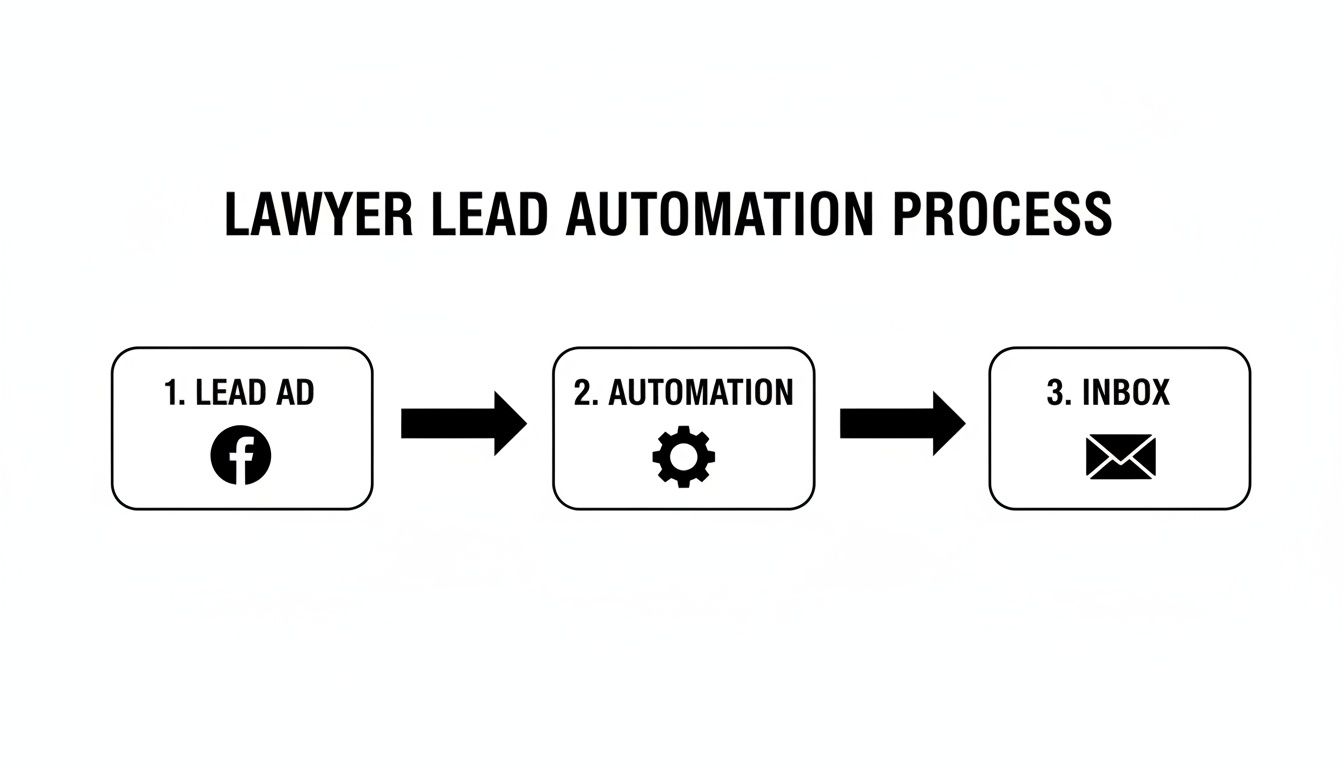
As you can see, a lead from a Facebook Ad can be instantly processed and delivered to the right person, completely cutting out manual delays. This speed ensures your firm is the first to respond, which dramatically boosts your chances of landing the case.
Qualify Leads to Focus Your Efforts
Look, not every lead is a good fit for your firm. Spending an hour on the phone with someone whose case you can't even take is a massive drain on your resources.
That's why the very first step after getting a new lead is qualification. Think of it as a quick, simple triage process to determine if this person is actually worth pursuing. Your goal is to sort incoming inquiries fast so your team can focus its valuable time on the most promising potential clients.
A basic qualification checklist might look like this:
- Practice Area Fit: Does their problem actually fall under your firm’s expertise?
- Location, Location, Location: Is their case within a jurisdiction you serve?
- Urgency & Intent: Are they looking to hire an attorney now, or are they just kicking tires?
- Conflict Check: Any potential conflicts of interest you need to know about upfront?
By asking these simple questions right away, you can quickly separate the high-potential leads from the time-wasters. This single step will save you countless hours and make sure your best people are working on your best opportunities.
The goal isn't to get every lead; it's to get the right leads. A strong qualification process acts as a filter, protecting your team’s time and maximizing your marketing ROI.
Nurture Prospects with Consistent Communication
Once you’ve confirmed a lead is a good fit, the nurturing process begins. This is where you build trust and stay top-of-mind until they are ready to sign with you. The foundation of this entire stage is consistent, helpful communication.
And by the way, mastering legal writing in plain English is a huge advantage here. Clear, simple communication builds trust far more effectively than dense legalese, helping you turn more prospects into profitable cases.
An effective nurturing sequence doesn't have to be complicated. It can be a simple, automated series of actions designed to provide value and showcase your expertise.
Example Nurturing Workflow:
- Instant Confirmation: The moment they hit "submit," an automated email goes out confirming you got their info and letting them know when to expect a call.
- Initial Follow-Up Call: Your intake specialist calls within 5-10 minutes to run through the qualification questions and gather basic case details.
- Educational Email: A day later, an automated email sends them a helpful article or checklist related to their legal issue (e.g., "5 Mistakes to Avoid After a Work Injury").
- Second Follow-Up: Two days later, a scheduled call or email follows up to answer any more questions and book the official consultation.
This systematic approach makes sure no one falls through the cracks. It positions your firm as organized, responsive, and genuinely helpful—the key differentiators that turn qualified leads into profitable, long-term clients.
Measuring Your Marketing Return on Investment
Throwing money at lead generation without tracking what comes back is like arguing a case without any evidence. You're just guessing. To win, you need hard data that shows you which strategies are actually working and which are just draining your budget.
Think of every dollar you put into marketing as an investment, not an expense. Key Performance Indicators (KPIs) are how you audit that investment. Instead of getting overwhelmed by a sea of metrics, you just need to focus on a few critical numbers that tell the real story of your firm's marketing health.
The KPIs Every Law Firm Must Track
To get a real handle on your performance, you need to know the language of marketing ROI. These core metrics will give you a clear, no-nonsense picture of how well you're turning marketing spend into profitable cases.
- Cost Per Lead (CPL): This is your most basic number. It tells you exactly how much you have to spend just to get one potential client to raise their hand and show interest. It’s all about the efficiency of your campaigns right at the top of the funnel.
- Client Acquisition Cost (CAC): This one goes a step deeper. It calculates the total cost to actually sign a new client, factoring in not just your ad spend but any other sales and intake costs involved in sealing the deal.
- Return on Ad Spend (ROAS): This is the bottom line. ROAS tells you precisely how much revenue you’re generating for every single dollar you spend on advertising. It’s the ultimate metric connecting your marketing directly to your firm's profitability.
Tracking these KPIs isn't just an accounting exercise; it's about taking control. When you know your CAC for a specific channel, you can confidently decide whether to pour more fuel on the fire or cut your losses and reinvest somewhere that actually delivers.
Calculating Your Firm's Critical Numbers
Knowing the concepts is one thing, but putting them into practice is where the magic happens. The good news is the formulas are surprisingly simple, and they give you actionable insights you can use immediately for your lead generation for lawyers.
Let's walk through a real-world example. Imagine your firm spends $2,000 on a Google Ads campaign for personal injury cases this month.
-
Calculating CPL: That campaign brings in 40 inquiries (leads).
- Formula: Total Ad Spend / Total Leads = CPL
- Example: $2,000 / 40 = $50 CPL
-
Calculating CAC: Out of those 40 leads, your intake team successfully signs 4 new clients.
- Formula: Total Ad Spend / New Clients = CAC
- Example: $2,000 / 4 = $500 CAC
-
Calculating ROAS: Those 4 new clients are projected to generate $20,000 in case value for the firm.
- Formula: Total Revenue / Total Ad Spend = ROAS
- Example: $20,000 / $2,000 = 10x ROAS
Just like that, you have total clarity. You now know that for every dollar you put into this campaign, you get ten dollars back. This is the kind of data that empowers you to stop wasting money on channels that don't work and double down on the strategies that deliver a clear, profitable return.
To help you keep these straight, here's a quick rundown of the essential metrics every law firm should have on its dashboard.
Essential KPIs for Law Firm Lead Generation
| KPI (Key Performance Indicator) | What It Measures | Why It's Important for Lawyers |
|---|---|---|
| Cost Per Lead (CPL) | The average cost to generate a single new inquiry or potential client from a marketing channel. | Helps you understand the top-of-funnel efficiency of your ads and content. A high CPL might mean your targeting is off. |
| Client Acquisition Cost (CAC) | The total cost of marketing and sales required to sign one new client. | This is the true cost of getting a new case. Comparing CAC across channels shows you where your most profitable clients come from. |
| Return on Ad Spend (ROAS) | The amount of revenue generated for every dollar spent on advertising. | The ultimate bottom-line metric. A high ROAS proves your marketing is a profit center, not just a cost. |
| Lead-to-Client Conversion Rate | The percentage of leads that become actual, paying clients. | This measures the effectiveness of your intake process. A low rate could signal issues with follow-up or qualification. |
| Website Traffic | The number of visitors coming to your law firm's website. | Indicates brand awareness and the reach of your SEO and content marketing efforts. More traffic means more opportunities. |
Tracking these numbers moves your firm from making decisions based on gut feelings to making them based on cold, hard facts. It's the key to building a predictable, scalable system for growth.
Your Top Questions About Lead Generation for Lawyers, Answered
Jumping into digital marketing always brings up a few questions. That's a good thing. Getting clear, practical answers is the first step toward building a lead generation engine that actually brings new clients through the door.
Let's tackle some of the most common questions we hear from attorneys.
How Much Should My Law Firm Budget for Lead Generation?
There's no single magic number, but a solid rule of thumb is to set aside 2-10% of your total revenue for marketing.
If your firm is brand new or you’re fighting for clients in a hyper-competitive space like personal injury, you'll probably need to aim for the higher end of that range to make a real dent.
But here’s the key: don't just set a budget and walk away. Start smaller, test the waters, and obsessively track your Client Acquisition Cost (CAC) for every single channel. Once you see what's bringing in profitable cases, you can confidently double down on what works.
What Are the Ethical Rules for Online Lawyer Advertising?
This one is critical. Staying compliant with your state bar’s rules of professional conduct is completely non-negotiable. While the exact rules differ from state to state, a few core principles are universal.
You absolutely cannot make misleading claims or guarantee a specific outcome in your ads. Period. Always be sure to label your content as "Advertising Material" if your local bar requires it, and never, ever engage in improper solicitation. Dig into your state's guidelines before you even think about launching a campaign.
How Long Does It Really Take for SEO to Work?
Let's be clear: SEO is a long game. It’s an investment in your firm's authority and online presence, not a get-rich-quick scheme.
While you might see some positive movement in search rankings within 3-4 months, it typically takes 6-12 months of consistent, focused effort to see a significant, steady flow of traffic and leads. This is especially true if you're in a competitive market where dozens of other firms are all targeting the same clients.
That's why it's so smart to run a targeted PPC advertising campaign alongside your SEO work. PPC gets you leads right now while your long-term organic foundation gets stronger and stronger.
Stop wasting time downloading spreadsheets and start talking to potential clients. With LeadSavvy Pro, your Facebook leads land in your inbox or CRM the second they come in, so you can be the first to respond. Try LeadSavvy Pro for free and put your lead flow on autopilot today.