facebook advertising for dentists: Grow Your Practice Fast
Think of Facebook advertising as your practice's secret weapon. It’s a way to get in front of potential patients before they even think to type "dentist near me" into Google.
Instead of waiting for them to find you, you're actively reaching into your local community to find the exact people you want as patients. This isn't just advertising; it's demand generation, and it's how you fill your schedule with high-value cases.
Why Your Practice Needs Facebook Ads
Let's be clear: Facebook isn't just for vacation photos anymore. For a modern dental practice, it's a patient acquisition machine. If you're still relying on mailers or just hoping people stumble upon your website, you're leaving a huge opportunity on the table. You're letting potential patients slip through the cracks.
The difference is simple: Facebook ads are proactive, not reactive. You get to put compelling offers right in the social media feeds of your ideal patients, day after day.
A Real-World Scenario
Imagine a practice that wants more cosmetic cases—veneers, implants, Invisalign—but their current patient base is mostly focused on routine cleanings. They’ve tried local ads, but the results are lackluster because they’re not reaching the right crowd.
This is where Facebook advertising for dentists completely flips the script.
With a targeted campaign, that same practice can now:
- Target by Income: Serve ads directly to people in higher-income ZIP codes who are more likely to invest in cosmetic work.
- Target by Interests: Reach users who follow luxury brands, wellness influencers, or beauty trends.
- Target by Location: Zero in on affluent neighborhoods within a 5 or 10-mile radius of the office.
Suddenly, their ads are showing up in front of local professionals who might have been thinking about a smile makeover but hadn't started looking. The campaign creates the demand and positions the practice as the go-to expert.
Building a Strong Business Case
The numbers don't lie. Dental Facebook ads see an average conversion rate of around 11%. That’s incredibly high compared to most other industries. It means for every 100 people who click your ad, you can expect around 11 of them to become a solid lead.
The true power of Facebook advertising is its insane level of targeting. You’re no longer just shouting into the void of your entire city. You're speaking directly to the 45-year-old on Elm Street who is a perfect candidate for your high-margin services.
This isn't just about getting more patients; it's about getting the right patients. For a truly robust growth plan, you should combine this with other proven strategies to increase patient volume to keep your practice thriving. A targeted Facebook campaign ensures every dollar you spend is working hard to bring the most valuable cases through your door.
Building Your Campaign Foundation
Jumping into Facebook Ads Manager without a game plan is like starting a root canal without an x-ray. You might get somewhere, but it's not going to be pretty, efficient, or cost-effective. The best campaigns are built on a solid foundation: clear goals, a deep understanding of your ideal patient, and an offer they can't refuse.
Seriously, don't skip this part. This upfront thinking is what separates the practices that get a trickle of tire-kickers from those that build a predictable system for attracting high-value patients. When you take the time to strategize, every dollar you spend has a purpose.
Define Your Campaign Objectives
Before you even think about pictures or ad copy, you have to answer one simple question: What, specifically, are we trying to achieve here?
A vague goal like "get more patients" is a recipe for wasted ad spend. Your objective drives every other decision you'll make, from the people you target to the offer you put in front of them.
Get granular with it. Are you trying to:
- Book more high-value services? A campaign for dental implants is going to look completely different than one for routine cleanings. The audience, the messaging, and the offer all have to match a procedure that's a much bigger investment for the patient.
- Fill the hygiene schedule? This is a volume game. You'd likely run a new patient special—exam, x-rays, and cleaning—and target a much broader local audience to keep the chairs full.
- Launch a new treatment? Just got certified as an Invisalign provider? Your first goal is to build awareness and educate potential patients, with the ultimate aim of getting them to book a consultation.
A well-defined goal is your campaign's North Star. If you want to book 10 new Invisalign consultations a month, you can actually work backward to figure out the budget and ad performance you need to hit that target.
Create Your Ideal Patient Personas
You know your patients, but have you ever actually written down who they are? A patient persona is just a simple profile of your ideal patient, based on what you already know about the people you love to treat. This is way more than just age and location.
For example, let's sketch out a persona for a high-value cosmetic patient:
- Name: "Cosmetic Caroline"
- Demographics: Female, 45-60, with a household income over $150k. She probably lives in one of the nicer suburbs in your area.
- Why she wants treatment: She's successful and active in her community. She just wants to feel more confident at work events or in family photos. Quality is everything to her; she'll happily invest in a solution that lasts.
- What she's worried about: She's nervous the process will be long or painful. She’s also scared the final result will look fake or "too perfect." Cost is a factor, but getting the right outcome is far more important.
See how powerful that is? This little profile tells you exactly how to talk to "Caroline" in your ads. Your copy needs to speak to her desire for confidence and quiet her fears about the process. Your ad visuals should look clean, professional, and high-end—just like the experience she expects.
Crafting an Irresistible Offer
Your offer is the hook. It's the one thing that stops someone from scrolling past your ad and makes them actually click. It needs to provide real, immediate value and push them past that "I'll do it later" inertia we all have.
Let’s look at two ways to attract implant patients:
- The Direct Discount: "$500 Off Dental Implants"
- The Value-Added Offer: "Free Implant Consultation + 3D Scan (A $450 Value)"
The first one seems simple enough, but the second one is almost always more effective. Why? It lowers the barrier to entry. There's no big financial commitment and, just as importantly, no big psychological one either. A "free consultation" feels like a safe, no-risk way to get information. It's an easy first step for someone who's anxious about a major procedure.
The trick is to match your offer to the level of commitment the service requires.
For low-barrier services like a cleaning, a simple, punchy discount like a "$99 New Patient Special" works like a charm. But for high-consideration treatments like implants or cosmetic makeovers, a no-obligation consultation is the perfect foot in the door. It builds trust and gets them into your office, where your team can really show them what makes your practice special.
Targeting to Find Your Ideal Patients
Alright, now for the fun part. You've got your strategy mapped out; it's time to dive into what makes Facebook ads so powerful for dental practices: targeting. This is where we stop shouting into the void and start whispering directly into the ears of your ideal future patients.
Think of it this way: a billboard on the highway is a shot in the dark. A Facebook ad, done right, is like handing a personalized invitation directly to someone in your neighborhood who is already thinking about the exact services you offer.
The whole game hinges on showing the right ad, to the right person, at the right moment. Facebook’s toolbox makes this incredibly precise.
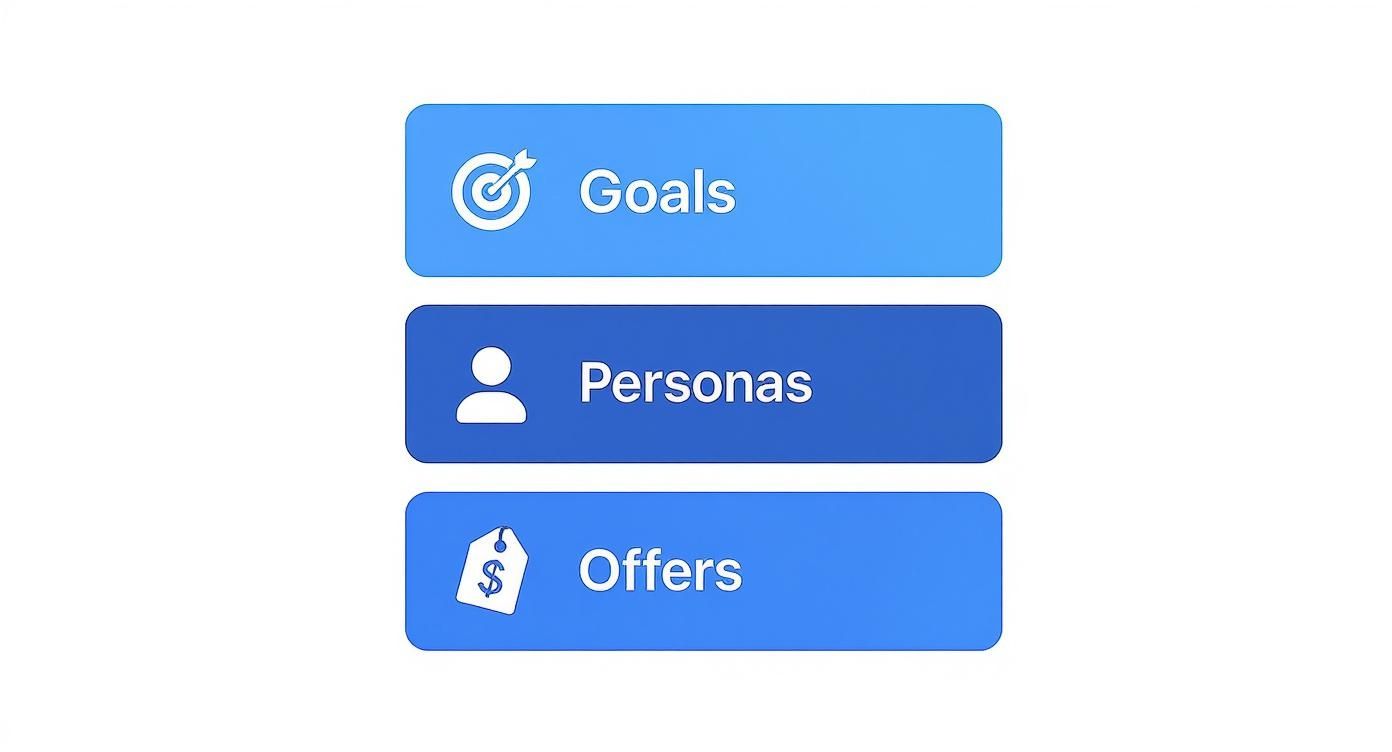
Nailing down your goals, personas, and offers before you touch the targeting settings is non-negotiable. It keeps you from just guessing and throwing money away.
Hyper-Local Geographic Targeting
First things first: geography. This is the bedrock of any local business campaign, and you don't want to waste a single cent showing your Invisalign ads to someone who lives an hour's drive away.
Facebook lets you draw a virtual circle around your clinic. For most practices in a city or busy suburb, a 5 to 10-mile radius is the sweet spot. It’s tight enough to capture people who genuinely see you as their local dentist.
A family practice in a dense area might stick to a sharp 5-mile radius. On the other hand, a specialized cosmetic or implant center might stretch that to 15 or 20 miles to pull from smaller surrounding towns. Just match the radius to how far people in your area are realistically willing to travel.
Layering Demographics and Interests
Once your location is set, you start refining. This is where you get specific and start layering on different criteria to zero in on the exact patient you want.
Let’s talk real-world examples:
- Pediatric Dentistry: Start with your local radius, then add the demographic for "Parents with young children (ages 6-8)." To get even sharper, you could add interests like "Parenting blogs" or "Local family activities" to find the most engaged parents.
- Cosmetic Services: After setting your location, you can filter for higher household income levels. Then, layer on interests like "Luxury goods," "Wellness," or people who have shown interest in "Cosmetic procedures" to find a high-intent audience.
- New Movers: This one is pure gold. You can target people based on behaviors, and Facebook can identify users who have recently moved into your area. These people are actively looking for all new local services—including a dentist. They are some of the lowest-hanging fruit you can find.
Targeting isn't about excluding people; it's about being smart with your budget. You’re telling Facebook to spend your money on the groups most likely to need, want, and afford the specific services you’re promoting.
To help you visualize this, here’s a quick breakdown of how you might target a few high-value dental services.
Dental Service Audience Targeting Examples
| Dental Service | Primary Age Group | Key Interests & Behaviors | Geographic Targeting |
|---|---|---|---|
| Dental Implants | 45-65+ | High Household Income, Dentures, Golf, AARP, Bridge (dentistry) | 10-20 mile radius |
| Invisalign | 25-45 | Weddings, Teeth Whitening, Engaged, Cosmetics, Fitness & Wellness | 5-15 mile radius |
| Family Checkups | 30-50 | Parents with Pre-Teens (9-12), Local Schools, Family Activities | 3-7 mile radius |
| Emergency Dentistry | 25-55 | (Broad – No interests needed) | Tight 3-5 mile radius |
As you can see, each service has a unique ideal patient, and your targeting should reflect that.
Custom and Lookalike Audiences: The Ultimate Targeting Tools
Interest and demographic targeting is great, but the most profitable audiences are always the ones you build from your own data. This is where top-performing practices separate themselves from the pack.
A Custom Audience is a list of people who already know you. You can create one by securely uploading a list of your existing patients' email addresses or phone numbers. Facebook takes that info and matches it to user profiles on its platform.
Why is this so valuable?
- Re-engagement: You can run exclusive offers or announce new tech directly to your current patients. It’s perfect for boosting loyalty and treatment plan acceptance.
- Exclusions: When you're running a "New Patient Special," you can exclude your current patient list. This is huge—it guarantees your ad spend is only going toward attracting new faces.
Now, from that Custom Audience, you can create a Lookalike Audience. This is where Facebook’s algorithm flexes its muscles. It analyzes the common traits of your best patients—their demographics, interests, and online behaviors—and then builds a brand new audience of people who look just like them.
This changes the game. Instead of guessing who your ideal new patient is, you’re literally telling Facebook, "Go find me more people just like my happiest, highest-value patients." As you can imagine, these audiences almost always deliver the best return on your investment.
For a deeper dive into all the available options, check out our complete guide on advanced Facebook ads targeting options.
Creating Ads That Actually Convert
So you've dialed in your audience. Great. Now comes the real challenge: actually getting them to stop scrolling and pay attention.
An effective ad is so much more than a pretty picture. It's a carefully crafted message designed to stop the thumb, build instant trust, and get someone to take action right now. This is where your understanding of what makes patients tick meets your creative execution.
The average person scrolls through hundreds of feet of social media content every single day. You have less than 2 seconds to make an impression. Your ad needs to be visually arresting, emotionally resonant, and crystal clear about what you want them to do next.
Ditch Stock Photos for Authentic Visuals
Let’s be blunt: the single biggest mistake I see dental practices make is using generic, glossy stock photos of models with impossibly perfect teeth. Today’s social media users can spot inauthenticity a mile away. These images don't build trust—they create a barrier.
Instead, you need visuals that humanize your practice.
- Real Patient Photos: With their permission, of course. Feature before-and-after photos or smiling shots of actual patients. There is nothing more powerful than visual proof, especially for cosmetic services like veneers or whitening.
- Office Tours: A quick, 15-second video walking through your clean, modern, and welcoming office can do wonders to ease the anxiety many new patients feel. Show them it's not a scary place.
- Meet the Team: Photos and short video clips of your friendly staff—from the front desk to the hygienists—make your practice feel approachable and less clinical. People connect with people.
Video is king on platforms like Facebook. It’s dynamic and engaging. If you really want to capture attention and see results, it's worth learning how to create compelling video ads that truly connect with your local audience.
Choosing the Right Ad Format
Facebook gives you a bunch of ad formats, but a few are real workhorses for dental practices. Don't just stick to single images; test different formats to see what your audience responds to.
Carousel Ads
These are perfect for showcasing transformations. You can tell a mini-story in one ad.
- How to use it: For an Invisalign campaign, the first card can be the "before" photo, the second can be the "after," and the third can be a short video testimonial from that same smiling patient. It’s a powerful, self-contained narrative.
Video Ads
Nothing builds a connection faster than video.
- How to use it: Film a short, friendly clip of a dentist calmly explaining a common procedure. Or better yet, capture a patient sharing their positive experience. Always add captions—most people watch videos with the sound off.
Lead Form Ads
This is your secret weapon for frictionless conversions.
- How to use it: When you're promoting a "Free Whitening Consultation," a Lead Form Ad lets people submit their name, email, and phone number without ever leaving the Facebook app. This dead-simple process can dramatically increase your lead volume because you're removing all the friction.
Writing Copy That Connects
Your ad copy needs to speak directly to your patient persona's real-world problems, fears, and goals. Ditch the clinical jargon. Focus entirely on the benefits from their point of view.
A simple framework that always works is Problem-Agitate-Solution (PAS).
- Problem: Start with their pain point. "Tired of hiding your smile in photos?"
- Agitate: Dig into the emotional impact of that problem. "Feeling self-conscious shouldn't hold you back from enjoying life's best moments."
- Solution: Present your service as the clear and easy answer. "Our custom veneers can give you a natural-looking smile you'll love to show off. Book your free, no-pressure consultation today."
Pro Tip: Always write your ad copy as if you're talking to one person. Go back to "Cosmetic Caroline" from our persona exercise. What would you say to her in the office to ease her concerns and get her excited about what's possible? Write that.
Navigating Healthcare Advertising Compliance
Finally, you have to play by Facebook's rules for healthcare advertising. Getting your ads rejected is frustrating and can kill your campaign's momentum before it even starts.
Here are the big ones to watch out for:
- Avoid "Before and After" on the Body: While incredibly effective, showing dramatic "before and after" images in a single frame can sometimes get flagged for focusing on negative self-perception. Spreading them across a carousel is often a safer bet.
- Don't Make Unrealistic Claims: Steer clear of phrases like "Cure gum disease" or "A guaranteed perfect smile." Stick to realistic, benefit-focused language that you can stand behind.
- Protect Patient Privacy: This should be obvious, but never, ever use a patient's image or story without their explicit, written consent.
By focusing on authentic visuals, benefit-driven copy, and a clear call-to-action, you’ll create ads that don't just grab attention—they build the trust needed to turn a casual scroller into your next scheduled patient.
Managing Your Budget and Measuring Results
Launching a campaign is just the beginning. The real magic—and the real growth—happens when you get comfortable with the numbers. This isn't just about spending money; it’s about making a smart, calculated investment in your practice's future. It's how you turn ad spend into a predictable pipeline of new patients.
So, what's a realistic starting point? You don't need a massive budget to see what works, but you do need enough to give Facebook's algorithm some data to chew on. For most single-location dental practices, a budget between $500 to $1,500 per month is a solid place to start. This gives you enough runway to test different ads and audiences without breaking the bank.
The goal isn't just to spend, but to spend wisely. The cost per click (CPC) for dental ads on Facebook can vary, but for conversion-focused campaigns, you'll often see a CPC between $1 and $2. If you're just aiming for website traffic, it's typically cheaper, around $0.50 to $1 per click. Yes, dental clicks come at a premium, but the quality of leads they generate often justifies the cost, leading directly to patient growth. For more stats, check out these insights on dental ad costs from goadfuel.com.
Key Metrics That Actually Matter
Forget about likes and shares. Those are vanity metrics that feel good but don't put new patients in your chairs. For a dental practice, only a few Key Performance Indicators (KPIs) truly move the needle.
- Cost Per Lead (CPL): This is your north star. It's the exact amount you're paying for each person who raises their hand and fills out your form. A good CPL can vary, but shooting for $25 – $75 per qualified lead is a great benchmark to aim for.
- Return on Ad Spend (ROAS): This is the ultimate bottom line. It measures the total revenue you generate for every dollar you spend on ads. If you spend $1,000 and bring in $5,000 in new patient value, your ROAS is 5x.
- Appointment Booked Rate: This metric bridges the gap between marketing and operations. What percentage of your hard-earned leads actually schedule an appointment? This tells you how well your front desk is converting those opportunities.
The secret to successful facebook advertising for dentists is shifting your focus from campaign activity to business outcomes. A low CPL is great, but a high ROAS is what truly grows your practice.
To truly understand which ads are driving results, you need to track everything. The table below breaks down the most critical metrics, what they mean for your practice, and what a good benchmark looks like in the dental industry.
Key Facebook Ad Metrics for Dentists
| Metric (KPI) | What It Measures | Good Benchmark for Dental |
|---|---|---|
| Cost Per Lead (CPL) | The average cost to acquire a single new lead (e.g., someone who filled out your form). | $25 – $75 per qualified lead |
| Cost Per Mille (CPM) | The cost to show your ad to 1,000 people. This reflects audience competition. | $10 – $30 |
| Click-Through Rate (CTR) | The percentage of people who saw your ad and clicked on it. Measures ad engagement. | 1% – 3% or higher |
| Conversion Rate | The percentage of landing page visitors who take your desired action (e.g., submit a form). | 10% – 20% |
| Return on Ad Spend (ROAS) | The total revenue generated for every dollar spent on ads. The ultimate profitability metric. | 3x – 10x+ |
Keeping a close eye on these numbers is non-negotiable. They tell you the story of your campaign—what's working, what's not, and where you need to make adjustments.
The Non-Negotiable Meta Pixel
You simply cannot measure your results effectively without the Meta Pixel. Think of it as your campaign's eyes and ears. This tiny piece of code, installed on your website and landing pages, tracks what people do after they click your ad.
Without it, you’re flying completely blind. The Pixel is what allows you to see which ads are actually driving people to your "Book an Appointment" page and which ones are just wasting your money. It’s the technical foundation for tracking conversions, optimizing your campaigns, and building powerful retargeting audiences. For a detailed walkthrough, you can learn more about setting up Facebook ad tracking in our guide.
A Simple Approach to A/B Testing
Never assume you know what will work best. A/B testing, or split testing, is your secret weapon for continuous improvement. It’s the simple process of running two slightly different versions of an ad to see which one performs better.
The key is to start with simple, high-impact tests. Don't try to change five things at once.
- Test Your Visuals: Run the exact same ad copy but with two different images. Maybe it's a photo of your smiling team versus a short video tour of your modern office.
- Test Your Headline: Use the same winning image but try two different headlines. You could test a benefit-focused one ("Get the Confident Smile You Deserve") against a direct offer ("$99 New Patient Special").
Let each test run for at least 3-5 days, or until each ad variation has reached at least 1,000 people. Then, dive into your Ads Manager. Whichever ad has the lower Cost Per Lead is your winner. Pause the loser, and turn the winner into your new "control" ad. This simple, iterative process is how you consistently lower your patient acquisition costs and squeeze every last drop of value out of your budget.
Turning Ad Clicks into Patients in Chairs
Getting someone to click your ad and fill out a form is a great first step, but let's be honest—it's only half the battle. The real work begins now.
That click doesn't mean anything until that person is actually booked in your schedule. The single biggest factor that determines whether a lead becomes a patient? Speed.
A lead's interest has an incredibly short shelf life. Research shows that contacting a new lead within the first five minutes can boost your odds of actually connecting with them by over 100%. If you wait even an hour, those chances plummet.
Your Front Desk Follow-Up Playbook
Your front desk team needs a dead-simple, repeatable system they can execute without even thinking. The moment a new lead notification hits, the clock is ticking.
- First, an immediate call. The absolute first move should always be a phone call. I tell my clients to aim for under two minutes from the time the lead comes in.
- Next, an instant text. If they don't pick up, don't just hang up and hope. Immediately fire off a friendly, personalized text. Something simple works best: "Hi [Name], this is [Staff Name] from [Practice Name]. We just got your request for our new patient special. Is now a good time for a quick call?"
- Then, a follow-up email. A few hours later, if you still haven't connected, send a follow-up email. It should restate the offer and give them another easy way to book, like a link to your online scheduler.
You have to be persistent. It's rare to connect on the first try. Plan out a sequence of calls, texts, and emails that spans a few days. Don't give up until you get a firm "yes" or "no."
The goal isn't to be annoying; it's to be helpful and available. You're catching them right at their peak moment of interest. A quick, professional response shows them your practice is on the ball and truly values their time.
Automate to Eliminate Slip-Ups
Manually checking Facebook for new leads and downloading CSV files is a recipe for disaster. Leads fall through the cracks, response times lag, and you end up wasting ad spend.
This is where simple automation becomes your secret weapon.
Tools like LeadSavvy Pro are designed for this exact problem. It can instantly sync new leads from your Facebook Lead Ads directly into a Google Sheet or your practice management software.
This simple connection triggers immediate notifications for your team, kicking off your follow-up sequence the second the lead comes in. No delays, no excuses. It guarantees no lead ever gets lost in the shuffle.
This automated follow-up process perfectly complements what a user sees on your ad's destination. For a deeper dive on that, check out our guide on how to create a landing page that actually converts clicks.
By building that seamless bridge from the ad click to your front desk's first call, you’ll see your appointment booking rate climb dramatically.
Common Questions About Dental Facebook Ads
Even with the best game plan, it's totally normal to have questions when you're getting started. Let's dig into some of the most common ones we hear from practice owners diving into Facebook ads for the first time.
One of the first things dentists ask is about the budget. Is this going to cost a fortune? The good news is, you don’t need a massive war chest to compete. You can get the ball rolling and start seeing real results with as little as $20-$50 per day. That’s enough to gather data, test your ad creative, and generate leads without breaking the bank.
How Long Until I See Results?
This is the big one. While you can absolutely start getting leads in the first week, it's smart to set realistic expectations. It usually takes a good 30-60 days to really dial in a campaign. That’s the time you need to test different audiences, figure out which ad creative works best, and truly understand your cost per lead.
That first month is all about learning. Don't sweat it if the first week isn't a blockbuster. Pay attention to the data, make small tweaks, and trust the process.
What If My Ads Get Rejected?
Ad rejections are a pain, but they happen to everyone and are usually an easy fix. For dental practices, rejections almost always come down to a few things:
- Making specific health claims: Steer clear of phrases like "guaranteed results" or "cure your gum disease." Facebook's policies are strict on this.
- Using overly dramatic before-and-after photos: A single, stark comparison image can get flagged. A better approach is often spreading the before and after shots across a carousel ad.
- Targeting sensitive health attributes: Instead of trying to target users based on a specific health condition, focus on broader interests and behaviors.
If an ad gets rejected, just read Facebook’s feedback carefully, make the edits they suggest, and resubmit. It’s usually a quick fix.
Ready to stop worrying about missed leads? LeadSavvy Pro instantly syncs your Facebook leads to a Google Sheet or CRM, so your team can follow up in minutes, not hours. Start converting more patients today at https://leadsavvy.pro.