Mastering the Automotive Sales Lead Pipeline
Think of an automotive sales lead as a digital hand-raise. It's that first signal from a potential car buyer that they’re ready to talk, moving from a silent browser to an active prospect. In a world where 95% of buyers use digital tools to research their next car, these hand-raises are the lifeblood of any modern dealership.
So, What Exactly Is an Automotive Sales Lead?
At its core, an automotive sales lead is a simple combination: contact information plus a clear sign of interest in buying a car. This isn't just a name pulled from a hat. It's a real person who took a specific action, turning themselves from an anonymous website visitor into a genuine opportunity for your sales team.
It’s the difference between cold-calling random numbers and getting a ping that someone just requested a test drive for that new Ford F-150 on your site. One is a shot in the dark; the other is a warm introduction.
The Game Has Changed: From the Lot to the Laptop
The way people buy cars has been completely flipped on its head. Gone are the days of customers spending entire weekends bouncing from one dealership to another, walking the lot to see what’s available. Today, all that initial legwork happens online.
The modern car buyer spends roughly 14 hours researching online before they ever step foot in a showroom. This isn't a trend; it's the new reality.
Your website, your social media pages, and third-party listings like Autotrader have become your new digital storefront. A sales lead is the online equivalent of a customer walking up to you on the lot and saying, "Tell me more about this one."
Why This Is a Big Deal for Your Dealership
Getting a handle on generating and managing these leads is critical. It’s what keeps your sales team busy with real buyers, not just chasing ghosts. A steady flow of quality leads does a few key things for your bottom line:
- Makes Your Team More Efficient: Salespeople spend their time talking to people who actually want to buy a car, not trying to find them.
- Creates Predictable Sales: When you know how many leads are coming in, you can forecast sales and manage inventory with much more confidence.
- Boosts Your Marketing ROI: You stop wasting money on ads that don't work and double down on the channels that deliver qualified, ready-to-talk buyers.
Plain and simple, mastering the art of the automotive sales lead is what separates the dealerships that are thriving from those just trying to survive.
Separating Hot Prospects from Tire Kickers
Not all leads are created equal. Getting a flood of inquiries feels good, but if you want an efficient sales floor, you’ve got to separate the serious buyers from the casual browsers. This is the art of lead qualification, a simple process that keeps your team from wasting hours on dead ends so they can focus on people who are actually ready to buy.
Think of it like a chef sorting ingredients before cooking. Some are prepped and ready for the main course (hot leads), while others need a little more time to ripen (warm leads). Some might not be right for the dish at all (cold leads). Your team’s ability to quickly categorize each automotive sales lead sets the pace for the entire sales process. Skip this step, and you’re just setting yourself up for burnout and missed deals.
This simple decision tree helps visualize that first crucial qualification step.
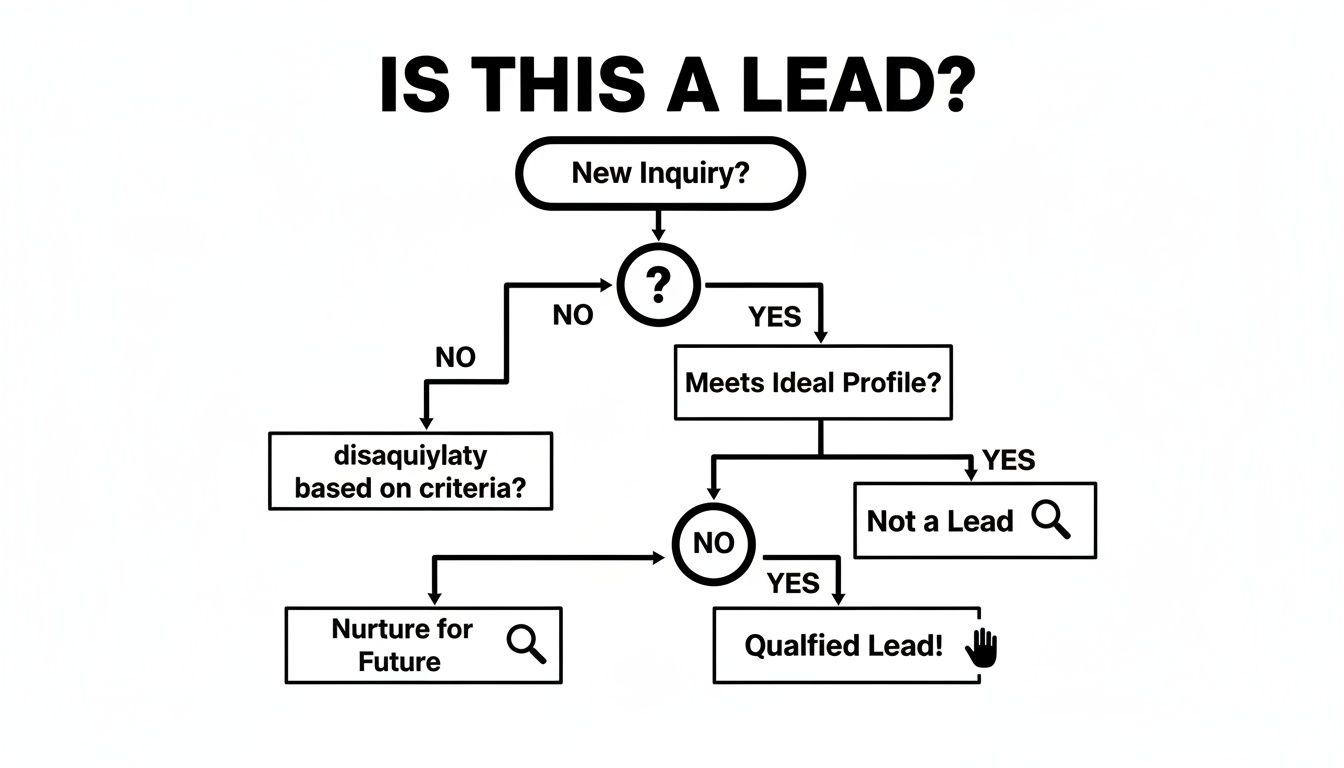
As you can see, specific actions like a direct inquiry immediately signal much stronger intent than someone just browsing your website.
Identifying High-Intent Signals
A hot lead practically waves a flag to get your attention. They give off clear, high-intent signals that show they’ve moved past simple curiosity and are actively trying to make a purchase. Your sales team needs to be trained to spot these green lights instantly.
These are the kinds of actions you can’t ignore:
- Submitting a credit application: This is one of the strongest buying signals you can get. The customer isn’t just looking; they're trying to line up the money for a car.
- Requesting a trade-in appraisal: When someone wants to know what their current car is worth, they're usually figuring out the budget for their next one.
- Inquiring about a specific VIN: If a lead asks about a particular vehicle on your lot, it means they’ve done their homework and have their eye on a specific prize.
- Placing a direct phone call: It takes more effort to pick up the phone than to fill out a form. A phone call almost always means a higher sense of urgency.
Phone calls from automotive leads convert 30% faster than web leads. Callers also show a 28% higher retention rate, proving their long-term value for dealerships aiming to thrive as global light vehicle sales approach 89.6 million units. To see why 84% of marketers report higher conversion rates from phone engagement, you need to understand the impact of these automotive marketing statistics.
Understanding Lead Scoring Basics
To systemize this process, understanding what lead scoring is is a game-changer. It’s a simple method of assigning points to leads based on who they are and what they do.
For example, a lead who opens every email, clicks on your financing page, and views a specific Vehicle Detail Page (VDP) multiple times would rack up a high score. On the other hand, someone who just signed up for your newsletter gets a much lower score. This simple system gives your team a clear, data-driven way to prioritize who they call first.
A quick reference guide like this can help your team get started.
Lead Quality Scorecard
| Indicator | Hot Lead (High Priority) | Warm Lead (Medium Priority) | Cold Lead (Low Priority) |
|---|---|---|---|
| Action Taken | Submitted credit app, trade-in request, called dealership. | Viewed VDPs, saved a car, asked a general question via chat. | Signed up for newsletter, downloaded a brochure. |
| Urgency | "I need a car this week." | "I'm looking to buy in the next 1-3 months." | "Just browsing right now." |
| Specificity | Inquired about a specific VIN or stock number. | Asked about a model (e.g., "any new Explorers?"). | Asked about general inventory or sales events. |
| Follow-Up | Call immediately. This lead is ready to engage now. | Nurture with targeted emails and a follow-up call within 24 hours. | Add to a long-term nurture campaign. |
This scorecard turns lead management from a guessing game into a repeatable science.
For a deeper dive, check out our complete guide on how to qualify sales leads. It provides a framework to help your team focus their energy where it actually counts.
Where to Find High-Quality Automotive Leads
An empty sales floor is every dealer's worst nightmare. The engine that keeps that from happening is a steady stream of good, qualified leads. But where do you find them?
Today, the hunt for your next buyer happens almost entirely online. It's not about one magic bullet; it's about building a smart strategy that captures a modern car buyer's attention right where they're spending their time.
Your Dealership Website Is Your Best Lead Source
Let's start at home base: your dealership's website. Think of it as your digital showroom. It’s the single most valuable piece of online real estate you control, and it's where your best leads will come from.
When someone lands on your site to browse inventory or fill out a credit app, they're not just kicking tires—they're raising their hand and showing serious intent. These are the hottest leads you'll ever get because they came directly to you. Your job is to make it easy for them with clear calls-to-action (CTAs), simple forms, and a site that works perfectly on a phone.
If you're looking for more ways to turn your website and other digital channels into lead-generating powerhouses, check out this modern dealership guide to generate leads for car sales.
Third-Party Marketplaces and Paid Advertising
While your website is your foundation, you can't ignore the massive audiences on third-party marketplaces. Platforms like Autotrader, Cars.com, and CarGurus are the digital equivalent of a massive auto mall where millions of buyers go to shop around. Listing your inventory there is non-negotiable—it puts your cars right in front of an active, in-market crowd.
But that visibility isn't free. You're paying listing fees and you're up against every other dealer in your area. This competition is driving up costs across the board. In fact, the average cost per lead in the auto industry is expected to hit $283 in 2025. With 89.6 million light vehicle sales projected globally, it’s clear that capturing a buyer's attention is getting more expensive, making every lead more valuable than ever.
Using Social Media for Targeted Lead Generation
This is where things get interesting. Social media, especially Facebook, has become a game-changer for finding high-quality auto leads. Instead of waiting for someone to search for you, social media lets you go find them. You can run hyper-targeted ads based on location, what they're interested in, and even if they've recently visited a competitor's site.
The killer tool in your arsenal here is Facebook Lead Forms.
Facebook Lead Forms are designed to make it ridiculously easy for someone to give you their information. When a user clicks your ad for a new truck, a form instantly pops up inside the Facebook app, already pre-filled with their contact info. They can hit "submit" in two taps without ever leaving their feed.
This is a huge deal. You're removing all the friction. Instead of asking a potential customer to leave the app, visit your website, and wrestle with a clunky form on their phone, you meet them right where they are. It’s perfect for promoting specific inventory, flash sales, or test drive events, and it's one of the most cost-effective ways to fill your sales pipeline with people who are ready to talk.
The Art of the Five-Minute Follow-Up
Getting a new automotive sales lead is a great first step, but the real race begins the second they hit "submit." Modern car buyers live in a world of instant gratification. If you hesitate, you're not just making them wait—you're practically rolling out the red carpet for your competitor down the street.

This is why we call the first five minutes the "golden window." Think about it: in that moment, the customer's interest is white-hot. They're still on your website, thinking about that specific car, with their phone in their hand. Every minute you delay, that heat fades and their attention drifts.
Why Speed Is Your Ultimate Advantage
In the lead follow-up game, speed isn't just a nice-to-have; it's your single biggest competitive edge. When a shopper sends an inquiry, they're probably sending it to three other dealers at the same time. The first one to respond instantly frames the conversation and sets the standard.
It's a proven fact: contacting a new lead within the first five minutes makes you 100 times more likely to actually connect with them compared to waiting just 30 minutes. Let an hour go by, and your odds of a successful conversation plummet by a factor of seven.
This isn't just about being first. It's about connecting while their intent is at its peak. A fast response screams professionalism, shows you value their time, and starts building trust before they even think about visiting the lot.
Crafting a Multi-Touch Follow-Up Sequence
A winning five-minute response isn't just one phone call. It’s a coordinated, multi-channel blitz designed to meet the customer where they are. Your goal is to make contact using a smart mix of methods, not just hoping they pick up the phone.
A powerful initial sequence looks like this:
- Immediate Automated Text: The very first touchpoint, within seconds, should be an automated SMS. Something simple works best: "Hi [Name], this is [Salesperson] from [Dealership]. We just got your inquiry on the [Vehicle Model]. Got a minute for a quick call?" This confirms you're on it and preps them for your call.
- The First Phone Call: Two to three minutes after the text, make the call. If they don't answer, don't sweat it. Leave a quick, professional voicemail that shows a real person is on the case.
- A Personalized Email: Right after the call, fire off a personalized email. Make sure it references the exact vehicle they were looking at and includes a direct link back to its VDP (Vehicle Detail Page).
This multi-touch approach massively increases your chances of getting a response. It lets the lead reply on whatever channel they prefer—a quick text, a call back, or an email.
Moving Beyond Generic Scripts
Speed gets their attention, but personalization builds the relationship. Once you get them on the line, ditch the generic script that makes them feel like another number on a spreadsheet. The quickest way to build rapport is to reference where they came from.
For instance, you could open with:
- "Hey, I saw you were just on our website looking at that silver F-150…"
- "Thanks for responding to our Facebook ad about the end-of-month SUV event…"
This tiny detail shows you're paying attention. It validates their interest and turns a cold outreach into a warm, relevant conversation. This is how you build a repeatable, lightning-fast system that ensures no lead ever goes cold.
Putting Your Facebook Lead Capture on Autopilot
If your dealership is running Facebook Lead Form campaigns, you're already playing in the right sandbox. You’re meeting customers where they are and making it dead simple for them to raise their hand and say, "I'm interested." But there's a huge, sales-killing bottleneck in this process: the manual download.
Seriously. Having a team member stop what they're doing to manually pull a CSV file of new leads from Facebook is a throwback to a different era. It creates a massive delay between the moment an automotive sales lead shows interest and the second your team actually reaches out. In that gap, a competitor who responds instantly can—and will—swoop in and book the test drive you should have had.
Bridge the Gap Between a Facebook Click and a Sales Call
To win, you have to close that gap. Completely. The only way to do that is with automation, creating a direct, real-time bridge between a new lead on Facebook and the salesperson who needs to be on the phone right now. This is exactly where a tool like LeadSavvy Pro becomes non-negotiable for a modern dealership.
Instead of leads getting stale in Facebook's backend, LeadSavvy Pro acts like a high-speed conveyor belt. The second a lead comes in, it's automatically grabbed and sent exactly where it needs to go—whether that’s a shared Google Sheet for your BDC team or straight into your dealership’s CRM. This simple connection flips your lead management from a reactive chore into a proactive, automated powerhouse.
Setting Up Your Automated Lead Workflow
Getting this system fired up is way easier than you might think. You don't need a team of developers or a degree in computer science. The whole process is designed to be plug-and-play, letting you connect your accounts and start getting leads in real-time in just a few minutes.
Here’s a quick look at how it works:
- Connect Your Facebook Account: First, you securely link your dealership’s Facebook Page to LeadSavvy Pro. This just gives it permission to see the lead forms from your ad campaigns.
- Choose Your Lead Destination: Next, you tell LeadSavvy where to send the leads. A Google Sheet is perfect for teams that need a central, easy-to-access log. You can also integrate directly with a supported CRM.
- Map Your Form Fields: This sounds technical, but it’s just matching things up. You tell the system that the "Name" field on your form goes into the "Name" column in your sheet. Simple.
- Activate Instant Notifications: Finally, you can set up email alerts for key people, like your sales manager or BDC coordinator, so they know the instant a hot lead lands.
By automating this process, you’re not just saving time. You're fundamentally changing your team's ability to engage with potential buyers when their interest is at its absolute peak.
Think about it. A lead from your new "F-150 Test Drive Event" ad pops into your top truck salesperson's inbox seconds after the person hits "submit." That salesperson can kick off their five-minute follow-up sequence immediately, while the lead is probably still scrolling through their phone.
This is how you close the speed gap and turn more of those high-intent leads into showroom appointments. To see exactly how to set this up, check out our complete guide on how to automate Facebook leads. This level of responsiveness is what separates a good dealership from a great one.
Measuring What Matters for Lead Success
Getting a steady flow of leads is just the start. If you aren't measuring your results, you're flying blind—spending money and hoping something sticks, without a clue what's working and what's a waste of time. It’s simple: you can't improve what you don't measure.
This is where Key Performance Indicators (KPIs) come in. Think of them as the dashboard on your sales engine. They give you the hard data you need to spot problems, make smart adjustments, and make sure every dollar spent on an automotive sales lead actually turns into revenue.
Key Metrics for Your Sales Dashboard
To get a real handle on the health of your lead pipeline, you need to zero in on a few core metrics. These numbers tell the story of your marketing efforts, your sales process, and how effective your team really is. They shift you from guessing games to data-backed decisions.
Here are the essential KPIs every dealership should have on their radar:
- Cost Per Lead (CPL): The most basic metric of all. It tells you exactly what you’re paying to get a single lead from a specific ad or source. A sky-high CPL on a campaign that isn’t converting is a massive red flag telling you to rethink your budget.
- Lead-to-Appointment Ratio: This KPI tracks the percentage of leads that turn into an actual appointment at the dealership. It’s a direct reflection of how good your follow-up is and whether the leads were high-quality to begin with.
- Appointment Show Rate: It’s great to book an appointment, but it means nothing if the person is a no-show. This metric tracks how many of those scheduled appointments actually walk through your doors.
- Closing Rate: This is the one that really hits the bottom line. It calculates the percentage of leads that end up as a final vehicle sale, giving you a crystal-clear picture of your entire sales funnel's efficiency.
Tracking these numbers isn't just about getting a report card—it's about diagnostics. A low Lead-to-Appointment Ratio, for example, might not mean you have bad leads. It could just as easily point to a weak BDC script or a slow response time from your team.
From Data to Decisions
Once you start consistently tracking these KPIs, you'll begin to see patterns emerge. Is your CPL from Facebook ads outperforming your third-party marketplace leads? Are Saturday leads twice as likely to book an appointment as Tuesday leads? This is the kind of insight that completely transforms your strategy.
When you have a centralized, automated system for capturing leads, tracking these numbers becomes effortless. With all your lead data flowing into one place, you can instantly see which campaigns are home runs and which are just burning through your budget. For a deeper dive into the numbers that fuel growth, check out our guide on the most important lead generation KPIs in our detailed guide.
This data-driven approach empowers you to make sharp, calculated moves. You can put more money behind your best-performing ads, give targeted training to your sales team, and fine-tune every step of the process. In the end, measuring what matters is how you turn a decent lead generation strategy into a great one that consistently boosts your bottom line.
Frequently Asked Questions
When you're trying to turn online interest into a handshake on the showroom floor, questions are going to pop up. Getting straight answers is the only way to build a process that actually works. Here are a few of the most common ones we hear.
How Quickly Should I Follow Up with a Lead?
Instantly. Or as close to it as humanly possible. We're talking within five minutes.
The data on this is crystal clear: the longer you wait, the colder the lead gets. After just one hour, your chances of even making contact with that person drop off a cliff. Even a simple, automated "Hey, we got your inquiry!" text message buys you time and puts you lightyears ahead of the competition.
A landmark study from the Harvard Business Review found that contacting a lead within the first hour makes you seven times more likely to have a meaningful conversation. Speed isn't just a nice-to-have; it's your single biggest advantage.
Think about it from the customer's perspective. They're online, they're interested right now. An instant response shows you're on the ball and respects their time, catching them while their interest is red-hot.
What Is the Best Way to Handle Facebook Leads?
Automate everything. Seriously. The old way of manually downloading a CSV file from Facebook every few hours is a recipe for disaster. It’s slow, clunky, and guarantees you’ll lose sales to faster dealerships.
The only effective way is to use a tool that pipes those leads directly into your CRM or even a shared spreadsheet the second they come in. No delays, no excuses.
This kind of automation means your sales team gets a real-time alert. They can follow up immediately while the person is still thinking about that specific car. This is proven to skyrocket appointment-setting rates because you're striking while the iron is hot, not hours later when they've already forgotten which ad they clicked.
What Is the Main Goal of the First Lead Conversation?
Your goal is simple: get them in the door. You are not trying to sell the car over the phone. The first call is all about building a little rapport and booking a solid appointment.
Focus your initial chat on three things:
- Confirm their interest: "I see you were looking at the F-150 online. Great choice! Is that the model you're most interested in?"
- Gauge their timeline: "Are you thinking of making a move in the next few days, or are you just starting your research?"
- Ask open-ended questions: Find out what really matters to them. Is it safety? Fuel economy? Towing capacity?
Everything you do should be aimed at locking in a specific day and time for them to come in for a test drive. The real selling happens on the lot, not on that first call.
Stop letting your best leads go cold. LeadSavvy Pro instantly grabs your Facebook leads and sends them straight to your sales team in seconds. Respond faster, set more appointments, and close more deals. Start your free trial today.