A Modern Playbook for Auto Dealership Digital Marketing
Auto dealership digital marketing isn't just about having a website and a Facebook page anymore. It's the strategic use of all your online channels—your site, social media, search engines, and email—to attract, engage, and convert car buyers.
Think of it as transforming your online presence into a 24/7 digital showroom. It's an engine that generates qualified leads and drives sales long before a customer ever steps onto your lot.
Building Your Digital Showroom
The modern car-buying journey has completely flipped. It no longer starts with a walk around the dealership; it begins with a search query on a phone or laptop.
Today’s customers do their homework online. They research models, compare financing, and check out dealerships, often making their decision before they even think about a test drive. Your success hinges on meeting them right where they are, right when they're looking.
This means your website needs to be more than just a digital brochure. A high-performing digital presence acts as your most effective salesperson—one that never sleeps. It's an integrated machine built to capture leads, build trust, and deliver predictable sales growth.
The Core Pillars of a Digital Showroom
A winning strategy isn’t about just checking boxes. It’s about connecting the dots between key activities to create a seamless customer acquisition machine. These pillars work together to turn online interest into showroom appointments.
- Search Engine Optimization (SEO): This is how local buyers find your dealership—not your competitor's—when they search for the vehicles you sell or the services you offer.
- Targeted Paid Ads: Paid advertising puts your inventory directly in front of in-market shoppers on platforms like Google and Facebook where they're already spending their time.
- Lead Capture and Automation: This is the magic. It’s about using smart tools to instantly grab a lead's contact info and kick off the follow-up process without any manual work.
This flowchart shows how these three core pillars—SEO, paid ads, and automation—don't just coexist; they feed into each other to form a powerful, non-stop marketing engine.
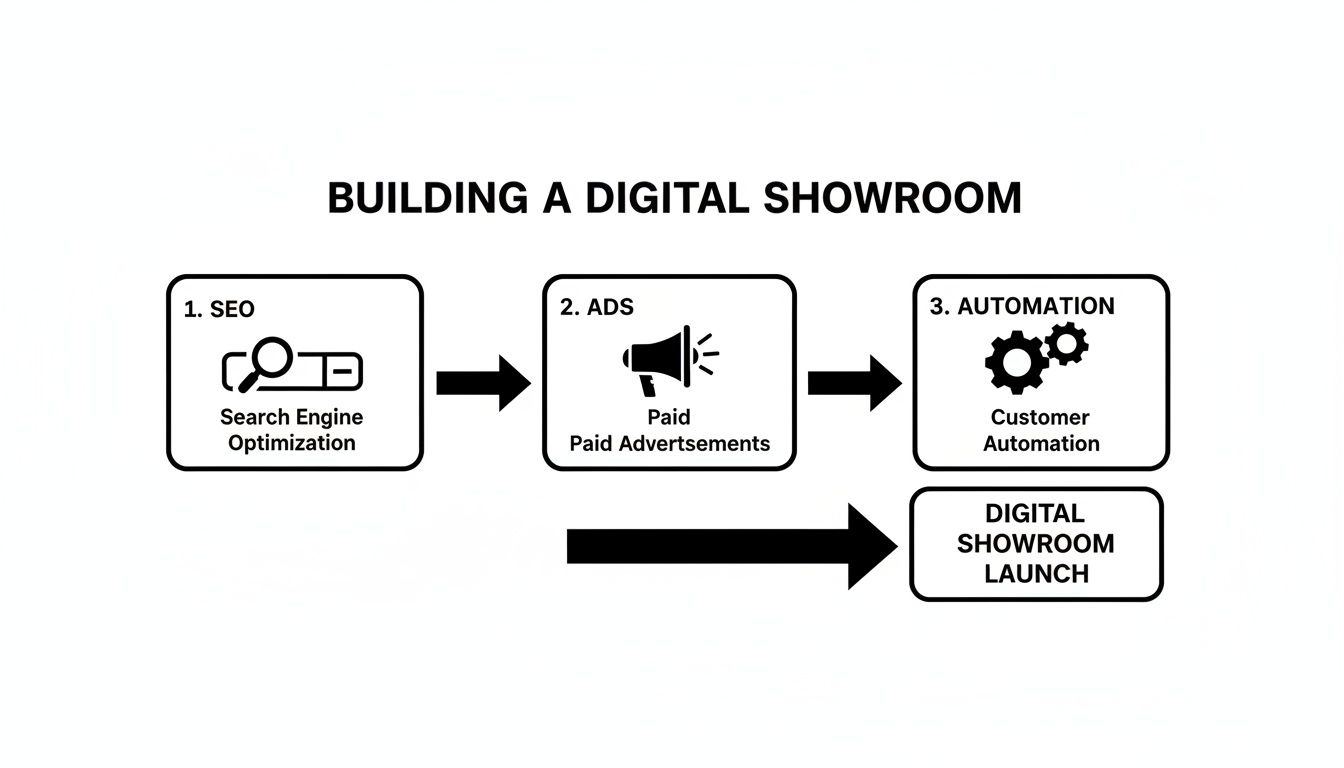
The key takeaway here is that these aren't separate tasks. They're part of a continuous flow designed to attract, engage, and convert customers around the clock.
Your goal isn't just to be online. It's to create an online experience that's as compelling and efficient as your physical showroom. Your website and digital channels should guide visitors smoothly from that first click to a scheduled appointment.
This all starts with a well-designed website at the center of it all. Your site has to be fast, mobile-friendly, and dead simple to navigate, with clear calls-to-action on every single page. If your site is falling short, it might be worth looking into specialized car dealership and automotive website design services that understand the industry's unique needs.
Ultimately, every piece of your marketing strategy, from an optimized vehicle detail page to an automated email response, is a part of building this digital showroom. If you're looking to improve how you capture leads on those pages, you might be interested in our guide on how to create a landing page that turns visitors into real opportunities.
Win Local Search with a High-Performance Website and SEO
Think of your dealership's website as your digital front door. It’s the central hub where all your online marketing efforts lead, turning casual browsers into scheduled appointments. For too many dealerships, though, it’s just a static online brochure—a massive missed opportunity. To actually compete and win, your site needs to be a lead-generation machine built for local search.
The stakes are incredibly high. Consider this: over 90% of vehicle shoppers kick off their buying journey on a search engine. They spend, on average, a full 13 hours researching online and browse about 4.2 different dealership websites before they even think about stepping onto a lot. If your website isn't optimized to grab and hold their attention, you’re basically invisible.
Building Your Technical SEO Foundation
Before you even think about fancy content or blog posts, your website has to be technically sound. Search engines like Google are obsessed with user experience, and if your site doesn't meet their standards, you'll get buried in the search results. These things are non-negotiable.
First up, your site absolutely must load fast. A slow website is a lead killer. A potential buyer will hit the back button and head to your competitor's site without a second thought. Use a tool like Google's PageSpeed Insights to see what’s slowing you down and get it fixed.
Next is a mobile-first design. The overwhelming majority of car searches start on a smartphone. Your website has to look and work perfectly on any screen size. Buttons need to be easy to tap, forms simple to fill out, and vehicle photos crystal clear on a small screen. No exceptions.
On-Page SEO Tactics That Drive Real Traffic
Once your technical house is in order, you can start focusing on the content that actually attracts local car buyers. This is all about answering the specific questions your customers are asking and showing them why your dealership is the best choice in town.
Start by creating hyper-local service pages. Don't just have a generic "Service Center" page. Build out dedicated pages for specific needs in specific locations. Think "Ford F-150 Oil Change in Downtown [Your City]" or "Honda Accord Brake Repair in [Neighborhood Name]." This approach captures high-intent searches from people who are ready to book an appointment right now.
Then, you need to beef up your Vehicle Detail Pages (VDPs). Go way beyond the standard spec sheet. Every VDP should have:
- High-quality photo galleries
- Video walkarounds
- Detailed descriptions highlighting unique features and benefits
Answer common questions right on the page. What's the real-world gas mileage? What are the standout safety features? Make it easy for them.
Your VDPs are your digital sales pitch. Treat every single one as a dedicated landing page designed to convince a shopper to take the next step—whether that's scheduling a test drive or getting pre-approved for financing.
Dominate the Local Map Pack
For any dealership, showing up in the Google "map pack"—those top three local business results with a map—is the holy grail. This prime digital real estate is controlled by your Google Business Profile (GBP).
Optimizing your GBP is one of the most powerful free marketing moves you can make. But it’s not a "set it and forget it" task. To dominate the map pack, you have to treat your profile like an active social media channel.
- Keep Info Current: Make sure your hours, address, and phone number are always 100% accurate.
- Upload High-Quality Photos: Regularly add new pictures of your showroom, service bays, staff, and fresh inventory.
- Use Google Posts: Share updates about new arrivals, service specials, and community events directly on your profile.
- Encourage and Respond to Reviews: A steady stream of positive reviews is a huge trust signal for both Google and potential customers.
To help you get started, we've put together a checklist of the foundational website and SEO elements every dealership needs to have in place.
Essential Website and SEO Checklist for Dealerships
| Element | Key Action | Why It Matters |
|---|---|---|
| Site Speed | Test with PageSpeed Insights and aim for a "Good" score. | A slow site frustrates users and hurts your search rankings. Every second counts. |
| Mobile-First Design | Ensure the site is fully responsive and easy to use on a smartphone. | Most car buyers start their research on mobile. A poor mobile experience loses customers instantly. |
| Hyper-Local Pages | Create specific pages for services/models in your city/neighborhoods. | Captures high-intent local search traffic from people ready to buy or book service. |
| Rich VDPs | Add video walkarounds, multiple high-res photos, and detailed descriptions. | Acts as your 24/7 digital salesperson, answering questions and building desire for a test drive. |
| Google Business Profile | Fully complete your profile and update it weekly with Posts and photos. | The key to ranking in the valuable Google Map Pack and attracting local foot traffic. |
| Customer Reviews | Actively request reviews and respond to every single one (good and bad). | Builds social proof and trust, which heavily influences both Google's algorithm and customer decisions. |
| Clear CTAs | Place obvious "Schedule Test Drive" or "Get Pre-Approved" buttons on every VDP. | Guides the user to the next step, turning a browser into a measurable lead. |
This isn't just a list of suggestions; it's the core of a winning digital strategy.
Given how localized auto sales are, it's critical to learn how to Boost Your Business With Local SEO. By combining a technically solid website with smart on-page content and a meticulously managed Google Business Profile, you create a powerful system that turns online searches into real showroom traffic.
Go Get In-Market Buyers with Targeted Paid Ads
SEO is your dealership's long-term growth engine, building a foundation for consistent organic traffic. But paid ads? That's the turbocharger.
Paid advertising lets you jump to the front of the line and put your best inventory directly in front of people actively looking to buy a car right now. A smart paid ad strategy on platforms like Google and Meta isn't just an option; it's a necessity for driving immediate, high-intent traffic.
Think of it as speed and precision. Instead of waiting for customers to find you, you're going directly to them, targeting users based on their recent searches, online behaviors, and interests. This is how you intercept motivated buyers at the exact moment they’re ready to make a decision.
Hyper-Targeting on Google Ads
When someone in your area searches "used Honda CR-V near me," you absolutely have to be the first result they see. Google Ads makes that happen, but winning here is about more than just bidding on keywords. The real advantage comes from using ad formats built specifically for dealerships.
Enter Google Vehicle Ads. This is a powerhouse format that displays your actual inventory—image, price, mileage, and all—directly in the search results. It works by connecting your live inventory feed to Google Merchant Center, which means your ads are always showing real-time, available stock to the most interested shoppers.
To get the biggest bang for your buck, you need to think hyperlocal. Forget targeting the whole state. Focus on specific zip codes or draw a tight radius around your dealership for high-intent keywords like "Toyota service center" or "trade in my car." This filters out the noise and puts your budget to work on customers who are most likely to actually walk through your doors.
Find Your Next Buyer on Meta
While Google is fantastic for capturing people who are already searching, Meta (Facebook and Instagram) lets you find potential buyers before they even hit the search bar. Using powerful behavioral and interest-based targeting, you can build audiences of people whose online activity screams, "I'm in the market for a new car!"
Meta's Automotive Inventory Ads (AIA) are a complete game-changer here. Just like Google's vehicle ads, they sync with your inventory feed to create dynamic, relevant ads. You can even retarget a user with an ad for the exact 2023 Ford Explorer they were just looking at on your website. That's how you stay top-of-mind.
Here's a pro tip: the key to winning on social media is creating content that stops the scroll. Slick, corporate-style ads get ignored. What works? Authenticity. A simple, well-lit video walkaround of a new arrival filmed on a smartphone often outperforms a high-budget commercial because it feels real and trustworthy.
This brings us to a critical point about your ad creative: video isn't optional anymore. It's essential. Over 75% of automotive shoppers say online video influences their buying decisions, and more than 60% visit a dealership after watching one. The industry knows it, too—ad spending is projected to hit a staggering $24.47 billion by 2026.
Make Lead Capture Effortless with Facebook Lead Forms
Okay, so you've grabbed their attention with a great ad. Now what? You have to make it ridiculously easy for them to give you their contact info. This is exactly where Facebook Lead Forms excel.
Instead of shipping users off to a landing page on your website (where they can get distracted and bounce), a Lead Form opens right inside the Facebook or Instagram app. Better yet, it pre-fills their name and email from their profile, reducing the friction to almost zero. All they have to do is hit "submit."
This one simple tool can massively boost your conversion rates and slash your cost per lead. If you're tired of manually downloading these leads, our guide on generating auto dealership leads shows you how to streamline the entire workflow.
By combining the intent-driven power of Google Ads with the sophisticated audience targeting of Meta, you build a paid media machine. It engages buyers at every stage of their journey, from their first curious browse to their final decision, driving a steady stream of qualified leads straight to your sales team.
Automate Your Lead Follow-Up for Faster Sales
Getting a lead from a sharp Facebook ad or a top-ranking Google search is a great start, but it's just that—a start. For auto dealerships, the real money is made or lost in the minutes that follow. The single most common—and costly—mistake I see dealerships make is treating lead retrieval as a manual chore.
Manually downloading a CSV file of leads once or twice a day might feel productive, but it's a sales killer. Every hour that passes between a prospect hitting "submit" and your salesperson reaching out cools their interest right off. That hot lead who was excited about your used Silverado? They've already moved on, browsing three other dealer websites.
Speed isn't just an advantage in this game; it's everything. The fix is to get the human delay out of the equation entirely by automating the whole process, from the initial click to the first sales touchpoint.
Ditch the Downloads and Sync Your Leads Instantly
The modern way to handle this is by connecting your ad platforms, like Facebook Lead Ads, directly to your dealership’s Customer Relationship Management (CRM) system. Instead of leads sitting in a digital waiting room, they're instantly pushed into your CRM the second they come in.
This creates an immediate, actionable trigger. The moment a new lead pops into the system, it can set off a series of automated alerts.
- Instant Email Notification: An email zips over to the on-duty salesperson or BDC team with all the lead's details—name, contact info, and the specific vehicle they asked about.
- Real-Time Text Alert: For an even faster jump, a text message can go straight to a salesperson's phone. This lets them act immediately, even if they're not glued to their desk.
This simple bit of automation flips your follow-up from a delayed, reactive task into a proactive, lightning-fast one. No lead is ever left hanging, and your team gets a shot at engaging prospects while their buying intent is at its absolute peak.
When a lead comes in, the clock starts ticking. An automated system that alerts your team in seconds gives you a massive leg up on dealerships still checking for new leads on a schedule. It’s the difference between a real conversation and a completely missed opportunity.
Implement Simple Nurturing Workflows
Beyond just pinging your team, automation lets you create a better customer experience right from the get-go. Setting up simple lead nurturing workflows can seriously improve engagement and set a positive, professional tone for the entire sales conversation. Honestly, this is a core part of effective lead management.
For example, the moment a lead syncs to your CRM, you can trigger an automated welcome message. It doesn't need to be fancy; a few simple, instant communications can work wonders.
Example Welcome Workflow:
- Immediate Confirmation Email: Send an automated email confirming you got their inquiry. Personalize it with their name and the vehicle they were looking at. This simple step assures them their request didn't just disappear into the ether.
- Follow-Up Text Message: A minute later, shoot them a text. Something like, "Hi [First Name], this is Mark from [Dealership Name]. Thanks for your interest in the [Vehicle Model]! A member of our team will be calling you from this number shortly to answer any questions."
This two-touch approach accomplishes several critical things at once. It confirms you received their info, sets clear expectations for what's next, and primes the customer to actually answer their phone when your salesperson calls. You’ve immediately built trust and professionalism without a single person lifting a finger.
Building these automated bridges is a cornerstone of modern dealership marketing. It ensures the valuable leads you worked so hard to generate are given the best possible chance to turn into a sale. For more on this, our guide on managing sales leads offers even deeper strategies to nail your process.
Measure What Matters and Start Optimizing
Here's a hard truth: if you're not tracking your marketing, you're just guessing. Pouring money into ads without knowing the real return is like driving with your eyes closed. To build a reliable growth engine for your dealership, you have to stop chasing vanity metrics like impressions and likes and focus on the numbers that actually move metal.
It's way too easy to get mesmerized by big, flashy numbers on a report that don't translate into actual sales. The real mission is to figure out exactly how much it costs to generate a legitimate opportunity and, ultimately, sell a car. This is the data-backed approach that separates the dealerships just getting by from the ones dominating their market.
Key Metrics That Actually Drive Dealership Growth
To get a real pulse on your digital marketing, you need to zero in on a few crucial metrics. These are the numbers that draw a straight line from your ad spend to showroom traffic and closed deals.
Kick things off by tracking these three essentials:
Cost Per Lead (CPL): This is your foundational metric. It’s a simple calculation: divide your total ad spend by the number of leads you generated. So, if you spent $2,000 on a Facebook campaign and got 40 leads, your CPL is a clean $50. Knowing this number is the very first step toward building a predictable budget.
Lead-to-Appointment Ratio: This KPI tells you how effective your BDC or sales team is. Of all the leads that come in, what percentage actually book an appointment to come in? If those 40 leads turn into 10 appointments, your ratio is 25%. A low number here is a huge red flag—it usually points to a breakdown in your follow-up process, not a problem with your ads.
Cost Per Vehicle Sold: This is the ultimate report card for your ROI, connecting marketing dollars all the way to a sale. To figure this out, you have to track which appointments resulted in a sold vehicle and trace the cost back to the original campaign.
These numbers live in different systems. Your CPL is right there in your Google Ads or Facebook Ads Manager dashboard. The other two, however, require diligent tracking inside your dealership’s CRM.
Set Up a Monthly Performance Huddle
Data is worthless if you don't do anything with it. Carve out some time every month for a straightforward performance review to see what's working and what's falling flat. This isn't about building fancy, complicated reports; it's about making smart, quick decisions to get more out of your budget.
Your monthly check-in should answer three simple questions:
- What's Winning? Pinpoint the campaigns, ads, or audiences delivering the lowest CPL and the highest appointment rates. That's where you double down and allocate more of your budget.
- What's Wasting Money? Find the duds. Are certain ad creatives being completely ignored? Is a particular audience just too broad and not converting? Don't be scared to pause or kill campaigns that aren't pulling their weight.
- What Should We Test Next? Use what you've learned to form a new hypothesis for the next month. Maybe you noticed that a simple video walkaround ad crushed your static images. The obvious next test is to run more video ads and see if the trend holds.
This steady rhythm of analyzing and adjusting is the heart of any effective digital strategy. The shift to digital in the auto world is undeniable; dealership websites are now getting thousands of visits, making a strong online presence a core revenue driver. As part of that, you have to prioritize KPIs like cost-per-lead and video engagement that are directly tied to sales to stay competitive. You can explore more insights on the 2025 automotive strategy to dive deeper.
A winning marketing strategy isn't some fixed, static plan. It's a continuous loop: launch, measure, learn, and optimize. Every single month, you get a little bit smarter, and your ROI gets a little bit better.
A/B Test Your Way to a Higher ROI
Optimization is all about testing. A/B testing, also known as split testing, is just the practice of running two slightly different versions of an ad or landing page to see which one performs better. By changing only one thing at a time—the headline, the image, the button text—you can systematically improve your results over time.
Here are a few dead-simple A/B tests any dealership can run tomorrow:
- Ad Creative: Pit a video walkaround of a vehicle against a high-quality photo gallery.
- Headlines: Try a headline focused on a low monthly payment ("Drive for $299/mo!") versus one highlighting a key feature like "Tackle Winter with All-Wheel Drive."
- Calls-to-Action (CTA): Compare how many clicks you get on a button that says "Schedule Test Drive" versus one that says "Check Availability."
When you consistently test and measure, you're replacing guesswork with hard data. This methodical approach is what turns your marketing from a monthly expense into a predictable investment that fuels real dealership growth.
Answering Your Top Dealership Marketing Questions
Even with the best game plan, you're going to have questions. Getting into digital marketing for your dealership can feel like stepping into a whole new world, complete with its own language and unwritten rules. To cut through the noise, I’ve pulled together some of the most common questions I hear from dealership owners and managers, along with straight-to-the-point answers.
Think of this as your go-to cheat sheet for navigating the big questions, from figuring out your budget to avoiding the classic mistakes that drain your bank account.
How Much Should a Dealship Really Spend on Digital Marketing?
This is the big one, and the only honest answer is: it depends. The old industry benchmark was to set aside $500 to $750 per new car sold for your total advertising budget. These days, a bigger and bigger slice of that pie needs to go toward digital.
If you’re a mid-sized dealership looking for a place to start, a monthly digital ad spend of $3,000 to $7,000 is a realistic range, usually split between Google and Meta (Facebook/Instagram).
But that's just a starting point. The right number for you comes down to a few things:
- Your Market: Are you in a packed metro area or a smaller town? More competition means you'll need a bigger budget to get noticed.
- Your Sales Goals: Pushing for 150 cars a month requires a much bigger investment than aiming for 50. Your ambition sets the budget.
- Your Local Reputation: A dealership that’s been around for decades with strong name recognition and SEO might not need to spend as much as a new player trying to make a name for themselves.
Instead of getting hung up on a magic number, get obsessed with your Cost Per Lead (CPL). Once you know it costs you, say, $50 to get a qualified person to raise their hand, you can work backward from your sales targets. This turns your marketing budget from an expense into a predictable sales machine.
What's the Single Biggest Mistake Dealerships Make Online?
Hands down, the biggest fumble is the failure to respond to leads immediately. I've seen it a thousand times. You can have the slickest website and the most persuasive ads on the planet, but if a lead form submission sits in an inbox for hours—or God forbid, a whole day—you've already lost.
We live in an on-demand world. When a potential buyer fills out your form, their interest is at its absolute peak. A 30-minute delay is more than enough time for them to click over to three of your competitors and book a test drive with the first one who gets back to them.
The fix is automation. It's not a "nice-to-have" anymore; it's table stakes. You need a system that instantly pipes leads from your ads straight into your CRM and pings your sales team the second it happens. This is foundational to winning in modern car sales.
Which Is Better for Ads: Google or Facebook?
This isn't an either/or question. It’s a "both/and." The smartest dealership marketing strategies use Google and Facebook together because they do two very different, but equally important, jobs.
Use Google Ads to capture buyers who are ready now. Think of this as fishing where the fish are biting. These are your "bottom-of-the-funnel" shoppers actively typing things like "used Ford F-150 near me" into the search bar. They have high intent and are ready to make a move.
Use Facebook & Instagram Ads to create future buyers. This is your "top-of-the-funnel" play. You can target people based on behaviors and interests that signal they're in the market for a vehicle, even if they haven't started actively searching. It’s the perfect way to show off new inventory, build your brand, and retarget anyone who’s ever visited your website.
The best approach is a balanced one. Put some of your budget toward Google to catch the people with their hands up, and put the rest toward Meta to find your next customers before your competition ever knows they exist.
Stop wasting time on manual downloads and start converting leads faster. With LeadSavvy Pro, you can instantly sync your Facebook leads to a Google Sheet or CRM and get immediate email notifications. Try our free plan and see how effortless lead management can be.