Proven Strategies to Generate High-Quality Car Dealer Leads
The best car dealer leads don't come from some secret, magic source. The reality is, a healthy sales pipeline is built on a smart mix of channels that work together—blending the high-intent traffic you get from SEO with the instant results from paid ads and direct inquiries from your own website.
Getting this mix right is the real key to predictable growth.
Your Dealership's Guide to Lead Sources
Generating a steady stream of high-quality leads is a lot like building a high-performance engine. You can't just slap one part in and expect it to roar to life. Every component has to work in harmony. The same goes for your marketing—relying on a single channel is a recipe for inconsistent results.
A winning strategy combines different sources, each with its own strengths, costs, and conversion potential. It’s like diversifying an investment portfolio; you spread out the risk to maximize your returns. This approach lets you connect with buyers at every single stage of their journey, from the moment they start Googling for cars to the day they're ready to book a test drive.
For a deeper dive into these strategies, check out this excellent automotive lead generation playbook.
Comparing Your Main Options
So, where do the best leads actually come from? Let's break down the big three for car dealers: organic search (SEO), paid advertising, and purchased lead lists. Each plays a totally different role in your overall game plan.
-
Organic SEO: Think of this as your dealership's most valuable long-term asset. When you rank high on Google for searches like "used F-150s near me," you attract people who are actively looking for what you sell. These are often the highest-quality leads because they found you on their own terms. It takes time, but the payoff is huge.
-
Paid Ads: Need to turn on the faucet and get leads right now? Paid ads on platforms like Facebook and Google are your answer. You can get incredibly specific, targeting people based on demographics, interests, and online behavior, putting your inventory right in front of their eyes.
-
Purchased Lists: This is easily the riskiest play. Sure, you get a list of names and numbers instantly, but these leads are anything but exclusive. Their intent is often lukewarm at best, since they've probably been sold to a half-dozen other dealers. Use these to supplement your efforts, not as a primary source.
This chart really drives home the difference in quality you can expect from each source.
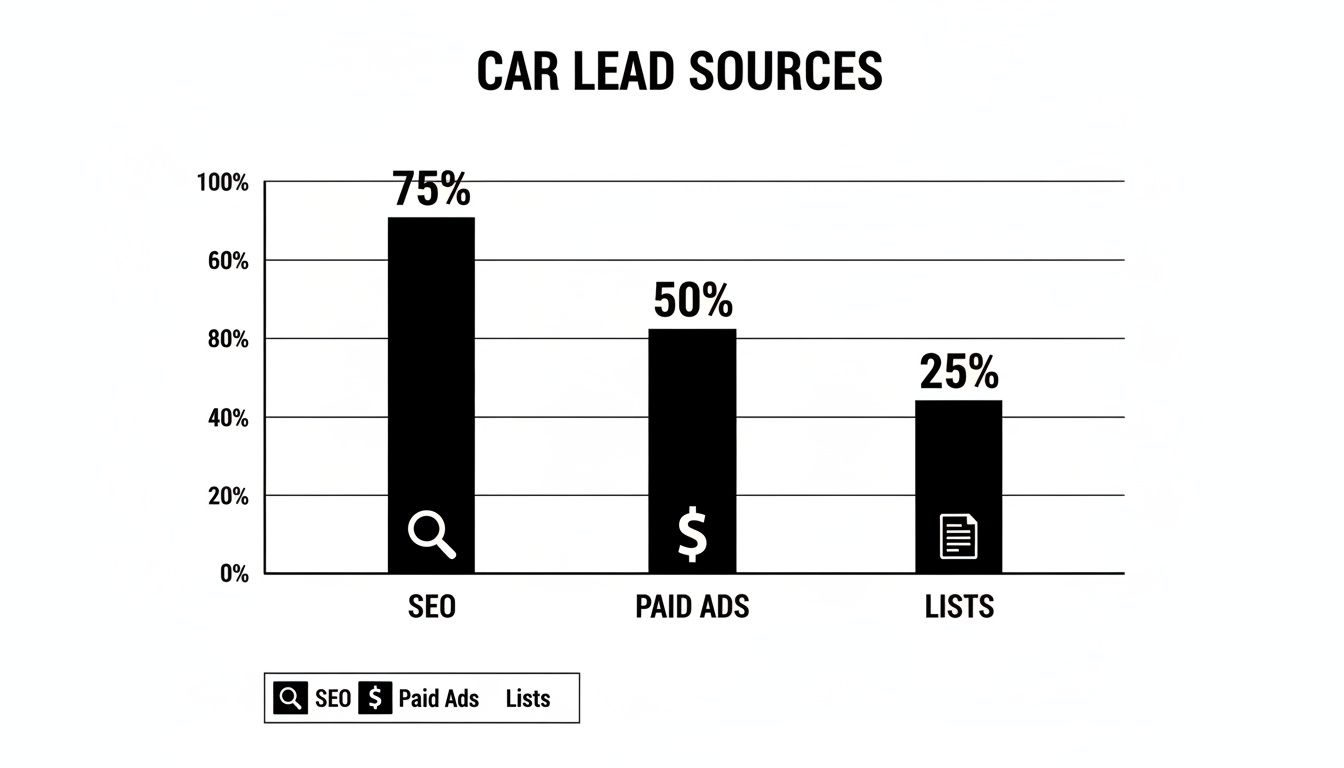
As you can see, leads from organic search almost always have the highest intent. Paid ads are a solid middle ground, while purchased lists lag far behind.
The most profitable dealerships don’t just find leads; they build a system that attracts them. Your goal is to create a predictable flow of prospects by balancing long-term brand building with short-term, targeted campaigns.
Comparing Car Dealer Lead Sources and Performance Metrics
To make smart budget decisions, you need to understand the typical costs and conversion rates associated with each channel. This table gives you a clear overview to help guide your marketing strategy.
| Lead Source | Average Cost Per Lead | Typical Conversion Rate |
|---|---|---|
| Organic Search (SEO) | $5 – $20 | 10% – 15% |
| Paid Social (Facebook) | $25 – $40 | 5% – 8% |
| Paid Search (Google) | $35 – $60 | 8% – 12% |
| Purchased Lists | $15 – $50 | 1% – 3% |
These numbers aren't set in stone—your results will depend on your market, brand, and follow-up process. However, they highlight a crucial point: the cheapest lead isn't always the best. A higher-cost lead from a high-intent source like Google Ads or SEO is often far more valuable than a dozen cheap, low-quality leads from a purchased list.
Why Lead Generation Is More Critical Than Ever
Gone are the days when having a few sharp-looking cars on the lot was enough to bring customers through the door. If you're still relying on that strategy, you're playing a game that ended years ago. Today's auto market is a different beast entirely—more competitive, faster-moving, and it demands a proactive plan for finding car dealer leads. It’s not just a nice-to-have; it's a necessity.
Simply waiting for walk-ins is a surefire way to get left in the dust. The modern car buyer starts their journey online, sometimes weeks or even months before they ever dream of stepping into a dealership. They're researching models, comparing prices, and scrolling through reviews from their couch. If your dealership isn't showing up where they are, you're completely invisible.
The Shifting Market Dynamics
The balance of supply and demand in the car world is always in motion, and it directly impacts how you sell. Not long ago, inventory was tight, and you might have had a handful of buyers fighting over the same vehicle. Well, the tables are turning.
Recent data shows new-vehicle inventories have climbed to roughly 2.8 million units, a huge jump from 2.5 million just a month before. You can read more about these market shifts to see what this means for your dealership. That 12% surge in available cars gives consumers more power and creates fierce competition among dealers.
With more cars on the lot than buyers actively looking, the game shifts from managing scarcity to creating demand. Your ability to consistently generate, capture, and convert new car dealer leads is what will separate you from the dealership down the street.
This new reality makes your lead generation engine the most important part of your dealership. Every single lead is a critical opportunity to move a unit. The dealers who will win are the ones with a rock-solid system for keeping their pipeline full, no matter what the market throws at them. It's about taking control, not being a victim of fluctuating demand.
Speed to Lead Is Your Competitive Edge
In a crowded market, speed is your secret weapon. When a potential buyer fills out an online form, they aren't just sending their info to you. You can bet they've sent it to two or three other dealers at the same time. The first salesperson who makes real contact has a massive advantage.
Study after study shows the odds of converting a lead drop off a cliff after just five minutes. If your team is still downloading CSV files from different platforms to find new leads, you're already losing the race.
Think of it like this: an online lead is a hot pizza. The second the customer hits "submit," it's fresh out of the oven. Every minute that passes, it gets colder. By the time you get around to it an hour later, the customer's interest is gone, and another dealer has already made the delivery.
This is where automation changes everything. A smart lead management system ensures every inquiry gets acted on instantly.
- Immediate Notifications: Your sales team gets an alert the second a lead comes in.
- Automated Routing: Leads go straight to the right person, no manual hand-offs needed.
- CRM Integration: All the lead's info is automatically logged in your CRM for easy tracking.
This kind of immediate, systematic approach isn't a luxury anymore—it's the new standard for survival. Having a process for instant lead capture and lightning-fast follow-up is how you turn interested prospects into showroom visitors before your competitors even know the lead exists.
Generating Organic Car Dealer Leads That Actually Convert
Imagine a steady flow of high-quality prospects hitting your inbox without you spending a single dime on ad clicks. This isn't a pipe dream; it's the payoff from a smart organic marketing strategy. These are the car dealer leads you earn through trust and value, not just the ones you buy with visibility.
Paid ads are great, but they stop working the second you turn off the budget. Organic efforts, on the other hand, build a lasting asset for your dealership. It's like owning your marketing real estate instead of just renting it.
The best part? The customers who find you this way are often way more qualified because they were actively looking for answers when they stumbled upon you.

Dominate Your Local Market with SEO
For most dealerships, the battle for customers is won or lost within a 20-mile radius of the showroom. This is where Local Search Engine Optimization (SEO) becomes your secret weapon. When a potential buyer searches "Toyota service near me," you absolutely have to be at the top of that list.
Your Google Business Profile is ground zero. Start by making sure your name, address, and phone number (NAP) are exactly the same everywhere online. Then, get aggressive about asking happy customers for reviews—that social proof heavily influences both your ranking and a buyer's decision.
This hyper-focus on local intent is what separates the winners from the losers. A dialed-in local presence makes you visible to the buyers most likely to actually walk through your doors. To dive deeper, check out our complete guide on mastering SEO for lead generation.
Create Content That Answers Real Questions
Your customers are online asking questions right now. "Is the Ford Explorer good for families?" "What's the real cost of owning a BMW?" When you create content that answers these questions, you stop being just a car seller and start being a trusted expert.
This doesn't have to be complicated. Simple blog posts, short walkaround videos, or even detailed model comparisons on your site can pull in highly motivated buyers. Just think about the top five questions your sales team fields every single day and turn those answers into helpful content.
The goal of content marketing isn't just to sell a car today. It's to become the go-to resource for car buyers in your area, so when they are ready to buy, your dealership is the first one they think of.
This approach builds a relationship long before a customer ever steps on the lot. That gives you a massive head start on competitors who are only focused on the hard sell.
Build a Community and a Referral Machine
Your best marketers are your existing customers. Hands down. A strong social media game and a little local community involvement can create a powerful referral engine that generates some of the highest-quality leads you'll ever get.
- Showcase Customer Stories: Turn those "happy customer with their new car" photos into killer social media posts and testimonials.
- Partner with Local Businesses: Co-host a weekend event with a popular local coffee shop or insurance agent. You get in front of their customers, and they get in front of yours.
- Engage for Real: Don't just post inventory on Facebook and Instagram. Start conversations, answer questions, and build a following of actual fans.
The automotive market is bouncing back in a big way. Light-vehicle sales recently hit about 91.7 million units worldwide, finally pushing past pre-pandemic levels. In a market this competitive, building a loyal community gives you an edge that money just can't buy. Every single lead matters.
Paid Advertising Strategies for Immediate Results
While your organic strategies are busy building long-term value, sometimes you just need to turn on the faucet and get car dealer leads flowing right now. That’s exactly where paid advertising shines. It gives you immediate visibility and results you can scale, letting you fill up your sales pipeline whenever you need to.
Think of it like the nitrous boost for your lead gen engine. Organic SEO is like building a powerful, reliable motor over time, but paid ads give you that instant burst of speed when you need it most—like during a month-end sales push or to clear out some aging inventory.
Unlike organic efforts that demand patience, a paid ad campaign can start sending potential buyers to your digital doorstep just hours after you launch it. This level of control is crucial for hitting sales targets and reacting to market changes on the fly.
The Big Three Paid Channels for Car Dealers
When you’re spending money on ads for your dealership, three platforms consistently bring home the best results. Each one has a specific job to do, and a smart strategy usually mixes all three to catch buyers at different points in their journey.
-
Google Ads (Paid Search): This is your high-intent powerhouse. You’re bidding on keywords like “used Honda CR-V for sale,” catching people who are actively looking for a car. These are often your highest-quality leads because they’re telling you exactly what they want to buy.
-
Facebook Lead Ads: This is perfect for drumming up new demand. Facebook lets you target people with incredible detail—demographics, interests, and behaviors—even if they aren't searching for a car at this exact moment. The built-in lead forms make it dead simple for them to send you their info without ever leaving the app.
-
Retargeting Campaigns: This is your follow-up machine. Retargeting lets you show specific ads to people who have already been on your website. Someone checked out a VDP for a specific truck but didn’t inquire? You can pop up an ad for that exact vehicle, keeping your dealership top-of-mind.
Knowing what each channel is good at is the key to spending your ad budget wisely and getting the most bang for your buck.
Optimizing Your Campaigns for Lower Costs
Anyone can run ads. Running them profitably is the real trick. Your main goal should always be to lower your cost per lead without letting the quality slip. This means you need to be testing and optimizing constantly.
Start by A/B testing your ad creative. Try out different images—a lifestyle shot of a family with an SUV versus a clean photo of the vehicle itself. Test a few different headlines and calls-to-action to see what gets people to click. Even tiny changes can make a huge difference in your click-through rates and conversion costs.
The most successful paid campaigns are never "set it and forget it." They are living, breathing efforts that you're constantly tweaking based on real performance data. Treat every campaign like an experiment to learn more about what your customers actually respond to.
It's also absolutely essential to watch your metrics like a hawk. Things like your lead conversion rates and cost-per-lead are the bottom line for figuring out if your marketing is even working. Industry stats show conversion rates can swing wildly from 2-10%, with average costs per lead anywhere from $42.95 to $283, depending on the source and vehicle.
You can check out more about these automotive lead generation statistics to see how your own numbers compare to the benchmarks. Watching your data helps you spot what’s working so you can double down on it.
Turning Website Forms into Sales Opportunities
Think of your dealership's website as your digital showroom. If that's the case, then your contact forms are the front door. Too often, dealers treat these forms like a simple mailbox, but they are so much more. They represent that critical moment when a casual browser decides to raise their hand and show genuine interest.
Optimizing this experience is one of the fastest ways to get more high-quality car dealer leads. This isn’t about flashy design; it’s about making it dead simple for a motivated buyer to connect with you. A clunky, confusing form creates friction, and that friction is enough to make a potential customer click away to a competitor's site in seconds.
The goal here is to tear down every single barrier between a customer's interest and your salesperson's inbox. Every extra field you add, every confusing question, and every second they wait for a page to load is another chance to lose a sale.
From Simple Forms to Powerful Lead Magnets
Turning a basic "Contact Us" page into a lead-generating machine starts with getting inside the user's head. They're on your site for a reason. Your form should speak directly to that reason while being as smooth as possible.
Start by slashing the number of fields. Do you really need their full mailing address right now? Probably not. Stick to the absolute must-haves: name, email, and phone number. Every extra box they have to fill can tank your submission rate.
Next, look at your call-to-action (CTA) button. "Submit" is generic and boring. Try something that promises value, like "Schedule My Test Drive" or "Get Today's Price." This tiny change reminds the customer what they get in return for their info. To really make this work, focusing on effective landing page design is a game-changer.
Think of your form as a conversation starter, not an interrogation. The initial submission is just the first step. Your goal is to get just enough information to begin a real dialogue with the prospect.
Finally, what happens after they click that button? A generic "Thank you" is a huge missed opportunity. Instead, send them to a dedicated thank-you page that confirms their submission, tells them when to expect a call, and maybe even shows them links to similar inventory or a quick video about your dealership.
Automating the Follow-Up for Maximum Impact
Getting the lead is only half the battle. The other half is won or lost in the first few minutes after they hit submit. The data doesn't lie: 35-50% of sales go to the dealership that responds first. If your process relies on a salesperson manually checking an email inbox, you are burning money.
This is where automation becomes your secret weapon. A solid CRM workflow makes sure no lead ever slips through the cracks. For a deeper dive, you can learn more about perfecting your lead capture forms and workflows right here in our detailed guide.
Here’s what a killer automated system looks like in action:
- Instant Notification: The second a form is submitted, your sales team gets a text or email alert with all the lead's details. No delay.
- Automated Routing: The lead is automatically assigned to the right salesperson based on the vehicle they're interested in or where the lead came from. No confusion, no waiting.
- CRM Entry: The lead's info is instantly and perfectly logged in your CRM, creating a clean record for tracking and follow-up.
- Initial Response: An automated (but personalized) text or email can go out to the customer immediately. It's a simple touch that says, "We got your request and we're on it."
This one-two punch of smart form design and immediate, automated follow-up creates an experience that feels seamless to the customer. It shows them you're professional, you value their time, and you're ready to help—dramatically boosting your chances of turning that click into a test drive, and ultimately, a sale.
Automating Your Facebook Leads for Faster Response
Getting a successful Facebook Lead Ad campaign up and running is a great start, but capturing those car dealer leads is just step one. The real money is made—or lost—in the minutes right after someone clicks "submit."
If your current process is manually downloading a CSV file of new leads once or twice a day, you are leaving an unbelievable amount of business on the table. When it comes to turning a digital lead into a showroom appointment, speed is the only thing that matters.
Think about it like this: a new Facebook lead is like a text from a friend. Reply instantly, and you're having a real conversation. Wait eight hours? The moment’s gone. Their attention has already drifted elsewhere. It's the exact same for a potential car buyer; minutes after they submit their info, they're already scrolling through your competitor's inventory.
This is where automation becomes your dealership’s secret weapon. By connecting your Facebook Ads directly to your CRM or your sales team's inbox, you slash that delay to zero. You turn a cold, manual task into an instant, actionable sales alert.
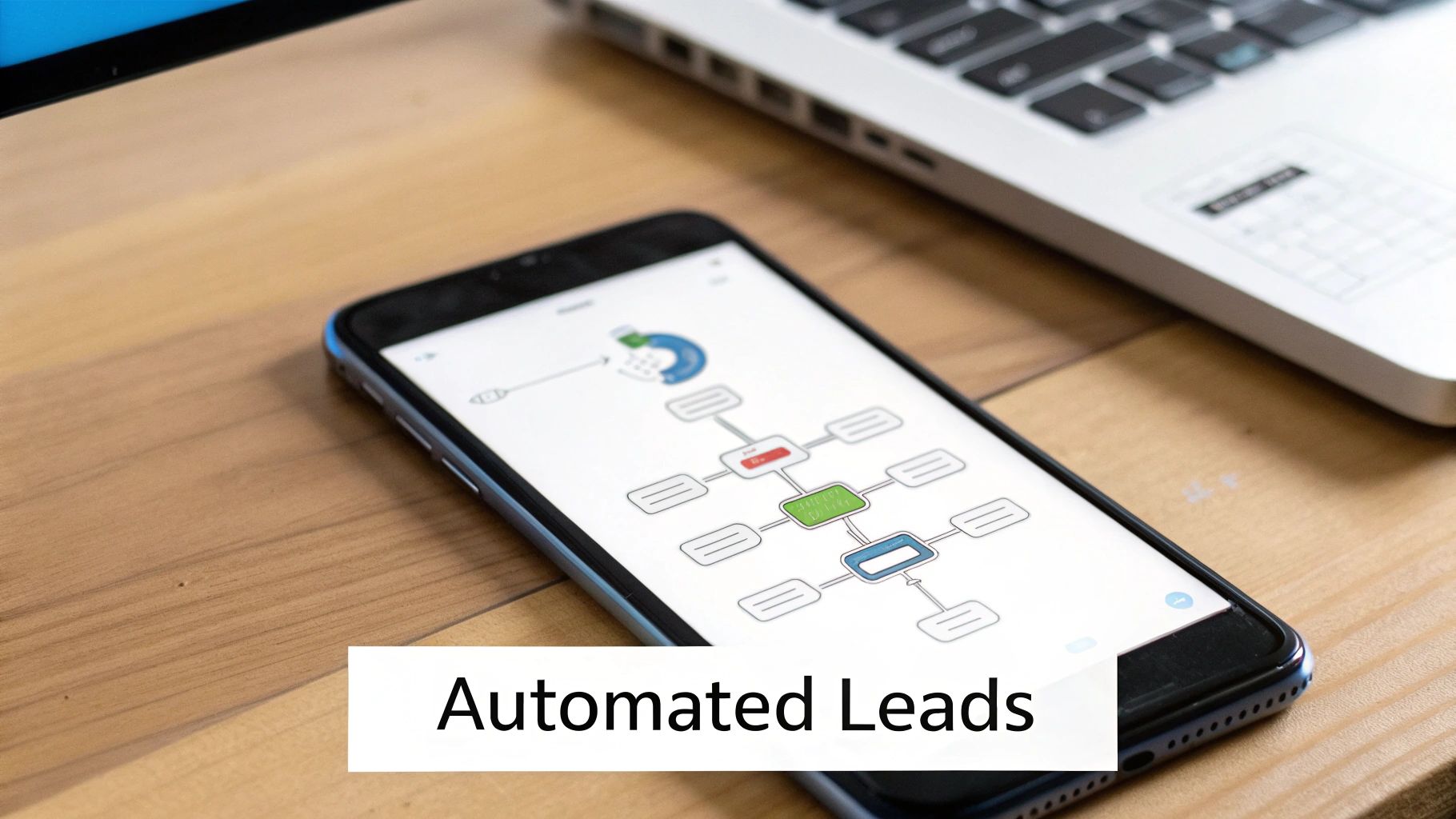
A Real-World Automation Workflow
Let’s walk through a simple, practical example. You're running a Facebook Lead Ad for a special lease offer on the brand-new SUVs that just hit your lot. The ad is crushing it and bringing in leads. Here’s how you make sure every single one gets the VIP treatment, instantly.
Step 1 Launch Your Facebook Lead Ad Campaign
First, you build a sharp-looking ad with great photos of the SUV and a clear call-to-action like "Get Lease Pricing." The most important part is the Instant Form. Keep it dead simple to get the most completions.
- Ask for the Essentials: Name, Email, and Phone. That's all you need to get the ball rolling.
- Use Pre-filled Fields: Facebook can auto-populate this info, making it incredibly easy for people to submit.
- Add a Custom Question (Optional): A simple multiple-choice like "What is your preferred contact method?" gives your sales team a perfect opener.
Step 2 Connect to an Automation Tool
This is the game-changer. Instead of letting leads sit inside Facebook's system, you use a tool like LeadSavvy Pro to act as the bridge. This connection is what makes real-time follow-up possible. The setup is incredibly straightforward—no coding required.
The second a user hits "Submit" on your Facebook ad, the automation tool grabs that data and pushes it exactly where you need it to go. This flips your lead management from a passive chore into an active, sales-driving machine.
Step 3 Route the Lead Data Instantly
With the connection live, you can now send the lead's information to multiple places at once. This creates a safety net and guarantees the right people see the lead right away.
- Sync to a Google Sheet: A central Google Sheet can act as a master log of every lead that comes in. It’s perfect for managers to track campaign performance and see lead volume at a glance.
- Trigger an Email Notification: The system fires off an email alert straight to your BDC or sales team. This email should have all the lead's info so they can act on it without logging into another platform.
- Push to Your CRM: The lead is automatically created as a new contact in your dealership's CRM, assigned to the right salesperson, and tagged with "Facebook SUV Campaign" as the source.
This multi-channel alert means nothing falls through the cracks. Your team is on it, fast.
The Dramatic Impact of Automation
The difference this kind of system makes is massive. Studies consistently show that contacting a lead within the first hour increases the chances of a meaningful conversation by seven times. By automating the process, you aren't just saving time—you're fundamentally stacking the odds in your favor.
Your team can now engage with potential buyers while their interest is at its absolute peak. To see more ways to put this into practice, our guide on how to automate your Facebook leads breaks down even more detailed steps.
This level of immediate, personal follow-up is what separates the top dealers from everyone else. It builds trust from the very first touchpoint and ensures your dealership is always the first one to make contact.
Common Questions About Car Dealer Leads
Look, navigating the world of car dealer leads brings up the same handful of questions for just about every dealership I talk to. Getting straight answers is the only way to sharpen your strategy and make sure your budget is actually working for you.
Let's cut through the noise and tackle the questions that really matter when you're trying to build a sales pipeline you can count on.
What Are The Most Cost-Effective Lead Sources?
For smaller or independent dealerships, the best bang for your buck almost always comes from your organic channels. It's not flashy, but focusing on local SEO and dialing in your Google Business Profile builds a long-term asset that generates leads without you having to constantly feed it ad money.
Once that foundation is solid, you can sprinkle in some highly-targeted, lower-budget Facebook Lead Ads. Running a quick campaign for a specific, in-demand F-150 or a fresh trade-in is a fantastic way to stir up immediate interest without torching your budget.
How Quickly Should My Team Contact A New Lead?
You’ve got about five minutes. That’s it. Study after study confirms that your speed-to-lead is the single biggest factor in turning a form submission into a showroom appointment.
A lead's interest doesn't just cool off; it falls off a cliff with every minute that ticks by. Setting up automated notifications for your sales team isn't a "nice-to-have" anymore—it's the only reliable way to hit that five-minute window and book the appointment before your competitor down the street does.
Can Purchased Lead Lists Actually Work?
This one's tempting, I get it. But honestly, purchased lists are a huge gamble and the conversion rates are typically dismal. Think about it: those leads aren't exclusive to you, and you have no idea if they have any real intent to buy.
They might give you a temporary shot in the arm during a slow month, but they should never be your main play. Your energy is always better spent generating your own exclusive, high-intent car dealer leads through marketing you control.
How Do I Measure The ROI Of My Lead Generation?
To really know if your marketing is making you money, you have to track two simple but critical numbers:
- Cost Per Lead: Take your total ad spend and divide it by how many leads you got.
- Cost Per Acquisition: Take that same total ad spend and divide it by how many cars you actually sold from those leads.
When you connect your ad platforms directly to your CRM, you can follow the breadcrumbs from the first click all the way to a signed deal. That’s how you get a true, undeniable picture of what's working and what's not.
Stop losing leads to slow, manual downloads. LeadSavvy Pro instantly syncs your Facebook leads to your CRM or a Google Sheet, so your team can respond in minutes, not hours. Start for free at https://leadsavvy.pro.