Drip Campaign Software: Boost Conversions with Smart Automation
Drip campaign software is your secret weapon for turning lukewarm interest into genuine, loyal customers. It’s an automation tool that sends a pre-written series of messages to your prospects over time. Think of it as your personal, automated system for lead nurturing, guiding people from their first click to their final purchase without you lifting a finger for follow-ups. It’s how you create consistent, personalized communication that actually scales.
What Is Drip Campaign Software

Imagine you're trying to grow a garden. You wouldn’t just blast a tiny seed with a firehose one time and expect it to flourish, right? Of course not. You’d give it a steady, patient trickle of water to help it grow strong. Drip campaign software does the exact same thing for your leads, solving the all-too-common problem of inconsistent follow-up.
This kind of tool is the perfect antidote to manual lead management, which, let's be honest, is a surefire recipe for missed opportunities. Especially if you're running ads on platforms like Facebook, new leads can pour in fast. Trying to keep track of every single one, remember who to follow up with, and craft the perfect message every time is a nightmare for even the most organized teams.
The Problem with Manual Lead Nurturing
Handling leads by hand creates huge gaps in your customer's journey. A potential customer who signs up on a Friday night might not hear from you until Monday morning. By then? Their initial excitement has completely vanished. That delay is expensive. Drip software closes that gap instantly by triggering a welcome sequence the moment a lead hits your system.
Here are the key headaches that automation just makes disappear:
- Inconsistent Communication: It guarantees every lead gets the same high-quality, on-brand nurturing experience.
- Wasted Time: Your team is freed from the soul-crushing task of sending repetitive emails, so they can focus on high-level strategy and closing deals.
- Lost Opportunities: It stops leads from slipping through the cracks because of simple human error or a busy schedule.
Drip software isn’t just about blasting out emails; it’s about building a relationship on autopilot. It delivers the right message at exactly the right time, making your prospects feel seen and understood all the way through their journey.
The Foundation of Automated Growth
At its heart, this technology is just a specific, powerful application of marketing automation. If you want to zoom out and see the bigger picture, it's worth understanding what is email marketing automation is all about and how it works as a whole.
The demand for this kind of tool is absolutely exploding as more businesses see the massive impact it has. The drip campaign software market is set to skyrocket from $2.5 billion in 2025 to an incredible $7.75 billion by 2033, all because companies need smarter, data-driven ways to nurture leads. This isn't just a fleeting trend; it shows that automation has gone from a "nice-to-have" to a must-have for any business looking to grow sustainably.
Core Features Every Drip Tool Must Have
Okay, so you get the big picture of what drip campaign software does. Now, let's pop the hood and look at the engine inside. Not all platforms are built the same, and the right features are what separate a basic autoresponder from a powerful, revenue-driving machine that intelligently nurtures your leads.
These are the non-negotiables. Think of them as your must-have checklist when you're sizing up any tool. They're the foundation of any drip strategy that actually works, giving you the control and insight you need to turn prospects into paying customers.
Essential Features of Drip Campaign Software
Before diving deep, here's a quick look at the core components you should be looking for. Any serious drip software will have these features built-in, as they are the building blocks for creating campaigns that adapt to your leads' behavior.
| Feature | What It Does | Why You Need It |
|---|---|---|
| Visual Workflow Builder | Lets you map out your entire campaign sequence using a drag-and-drop interface. | It makes complex campaigns easy to build, visualize, and tweak without any coding. You see the entire customer journey at a glance. |
| Advanced Segmentation | Divides your audience into smaller, specific groups based on their data or actions. | Sending the right message to the right person is everything. This lets you deliver hyper-relevant content that resonates and converts. |
| Intelligent Triggers | Sets "if this, then that" rules that automate actions based on lead behavior. | This is true automation. It moves leads through your funnel based on what they do, not just a rigid schedule, making your follow-up timely and smart. |
| A/B Testing | Allows you to test different versions of your emails (e.g., subject lines, CTAs) to see which performs better. | Stop guessing what works. Data-driven testing is the only way to consistently improve your open rates, click-throughs, and conversions. |
| Analytics & Reporting | Provides a dashboard with key performance metrics like open rates, CTR, and conversion rates. | If you can't measure it, you can't improve it. Clear analytics show you what's working and where you're losing leads. |
These features work together to create a system that doesn't just send emails, but starts meaningful conversations that lead to sales.
Visual Workflow Builders
The best drip tools give you a visual workflow builder. Forget about fumbling with complex menus or needing to code. This is all about mapping out your entire customer journey with a simple drag-and-drop canvas. It’s like drawing a flowchart for your entire lead nurturing process.
You can literally see what happens the moment a new lead from Facebook enters your system, which email they get first, and what action triggers the next message. This kind of visual clarity makes it dead simple to build and adjust even complex campaigns, making it a breeze for non-technical folks.
Advanced Segmentation and Triggers
Next up is segmentation. This is where the magic really starts. It’s all about slicing your audience into smaller, highly targeted groups based on their data or how they behave. For instance, a marketing agency could segment leads by the specific service they asked about—like "SEO services" vs. "PPC management"—and send them super-relevant case studies that actually speak to their needs.
Working hand-in-hand with segmentation are intelligent triggers. These are basically the "if this, then that" rules that put your campaigns on autopilot. A trigger could be anything—a lead clicking a specific link in an email, visiting your pricing page, or not opening your last three messages. That action then automatically moves them into a more appropriate, sales-focused sequence.
This level of automation is what's driving massive growth in the market. The marketing automation sector, which is home to drip software, hit a staggering $6.65 billion in 2024 and is on track to hit $15.58 billion by 2030. Why the boom? Because nurtured leads make 47% larger purchases, which is hard proof of the direct financial impact these features have. You can dig into more of this data by exploring the full marketing automation market research.
A/B Testing and Analytics
Finally, no tool is worth its salt without solid analytics and testing features. A/B testing lets you pit different parts of your emails against each other—like two different subject lines or calls-to-action—to see what truly gets the best response. This data-first approach takes all the guesswork out of the equation and helps you continuously dial in your results.
A good analytics dashboard gives you a crystal-clear view of how your campaigns are performing, tracking the metrics that actually matter:
- Open Rates: Are people even seeing your message?
- Click-Through Rates (CTR): Are they taking the action you want them to take?
- Conversion Rates: How many leads are hitting that final goal, like booking a demo or pulling out their credit card?
These features give you the critical feedback loop you need to stop flying blind, refine your strategy, and get the best possible return on your investment.
Building Your First Drip Campaign Step by Step
Alright, theory is one thing, but let's get our hands dirty. This is where you'll see just how powerful drip campaign software really is. We're going to walk through a real-world scenario, tracking a new lead from the moment they click your Facebook ad all the way until they're a sales-ready contact.
The whole process kicks off the second someone hits "submit" on your Facebook Lead Form.
Instead of that lead's info just sitting in a spreadsheet waiting for you to download it, a tool like LeadSavvy Pro grabs it instantly. That single action fires the starting pistol for your entire automated sequence. No delays, no missed opportunities—just pure, real-time engagement when their interest is highest.
The Five-Email Nurturing Blueprint
Once the lead is in your system, the automated workflow takes over. Here’s a simple but incredibly effective five-email sequence you can steal and adapt for your own business. The goal is to build trust, dish out serious value, and gently nudge your prospect toward becoming a customer.
-
Email 1: The Instant Welcome (Sent Immediately): This email needs to land in their inbox seconds after they sign up. It confirms their submission, delivers whatever you promised them (like an ebook or checklist), and lets them know what to expect next. You're aiming for immediate gratification and a killer first impression.
-
Email 2: The Value-Packed Resource (Sent 2 Days Later): Hold off on the sales pitch. This email is all about giving them something genuinely useful that solves a problem. Think a link to a helpful blog post, a quick video tutorial, or a case study that shows you know your stuff. This is how you start building trust.
-
Email 3: Social Proof and Authority (Sent 4 Days Later): Now it's time to show them they're in good company. Share a compelling customer testimonial or a short, punchy case study. This isn't bragging; it's building credibility and helping them picture their own success with your help.
-
Email 4: The Gentle Offer (Sent 7 Days Later): After a full week of providing value, you've earned the right to make an offer. This email should clearly explain how your service solves their specific problem and include a soft call-to-action (CTA). Something like "Book a 15-Minute Demo" or "See Our Pricing" works perfectly.
-
Email 5: The Relationship Builder (Sent 10 Days Later): The final email in the sequence pivots back to building a long-term connection. Ask an open-ended question to get a reply, invite them to follow you on social media, or point them to another high-value resource. You're ending the conversation on a helpful, non-pushy note.
This visual breaks down how the core pieces of drip software—the builder, segmentation, and triggers—work together to make these sequences possible.
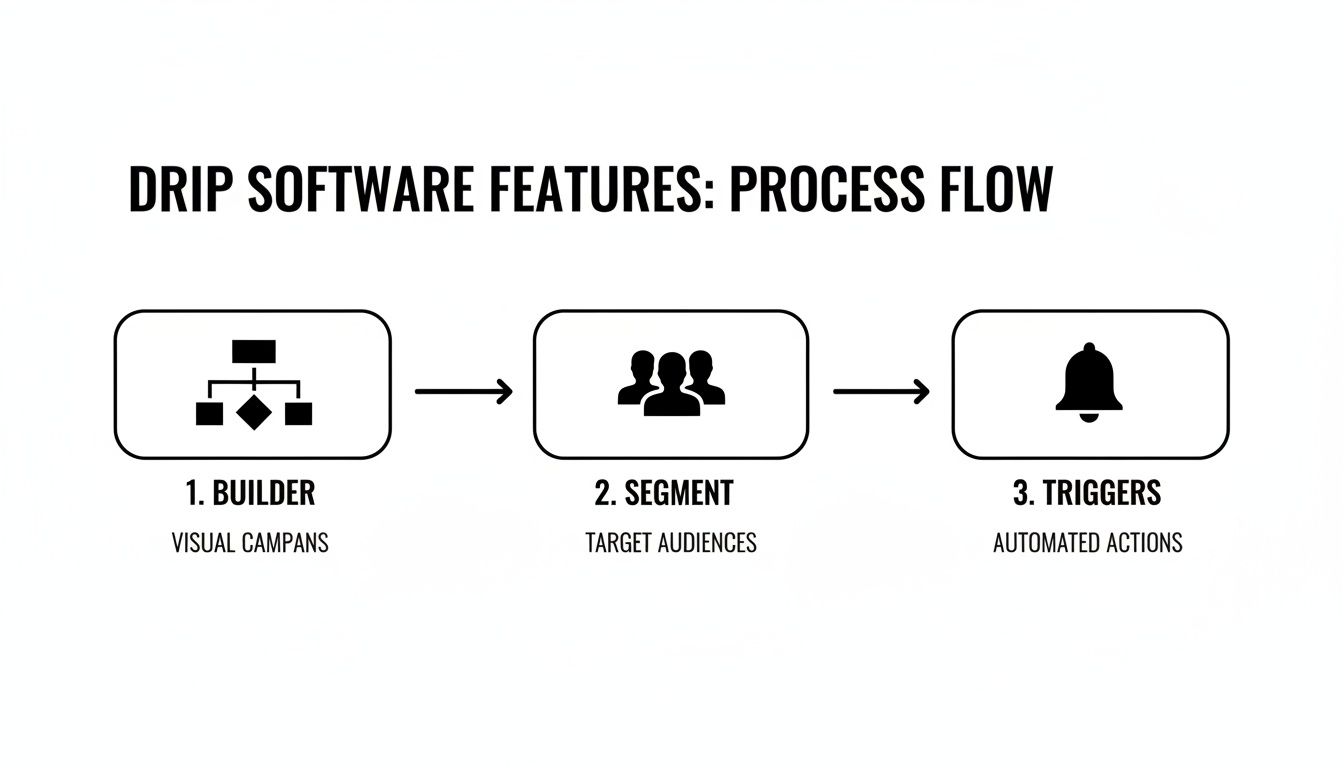
As you can see, a great campaign depends on a visual builder to map out the journey, segmentation to hit the right people with the right message, and triggers to make it all happen automatically.
Key Takeaway: An effective drip sequence is a conversation, not a monologue. Each email should build on the last, systematically moving the prospect from just being aware of you to seriously considering you—all by consistently delivering value before asking for the sale.
This structure is a solid foundation for your first campaign. If you need more inspiration, you can explore these actionable drip campaign examples to see how this blueprint can be tweaked for different industries and goals.
How to Choose the Right Drip Campaign Software
Picking the right drip campaign software can feel overwhelming. With dozens of options out there, all promising the moon, it’s easy to get lost in flashy marketing claims. The secret is to cut through the noise and focus on what actually matters for your business, your team, and your growth.
A great choice goes way beyond a long list of features. You need a tool that doesn’t just send emails but slides right into your daily workflow. After all, what good is a powerful platform if your team finds it impossible to use? It’ll just end up collecting digital dust.
Evaluate Ease of Use and Team Accessibility
Your first and most important filter should be simple: is it easy to use? Can someone on your team who isn't a tech genius build a multi-step sequence without calling a developer for help? Look for a platform with an intuitive drag-and-drop builder—for most businesses, this is non-negotiable.
A clean interface, straightforward navigation, and solid onboarding guides are huge pluses. Take advantage of free trials. Seriously, use them. If your team can't get a basic campaign up and running within an hour, it’s probably not the one. You want software that empowers your team, not one that makes them want to pull their hair out.
Prioritize Integration Capabilities
No marketing tool works in a silo. Your drip campaign software has to play nice with the other tools you rely on every day, especially your CRM and lead sources like Facebook Lead Ads. If it doesn't, you'll be stuck with data gaps and tedious manual work, which completely defeats the point of automation.
A tool like LeadSavvy Pro is designed to be that bridge, making sure leads flow instantly from the moment they're captured into your nurturing sequence. Before you sign on the dotted line, double-check for native integrations with your must-have tools. At the very least, make sure it has robust support for Zapier. This connectivity is the backbone of a marketing machine that actually works.
When you're weighing your options, remember this: the best software isn't the one with the most features. It's the one that flawlessly executes the features you actually need. Always put usability and integration ahead of a long list of functions you may never touch.
Assess Scalability and Pricing Models
Finally, look ahead. Where do you see your business in one, three, or even five years? The tool that’s perfect for your first 500 contacts might have a shockingly high price tag when you hit 5,000. Dig into the pricing tiers. Do they charge based on contacts, the number of emails you send, or the features you unlock?
You need a solution that can grow alongside you without breaking the bank. Choosing a scalable platform now means you won't have to deal with a painful migration process right when your business is gaining momentum. For a detailed look at how different platforms compare on features and cost, check out this marketing automation tools comparison. Making a smart decision today will save you a world of headaches down the road.
Proven Strategies for High-Converting Drip Campaigns
Owning the best drip campaign software is like having a high-performance race car—it’s not much use without a skilled driver and a smart strategy. The real difference between a campaign that converts and one that gets ignored comes down to the tactics you use. Success isn't just about automation; it's about making that automation feel human.
The secret sauce is crafting compelling, person-centric copy. Your messages need to read like they're coming from a helpful individual, not a faceless corporation. This is how you build a genuine connection and keep your leads hooked from the first email to the last.
Write Human-Centric Copy
Robotic, jargon-filled emails are a one-way ticket to the unsubscribe button. Ditch the corporate speak and write like you talk. Use a conversational tone, speak directly to your reader's pain points, and focus on giving value before you even think about asking for a sale.
Here are a few tips to make your copy pop:
- Use "You" and "I": Frame every message like it's a one-on-one conversation.
- Tell a Story: Weave a simple narrative that helps prospects see themselves winning with your help.
- Keep it Simple: Forget complex sentences and industry buzzwords. Clarity always wins.
For a deeper dive into crafting messages that truly connect, check out these proven email marketing automation strategies.
Your number one goal should be to build a relationship, not just push a product. When leads feel understood and valued, they are far more likely to trust you and, eventually, buy from you.
The impact of getting this right is huge. Drip campaigns consistently crush generic bulk emails, pulling in 29% higher open rates and 17% more clicks. It's tactics like these that are driving a digital marketing software market projected to hit $109.36 billion in 2025. You can read more about the growth of digital marketing tools.
Focus on a Single Call-to-Action
Every single email in your sequence needs one clear, singular purpose. Don't overwhelm your reader with multiple requests—like "read our blog," "follow us on social," and "book a demo" all in one message. That just creates decision paralysis. Guide them toward one specific action instead.
A focused call-to-action (CTA) makes the next step obvious and easy for the user. Whether you want them to download a guide, watch a video, or just reply to your email, a single CTA dramatically increases the odds they'll actually do it.
Master Your Timing and Cadence
Finally, let's talk about timing. The space between your emails is critical. Fire off messages too frequently, and you'll feel aggressive and spammy, leading straight to unsubscribes. But if you wait too long, your leads will go cold and forget why they were interested in the first place.
There’s no magic number here, but a great starting point is a 2-3 day gap between emails. Test different intervals to see what your audience responds to. The goal is to stay top-of-mind and keep the momentum going without becoming a pest. Nail your cadence, and you'll transform your automated sequence into a powerful conversation that drives real results.
Measuring Success with the Right Metrics
If you can't measure your marketing, you can't improve it. It’s as simple as that. Launching a drip sequence is just the first step; the real magic happens when you start tracking its performance. The right drip campaign software gives you a dashboard that cuts through the noise and shows you the true business impact of your work.
It’s way too easy to get caught up in vanity metrics like open rates. Sure, a high open rate feels good, but it doesn't pay the bills. It means nothing if nobody is actually taking the next step you want them to. Great analytics point you toward the key performance indicators (KPIs) that really matter for growth.
Core KPIs for Drip Campaign Analysis
To get a clear, honest picture of your campaign’s health, you only need to focus on a handful of crucial metrics. These numbers tell you exactly how well your messages are connecting with your audience and guiding them toward your end goal.
Here are the essential metrics you should be watching like a hawk:
-
Click-Through Rate (CTR): This is the percentage of people who actually clicked a link in your email. CTR is one of the best signs of genuine engagement—it proves your content was compelling enough to make someone stop what they were doing and take action.
-
Conversion Rate: This is the big one. Your conversion rate tracks the percentage of recipients who completed the goal you set out for them, whether that’s booking a demo, buying a product, or signing up for a webinar. This is your success metric.
-
Unsubscribe Rate: This number shows you how many people are opting out of your list after getting a message. A few unsubscribes are perfectly normal, but if you see a sudden spike, it's a major red flag that your content is missing the mark or you’re emailing too often.
By focusing on these action-oriented metrics, you can start making smart, data-driven decisions. A low CTR on a specific email, for instance, might tell you that the call-to-action is weak or the offer just isn't compelling enough for that stage of the journey.
At the end of the day, the real value of your drip campaigns comes down to one thing: return on investment. The best way to prove the impact on your bottom line is by learning how to calculate marketing ROI. When you can directly connect your campaign’s performance to revenue, you've proven its worth and can confidently justify putting more resources behind what works.
Still Got Questions?
It's normal to have a few questions floating around before you dive into a new tool. Let's tackle some of the most common ones we hear about drip campaign software.
How Many Emails Should a Drip Campaign Have?
There’s no single magic number here, but the sweet spot for most campaigns falls between 4 and 11 emails.
Honestly, it really depends on your goal. A simple welcome series for new subscribers might only need three or four messages to get the job done. But if you're nurturing a high-value B2B lead through a long sales cycle, you'll likely need a more extensive series to build that crucial trust and show them you know your stuff.
Can I Use Drip Software for More Than Email?
Absolutely. And you definitely should. The best platforms today are omnichannel, meaning they let you weave in SMS messages, social media touchpoints, and even create internal tasks for your sales team.
This approach creates a much more complete and effective customer journey. You're meeting people where they actually hang out, instead of just hoping they see your email.
Is Drip Campaign Software Expensive?
The cost of drip software varies, but many excellent tools are designed specifically for small businesses. You can find many platforms with affordable entry-level plans or even free tiers that offer core functionality. Always evaluate the return on investment—the right software should pay for itself by converting more leads.
Ready to stop wasting time on manual downloads and start nurturing leads the moment they show interest? Try LeadSavvy Pro today and see how effortless Facebook lead automation can be. Get started for free at LeadSavvy.pro.