Effective Advertising for Roofing Companies
Look, before you even think about spending a single dollar on Google or Facebook ads for your roofing business, we need to talk. Far too many roofers jump the gun, light their money on fire with flashy ads, and then wonder why the phone isn't ringing.
The truth? Effective advertising for roofing doesn't start with the ad; it starts with a rock-solid digital foundation. It's about having a professional, mobile-friendly website and knowing exactly who you're trying to reach. Get these things wrong, and even the slickest ad campaign is doomed to fail.
Building Your Digital Foundation for Roofing Ads
Running ads without a proper website is like building a beautiful house on a foundation of sand. It might look good for a minute, but it’s going to crumble. Your website, customer profiles, and your core message are the concrete slab that holds up every successful ad campaign you'll ever run.
Think of your website as your best salesperson—it works 24/7 and never calls in sick. When a homeowner clicks your ad (often in a panic after a storm), they need to land on a site that's professional, loads fast, and builds trust instantly. If your site is clunky, outdated, or impossible to use on a phone, that lead is gone. Forever.
Define Your Ideal Roofing Customer
You wouldn't use the same sales pitch for every single person you meet, right? So why would your ads be any different? Before you write a single line of ad copy, you have to know who you're talking to.
Are you targeting high-end homeowners in the rich part of town who want premium slate or metal roofs? Or is your bread-and-butter the family in a storm-prone subdivision who needs a fast, affordable repair right now?
Get specific. Create a few customer personas to keep your marketing sharp:
- Emergency Repair Eric: He's got a 20-year-old roof, a hailstorm just rolled through, and he's frantically Googling on his phone for a roofer who can stop a leak before it starts. He's looking for speed, availability, and someone who answers the phone.
- Commercial Property Paula: She manages a portfolio of retail buildings and needs a reliable contractor for routine maintenance and eventual replacements. She cares about warranties, long-term value, and a crew that won't disrupt her tenants' businesses.
When you know their problems, you can tailor every single ad and landing page to solve them. It's that simple.
Craft a Compelling Unique Selling Proposition
The global roofing market is absolutely massive—it's expected to grow from roughly $296 billion in 2024 to $353 billion by 2029. In a market that crowded, you have to give people a reason to pick up the phone and call you instead of the other ten roofers in town.
You need to answer one simple question: "Why should I choose you?"
Your Unique Selling Proposition (USP) is that answer. It’s the one thing that makes you different.
Your USP isn't just a catchy slogan. It's the DNA of your brand. It should be plastered on your website, in your ad copy, and even in how your team answers the phone. A strong USP makes you memorable and tells customers why they should trust you with their biggest asset.
Maybe it's your famous "No-Mess Guarantee," your specialization in restoring historic homes, or the fact that you offer a 24/7 emergency tarping service. Whatever it is, own it. Make it impossible to miss.
This clarity isn't just for paid ads; it strengthens your entire online presence. A powerful brand message will even boost your results from other marketing channels, something we cover in our guide to SEO lead generation strategies.
And if you're just getting started, digging into some effective marketing tips for tradies can help you nail down these foundational pieces. When you get this groundwork right, every dollar you eventually spend on ads will work ten times harder for you.
Before you launch a single ad, you need to have your ducks in a row. It's not sexy, but it's what separates the roofers who thrive from those who just survive.
Your Pre-Launch Roofing Ad Checklist
Here's a quick rundown of the absolute non-negotiables. Don't even think about running an ad until you can check off every single one of these boxes.
| Component | Why It's Critical for Ads | My Pro Tip |
|---|---|---|
| Mobile-First Website | Over 60% of searches for local services happen on a phone. If your site isn't flawless on mobile, you're losing leads. | Open your website on your phone right now. Can you click-to-call and fill out a form with one thumb in under 30 seconds? If not, fix it. |
| Clear Call-to-Actions | People need to know exactly what you want them to do next. "Get a Free Estimate" or "Call For Emergency Service" leaves no room for confusion. | Put a "Click to Call" button and a short lead form "above the fold" on every single page. Don't make people hunt for it. |
| Customer Personas | Generic ads get ignored. Speaking directly to a specific customer's pain point (e.g., storm damage, old roof) grabs their attention. | Base your personas on your best past customers. Who were they? What was their problem? Why did they choose you? Build from there. |
| Unique Selling Prop (USP) | This is your tie-breaker. In a sea of "quality service" claims, your USP (e.g., "50-Year Warranty," "Cleanest Job Site Guaranteed") makes you stand out. | Your USP shouldn't just be a claim; it should be a promise. Be prepared to back it up in your customer service and your work. |
| High-Quality Photos/Videos | Stock photos scream "amateur." Real photos of your team, your trucks, and your completed projects build instant trust and credibility. | Video testimonials are gold. A 30-second clip of a happy customer is more powerful than a thousand words of sales copy. |
Take the time to nail this foundation. It's the most important investment you can make in your advertising success. Once this is all in place, you’ll be ready to launch campaigns that actually generate qualified leads and grow your business.
Choosing Your Best Lead Generation Channels
When it comes to advertising for your roofing business, throwing your money at every platform is a surefire way to burn through your budget with nothing to show for it. I've seen it happen too many times. You need to be smart and strategic, focusing on where your actual customers are looking and what they're thinking when they see your ad.
This isn't about finding the one "magic" platform. It’s about building a solid mix that covers all your bases. You need a way to get in front of homeowners with a leak right now, and you also need a plan to make sure you're the first roofer they call when a storm hits next year.
Google Ads for High-Intent Homeowners
Let’s be real. When a homeowner finds a fresh water stain on their ceiling after a big storm, they aren’t scrolling Facebook. They’re grabbing their phone and heading straight to Google, typing in things like "emergency roof repair near me" or "local roofer for leak."
This is where Google Ads is king. It puts your business right in front of people who are actively searching for a solution to a problem they have at this very moment. This is pure search intent in action. These people aren't just browsing; they are motivated buyers who need help, and they need it now.
Running campaigns targeting keywords like "roof replacement cost" or "asphalt shingle repair" lets you connect with leads at the exact moment of need. You’re not an interruption; you're the solution. That’s why Google Ads remains a powerhouse for generating immediate, high-quality leads ready to book an inspection.
Facebook Ads for Proactive Brand Building
While Google is great for capturing existing demand, Facebook is where you go to create it.
Imagine a hailstorm hammers a few specific neighborhoods. With Facebook's incredible targeting options, you can immediately run ads to homeowners in those exact zip codes. Think about an offer like a "Free Post-Storm Drone Inspection." This is proactive, hyper-local advertising for roofing at its best.
Facebook is also perfect for building your local reputation over the long haul. You can run ads showcasing video testimonials from ecstatic customers or share compelling before-and-after photos of your recent work. This constant presence builds familiarity and trust. So when a homeowner does need a new roof a year from now, your company is already the name they know and trust.
And the data backs this up. The global social media ad market is expected to jump by 12% in 2025, and a whopping 76% of consumers say social content influences their buying decisions. If you want to dive deeper, you can discover more insights about 2025 roofing marketing trends that highlight just how crucial this is.
Google Local Services Ads The Ultimate Trust Signal
For any local service business, but especially for roofers, Google Local Services Ads (LSAs) are an absolute game-changer. These are the ads you see at the very top of Google, often above everything else, proudly displaying a "Google Guaranteed" badge.
That Google Guarantee isn't just a fancy icon. It means Google has personally vetted your business, checking for proper licensing and insurance. For a homeowner about to make a five-figure investment, that third-party stamp of approval provides a massive amount of confidence.
The best part? You only pay when a potential customer calls you directly through the ad. You're paying for a genuine lead, not just a click. This pay-per-lead model makes LSAs one of the most cost-effective and powerful advertising tools a roofer can have.
Here’s exactly what homeowners see—the Google Guaranteed providers are front and center.
That prime real estate and the green checkmark immediately draw the eye, positioning your business as one of the most credible options available.
By weaving these channels together, you create a powerful, multi-layered strategy. You use Google Ads and LSAs to scoop up the immediate, high-intent leads who are actively searching. At the same time, you use Facebook Ads to build your brand in key areas, generate new demand after weather events, and make sure you’re the go-to roofer for years to come. This balanced approach gives you a steady flow of leads today while building a stronger, more recognizable brand for tomorrow.
Creating Ads That Homeowners Actually Trust
Let's be real. Your ad is often the very first time a potential customer "meets" your business. It's your digital handshake, and in the roofing game, a firm, trustworthy handshake is everything.
The goal isn't just to snag a click. It's about building immediate confidence that you're the right crew for the job.
You have to shift your thinking. You're not just selling shingles; you're selling peace of mind. Homeowners are usually stressed out, dealing with a leak, fresh storm damage, or the massive financial weight of a full replacement. Your ad needs to speak directly to that problem and position you as the reliable, no-nonsense solution.
The Psychology of Trust in Ad Copy
When a homeowner sees your ad, they're asking themselves one thing: "Can I trust this company with my house and my money?" Every single word you write needs to scream "Yes!"
This is where trust signals become your secret weapon. These are quick, punchy phrases and badges that instantly tell a homeowner you’re legit. Don't bury them in the fine print; make them the star of your headline or the first line of your ad.
Here are the trust signals that absolutely must be in your ads:
- "Licensed & Insured": This is table stakes. It tells homeowners you're a pro and that they're protected.
- "5-Star Rated on Google": Nothing sells like social proof. Mentioning your high ratings lets past happy customers do the selling for you.
- "Family-Owned & Operated": This hits home in local markets. It suggests you care about your reputation and are accountable to the community.
- "20+ Years of Experience": This signals that you've seen it all and you're not going anywhere.
These aren't just fluffy buzzwords. They are shortcuts to building confidence. An ad for "Local Roof Repair" is fine. But an ad for "5-Star Rated, Licensed & Insured Roof Repair" is the one that gets the click.
Use Visuals That Build Real Credibility
Scrap the generic stock photos of perfect suburban houses. Savvy homeowners can spot them a mile away, and it just feels fake. Your images and videos need to be authentic and back up the promises you're making in your ad copy.
Get high-quality photos of your actual team on a real job site. Show off your branded trucks. And for goodness sake, use stunning before-and-after shots of projects you've actually completed. This is the proof in the pudding.
Video is even better. A quick, 30-second clip of a happy customer talking into their phone is more powerful than any sales pitch you could ever write. It feels genuine and relatable, cutting right through the skepticism.
A candid video of a satisfied customer standing in front of their beautiful new roof is pure gold. It’s authentic, it’s relatable, and it provides the kind of social proof that makes your phone ring.
Craft Offers They Can't Refuse
A killer ad mixes rock-solid trust with a compelling reason to act right now. Your offer needs to be valuable and solve an immediate problem for the homeowner. This isn't about being the cheapest guy in town; it's about providing the most upfront value.
Here are a few offers we've seen work wonders:
- Free Storm Damage Inspection: This is perfect for targeting areas just hit by bad weather. It's a no-risk way for a homeowner to figure out what they're dealing with.
- $500 Off a Full Roof Replacement: A real discount gives a tangible reason to call you if they're already weighing a major project.
- Free Gutter Cleaning with Repair: This adds a ton of value to a smaller job and gives you a chance to show them your quality work.
The key is to make it feel personal. A staggering 71% of consumers now expect personalized experiences, and 76% get annoyed when they don't get them. This means your offer for an emergency repair should be different from your offer for a planned cosmetic upgrade.
If you want to dig deeper, you can learn more about personalized roofing marketing trends that show how this approach works. When you combine those undeniable trust signals with a relevant, valuable offer, you stop the scroll and start a real conversation.
Designing Landing Pages That Convert Clicks to Calls
Getting a homeowner to click your ad is a small win, but it's only half the battle. If that click doesn't turn into a phone call or a form submission, you just paid for a window shopper. The single biggest mistake I see roofers make in their advertising for roofing is dumping all that valuable ad traffic onto their generic homepage.
Think about it. Your homepage is designed to do a dozen things at once—tell your company story, list all your services, maybe even host a blog. A landing page has one job and one job only: convert that specific ad click into a qualified lead. It's a focused, high-performance sales tool built for a single purpose, and it's absolutely non-negotiable for a successful ad campaign.
The Anatomy of a High-Converting Roofing Landing Page
Your landing page needs to act like your best salesperson. It should be clear, direct, and immediately solve the visitor's problem without any distracting fluff. There are a few core elements that every single one of your roofing landing pages absolutely must have.
These pieces work together to build instant trust and nudge the visitor toward taking that next step.
- A Powerful, Matching Headline: The headline has to mirror the promise from the ad they just clicked. If your ad offered a "Free Storm Damage Inspection," the landing page better say that loud and clear at the top. This creates a seamless experience and tells them they’re in the right place.
- Highly Visible Call-to-Action (CTA): Use bright, contrasting buttons with simple, action-focused text like "Get My Free Estimate Now" or "Schedule My Inspection." Put one right at the top (above the fold) and sprinkle a few more as they scroll down the page.
- A Simple, Frictionless Form: Only ask for what you absolutely need. Name, phone number, email, and maybe a dropdown for the service they're interested in. That's it. A long, complicated form is a guaranteed conversion killer.
- Prominent Trust Badges: Show off your credibility! Display logos from the Better Business Bureau (BBB), your local roofing association, or any certifications you have, like "GAF Master Elite." These are visual shortcuts that scream professionalism and trustworthiness.
This isn't just about making things look nice; it's about psychology. You have about five seconds to convince someone to stick around. These elements work in concert to make an immediate impression that you're a competent and trustworthy pro.
Why Dedicated Landing Pages Outperform Homepages
Sending ad traffic to your homepage is like dropping a potential customer in the middle of a massive warehouse and hoping they stumble upon what they need. A dedicated landing page is like giving them a personal guide who walks them straight to the checkout counter.
The difference in performance is staggering. I've seen it time and time again: dedicated landing pages have much higher conversion rates because they eliminate all distractions and focus on a single offer. This laser focus means you squeeze more leads out of the exact same ad spend, which dramatically lowers your Cost Per Lead (CPL).
A well-designed landing page isn't an expense; it's an investment that multiplies the effectiveness of every dollar you spend on ads. By matching the page to the ad's promise, you create a frictionless path from click to call, maximizing your return.
For a deeper dive, our complete guide on how to create a landing page that converts walks you through the entire process from start to finish.
A/B Testing Your Way to More Leads
Never assume your first draft of a landing page is the best it can be. The real pros are constantly tweaking and testing their pages to get every last possible lead from their traffic. This is called A/B testing. You simply create two versions of a page, show each version to 50% of your visitors, and see which one gets more form fills or calls.
Start with simple but powerful tests:
- Test Your Headline: Pit a benefit-driven headline ("A Leak-Free Roof, Guaranteed") against a direct-offer one ("Get Your Free Roof Inspection Today").
- Test Your CTA Button Color: Does a bright orange button outperform a green one? You'd be surprised how much a simple color swap can impact clicks.
- Test Your Offer: Which offer moves the needle more? "$500 Off a Replacement" or a "Free Gutter Cleaning with Repair"? Test different value propositions to see what your local market really wants.
Beyond tweaking your landing pages, understanding broader essential website design tips for small businesses will only improve your overall online presence. Small, measured changes over time lead to huge gains in lead volume, ensuring your advertising for roofing budget is working as hard for your business as you do.
Nailing Your Follow-Up: The System That Actually Wins Jobs
Let's be blunt: the greatest ad campaign on earth is worthless if the leads it generates just rot in your inbox. In roofing, speed-to-lead isn't just some buzzy marketing phrase; it’s the single biggest factor that separates the companies that are growing from the ones just getting by.
Think about it. When a homeowner needs a roofer, especially after a storm, they're not casually shopping around for weeks. They're going to hire the first competent, professional contractor who actually answers their call.
A lead that waits even an hour for a callback has probably already spoken to two of your competitors. This is the moment your advertising investment either pays off or goes right down the drain. You absolutely must have a rock-solid system to respond to every single lead, instantly.
The Power of Being First
Put yourself in the homeowner's shoes. They just gave you their name, email, and phone number through a form on your website. They're trusting you. Silence on your end feels like you don't care about their leaking roof.
An instant response, on the other hand, tells them you're on the ball. You've got their request, and you're ready to help.
This first touch doesn't even have to be a person-to-person call. A simple, automated text message is a game-changer.
Sending an automated text within 60 seconds of a form submission can boost conversion rates by over 300%. It sets the tone immediately—you're responsive, you're professional, and you're ready to solve their problem. This gives you a massive head start before your team even picks up the phone.
The goal is simple: bridge the gap between them hitting "submit" and you calling them back. Don't give them a chance to go looking for someone else.
Here’s what that quick journey looks like from their perspective:
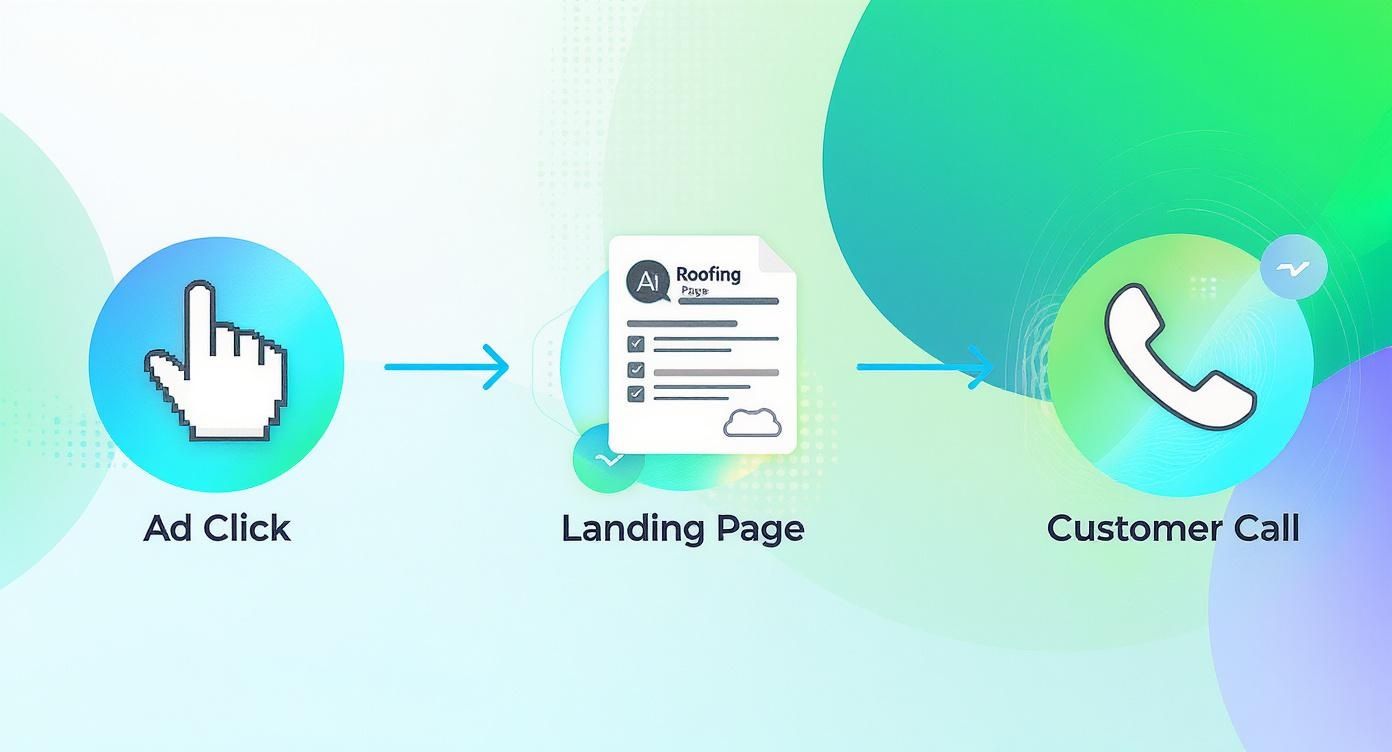
That final step—the customer call—is where the money is made. The speed at which you make it happen determines whether your marketing works.
Building Your Follow-Up Workflow
A bulletproof follow-up system isn't rocket science. It's about using simple automation for the first touch and then having a disciplined process your team can execute without thinking. This is how you stop leads from falling through the cracks.
Here’s a practical workflow you can set up today:
-
Instant Automated Response: The second a lead hits your system, an automated text and email should fire off. The text can be dead simple: "Hi [Name], this is Mike from Apex Roofing. We got your request for a free inspection and will call you from this number in the next 5-10 minutes to get it scheduled." This does two things: it engages them immediately and tells them exactly what to expect next.
-
The First Call (Within 5 Minutes): This is it. This is the most important part of the whole process. Your salesperson or appointment setter must call that lead within five minutes. Not an hour. Not thirty minutes. Five. That kind of speed screams professionalism and wins jobs, period.
-
The Nurture Sequence: What if they don't answer? The game's not over. This is where a gentle, persistent follow-up sequence kicks in. You're not trying to be pushy; you're just staying top-of-mind because life gets in the way. You can dive deeper into building an effective lead follow-up sequence for contractors to see detailed templates and strategies.
This structured approach turns your lead management from a chaotic guessing game into a predictable, revenue-generating machine. By automating that first touch and committing to a rapid calling schedule, you give every single dollar you spend on advertising for roofing the best possible chance of turning into a signed contract.
Measuring What Matters to Grow Your Revenue
You can't manage what you don't measure. Pouring money into advertising without tracking the right numbers is like trying to cut a rafter blindfolded—it’s going to get expensive, and it’s not going to end well.
It’s time to stop getting distracted by vanity metrics like clicks and impressions. Those numbers feel good, but they don’t pay the bills. Let's focus on the key performance indicators (KPIs) that actually tell you if your ads are making you money.
The Only Three Metrics That Truly Matter
If you want your advertising to be a profit center, not an expense, you need to get obsessed with three core metrics. These numbers cut through the noise and give you a crystal-clear picture of your campaign’s health.
These are the only numbers you need to live by:
- Cost Per Lead (CPL): This is your total ad spend divided by the number of leads you generated. Simple. If you spend $1,000 on Google Ads and get 20 form submissions, your CPL is $50. This tells you exactly what it costs to make the phone ring.
- Cost Per Acquisition (CPA): This one takes it a step further. It's your total ad spend divided by the number of actual jobs you won. If that same $1,000 campaign landed you 4 signed contracts, your CPA is $250. This is the true cost of getting a new customer on the books.
- Return on Ad Spend (ROAS): This is the big one—the metric that really matters. ROAS measures the total revenue you generated for every single dollar you spent on ads. If those 4 jobs brought in a combined $20,000 in revenue, your ROAS is 20x ($20,000 / $1,000).
Tracking these figures isn't optional. It’s the financial bedrock of a successful ad strategy.
Your goal isn't to get the cheapest leads; it's to get the highest ROAS. A $100 lead that turns into a $15,000 full roof replacement is infinitely better than a $20 lead for a minor repair that never even answers your call.
A Simple Framework for Review and Optimization
You don’t need a data science degree to figure this out. Just set aside a little time each week to look at your campaigns through this simple lens.
Open up your ad platforms and start asking the right questions. Which campaigns are bringing in the lowest CPA? Which keywords are generating leads that actually turn into high-ticket jobs? Once you know, the next step is obvious: double down on what’s working and ruthlessly cut what isn’t.
For example, you might find that your "emergency storm repair" ads have a pretty high CPL but an incredible ROAS because the jobs are urgent and people aren't shopping around. On the flip side, your "metal roof cost" ads might have a super low CPL but a terrible CPA because you're just attracting tire-kickers.
That insight is gold. It allows you to shift your budget intelligently and make every single ad dollar work harder for you.
Common Questions About Roofing Ads
Jumping into online advertising can feel like a maze. Where do you even start? What's a reasonable budget? Let's clear up a few of the most common questions I hear from roofers so you can build a strategy that actually works.
Getting these fundamentals right from the beginning is the key to making sure your marketing dollars don't go to waste.
How Much Should a Roofer Spend on Advertising?
This is the big one, right? The honest answer is it depends, but a solid rule of thumb is to earmark 5-10% of your target revenue for all your marketing efforts.
If you're in a super competitive city or you're trying to grow fast, you'll want to push closer to that 10% figure.
But you don't have to go all-in from day one. My advice? Start with a manageable test budget. Think $1,000-$2,000 a month and pour it into one or two channels you know have high potential, like Google Ads. Once you see the leads coming in and can prove you're getting a good return, you can confidently turn up the dial.
Are Google Ads or Facebook Ads Better for Roofers?
It's not really an "either/or" situation. The smartest roofers use both, because they do completely different jobs.
Google Ads is your go-to for capturing "hand-raisers." These are homeowners actively typing "roofer near me" or "roof leak repair" into Google. They have an urgent problem, and your ad is the solution. It's the best way to get in front of people who need you right now.
Facebook Ads, on the other hand, are perfect for generating demand before they even know they need you. You can get incredibly specific, targeting neighborhoods that just got hit by a hailstorm or reminding past customers that it's time for an inspection. It's about building your brand and staying top-of-mind.
The single biggest mistake I see roofers make is slow—or nonexistent—lead follow-up. You can spend thousands on the perfect ad campaign, but if you don't contact that lead within minutes, another roofer will. The first contractor to call almost always has a massive advantage.
An instant, automated text message followed by a quick phone call can easily double the return on your ad spend. It's what turns clicks into actual, paying jobs.
Stop letting your best leads slip through the cracks. LeadSavvy Pro instantly and automatically follows up with your Facebook leads, so you're always the first to respond. See how speed-to-lead can transform your business with a free trial at LeadSavvy.pro.